

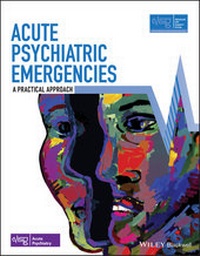
Acute Psychiatric Emergencies
Description

This valuable resource provides a practical approach for dealing with mental health emergencies, helping healthcare professionals from different specialties speak a common language and develop a shared understanding that expedites excellent care. The manual outlines the assessment and management of patients who have self-harmed, those that are apparently drunk, the patient behaving strangely, the patient with acute confusion, and those that are aggressive.
* Presents a structured, practical approach for the emergency care of patients presenting in acute psychiatric crisis
* Covers common presentations of psychiatric emergencies
* Emphasises close co-operation of emergency and mental health teams
* Offers content designed jointly by practicing psychiatrists and emergency physicians from the Advanced Life Support Group (ALSG)
Acute Psychiatric Emergencies will be useful for practitioners of emergency medicine, psychiatry, emergency and mental health nursing as well as other mental health and crisis care professionals.
More details
Other editions
Additional editions
Persons
Content
Contributors viii
Foreword ix
Preface and acknowledgements xi
Contact details and website information xii
How to use your textbook xiii
1 Structured approach to acute psychiatric emergencies 1
2 Primary unified assessment and immediate psychiatric management 5
3 Secondary physical and psychosocial assessment 13
4 The patient who has harmed themselves 19
5 The apparently drunk patient 37
6 The patient behaving strangely 51
7 The acutely confused patient 63
8 The aggressive patient 75
9 Legal aspects of emergency psychiatry 91
10 Human factors 97
11 The patient experience 107
Index 111
CHAPTER 2
Primary unified assessment and immediate psychiatric management
Learning outcomes
After reading this chapter, you will be able to:
- Explain how to assess someone who is acutely disturbed
- Describe how to take structured steps to ensure safety and minimise any potential harm to others
2.1 Introduction
The effective management of an acutely disturbed patient who has presumed mental health problems is a key emergency skill. By using the basic techniques and strategies described, a safe framework can be established, from which a more detailed assessment or intervention can then be carried out. It is essential that all staff who work in an acute hospital setting have these basic skills.
In the structured approach, the person who is acutely disturbed should have a primary assessment that includes ABCD and AEIO risk assessments (see Figure 2.1). It may not be possible to carry out a full physical assessment because of the level of disturbance, but consideration should be given to physical status and potential organic causes of the presentation.
In this chapter, we focus on the mental health assessment, but physical factors should always be considered, and accompanied by a parallel physical assessment, when appropriate.
2.2 Preparation
Never approach a patient who is acutely disturbed by yourself. Wait until a sufficient number of appropriately trained staff, police officers and security guards are present. The number required will depend upon the size of the patient, the nature and degree of their disturbance, and the physical characteristics and resources of the facility in which you are working.
In most circumstances, there is time to gather information quickly before seeing the patient (e.g. if the patient is brought to the emergency department (ED) by the family, the police or the paramedic emergency service). The aim at this point is to access relevant information that will inform the rapid assessment.
Information may include verbal accounts from the family, paramedics, police, relevant others and the hospital record systems. Ask and obtain answers to the following questions:
- Can you tell me about the behaviour of X whilst in your care?
- On a 10 point scale (0 being not disturbed at all, to 10 being extremely agitated/violent/aroused) how would you rate this person's behaviour?
- Can you tell me about/give me an example of the most extreme or disturbed level of behaviour you have witnessed?
- Do they speak English and, if not, what language do they speak?
Many mental health record systems have specific, designated subsections for flagging information about 'risk of harm to self and others'. However, ED or hospital staff may not have access to these systems. Make sure all relevant information is shared between all staff involved with the patient.
Key factors to note are:
- A prior history of self-harm
- A prior history of harm to others
- Alcohol and illicit drug use
- Prior history of severe mental illness
- Prior history of violence, forensic history (mental health treatment in a secure setting because of criminal behaviour) or a criminal record
Before entering a room with a disturbed patient, make sure you have back-up in terms of available staff who can help if necessary. Have at least two other members of staff with you. There may already be staff or police officers in the room. Stay close to the door and keep it open. Do not allow yourself to be trapped behind the door.
Make sure there is a way to sound an alarm, if needed, with a suitable response. Many 'safe rooms' in EDs do not have alarms because of inappropriate, frequent use. So make sure you have a personal attack alarm, or that there is someone outside the room who can call for back-up.
It is usual for most patients to undergo triage from a member of the ED nursing staff soon after they present. However, if patients are either very physically unwell (for instance if they have stabbed themselves) or are significantly behaviourally disturbed, it may not be possible to do this. Do not assume that behavioural disturbance is due solely to mental health issues. Seek relevant physical health signs or symptoms that need to be addressed.
The structured approach is applicable to patients of all ages, but consideration of developmental factors is vital when dealing with both adults with learning disabilities and children and adolescents. For example, understanding of the irreversibility of death typically develops in middle childhood, so may not be present in adults with learning disability or young children, and this would need to be considered in an assessment of intent. There are additional considerations about child and adult safeguarding. There is also an increased significance in the role of parents and carers who may be a helpful source of information and support but may also be a potential risk.
Figure 2.1 Structured approach: primary assessment
2.3 Primary assessment - the unified assessment
The first priority is to ensure that the patient is kept safe (both physically and psychologically) whilst they are awaiting detailed psychiatric assessment or are undergoing physical investigations. They must be prevented from either intentional or unintentional harming of themselves or others. A fast and focused assessment is required to:
- Establish the level of physical and psychiatric risk
- Put in place appropriate measures to minimise that risk
Observe the patient. Note his/her conscious level, degree of agitation and current behaviour. Introduce yourself:
- 'I'm X, I'm a doctor/nurse, I'm here to try and help you'
- Ask the patient their name and what they like to be called
- Ask them if they know where they are
- If they do not know, explain they are in a hospital, they are safe, and you are here to try and help them
As you are doing this, make a quick assessment of the patient's overt physical health. Look for skin colour (pallor or flushed), whether or not they are sweating, pupil size (pinpoint or dilated), any obvious injuries, any signs of self-harm (ligature mark around neck, scars to arms) or disabilities.
Ask the patient if they are hurt or in pain. If they respond positively, you will need to get details of their concerns to establish the nature of the injury or their physical health problems. Ask them if it would be okay for someone to check their pulse, temperature and blood pressure.
As you are doing this, make an assessment of their cognitive function, including basic orientation and attention.
- Can they give you their name and address and date of birth?
- Do they know where they are?
- Do they know the time of day, month and year?
- Do they understand questions?
- Do they respond appropriately?
Tell them that you need to ask them some brief questions to check that they are safe. Tell them that these are routine questions.
2.4 Primary physical risk assessment
The primary physical risk assessment should focus on four key areas:
- A Airway - patency and security
- B Breathing - adequacy and effectiveness
- C Circulatory - adequacy
- D Disability - assessment of conscious level and pupils
ABCD problems should be addressed as soon as they are identified. It is outwith the scope of this book to describe the life support techniques that might be necessary - patients should be moved to the resuscitation area as soon as possible and physical resuscitation should be continued there whilst the AEIO assessment described below is carried out.
Go on to ask the following:
- Have you taken any tablets or anything else that might be harmful in the last 24-48 hours?
- Have you had any alcohol?
- Have you taken any street drugs, e.g. amphetamines, cocaine, spice, ketamine?
- Have you suffered a recent head injury?
- Do you have any physical health conditions, such as diabetes or epilepsy? Do you have any condition for which you take regular tablets or medications?
- Do you have any allergies?
2.5 Primary psychiatric risk assessment
The primary psychiatric risk assessment should focus on four key areas:
- A Agitation/Arousal
- E Environment in which the patient is being cared for
- I Intent of individual
- O Objects that the patient has in their possession, which may be used for self-harm or harm to others
This enables staff to carry out a quick assessment of risk of harm (to self or others) and of flight risk. This enables planning of a risk reduction and containment strategy, which may or may not involve rapid tranquillisation.
(A) Agitation/Arousal
This assessment depends on a quick observation of the patient. Their level of arousal or agitation is determined according to the following guide (Box 2.1).
