

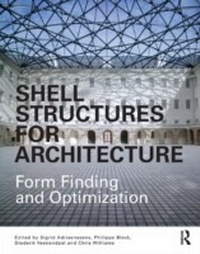
Shell Structures for Architecture
Form Finding and Optimization
1st Edition
Published on 21. March 2014
340 pages
978-1-317-90938-5 (ISBN)
Description

*** Featuring a foreword by Pritzker Prize Winner Shigeru Ban ***
Bringing together experts from research and practice, Shell Structures for Architecture: Form Finding and Optimization presents contemporary design methods for shell and gridshell structures, covering form-finding and structural optimization techniques. It introduces architecture and engineering practitioners and students to structural shells and provides computational techniques to develop complex curved structural surfaces, in the form of mathematics, computer algorithms, and design case studies.
* Part I introduces the topic of shells, tracing the ancient relationship between structural form and forces, the basics of shell behaviour, and the evolution of form-finding and structural optimization techniques.
* Part II familiarizes the reader with form-finding techniques to explore expressive structural geometries, covering the force density method, thrust network analysis, dynamic relaxation and particle-spring systems.
* Part III focuses on shell shape and topology optimization, and provides a deeper understanding of gradient-based methods and meta-heuristic techniques.
* Part IV contains precedent studies of realised shells and gridshells describing their innovative design and construction methods.
Bringing together experts from research and practice, Shell Structures for Architecture: Form Finding and Optimization presents contemporary design methods for shell and gridshell structures, covering form-finding and structural optimization techniques. It introduces architecture and engineering practitioners and students to structural shells and provides computational techniques to develop complex curved structural surfaces, in the form of mathematics, computer algorithms, and design case studies.
* Part I introduces the topic of shells, tracing the ancient relationship between structural form and forces, the basics of shell behaviour, and the evolution of form-finding and structural optimization techniques.
* Part II familiarizes the reader with form-finding techniques to explore expressive structural geometries, covering the force density method, thrust network analysis, dynamic relaxation and particle-spring systems.
* Part III focuses on shell shape and topology optimization, and provides a deeper understanding of gradient-based methods and meta-heuristic techniques.
* Part IV contains precedent studies of realised shells and gridshells describing their innovative design and construction methods.
Reviews / Votes
'As the role of computational tools in structural design continues to grow, the form-finding techniques detailed here are more relevant than ever. Bringing together experts in the field, I expect Shell Structures for Architecture will be a valuable inspiration and reference for architecture and engineering students and professionals seeking a deeper understanding, which is essential to make full use of such tools and techniques.'Daniel Piker, Robert McNeel & Associates
'This book should be in the library of designers of shells and grid shells.'
Bill Baker, Partner at Skidmore, Owings & Merrill LLP
'In their integration of technical and creative disciplines, shell structures are a fascinating typology - this is a valuable source book for architects and engineers alike.'
Xavier De Kestelier, Partner, Foster + Partners
'Shell Structures for Architecture expands architectural possibilities; a great influence on the thinking of contemporary architects.'
Toyo Ito, Founding partner, Toyo Ito & Associates
More details
Language
English
Place of publication
London
United Kingdom
Publishing group
Taylor & Francis Ltd
Target group
College/higher education
Professional and scholarly
Illustrations
176 farbige Abbildungen, 6 farbige Tabellen, 184 farbige Zeichnungen
6 Tables, color; 184 Line drawings, color; 176 Illustrations, color
File size
39,29 MB
ISBN-13
978-1-317-90938-5 (9781317909385)
Copyright in bibliographic data and cover images is held by Nielsen Book Services Limited or by the publishers or by their respective licensors: all rights reserved.
Schweitzer Classification
Other editions
Additional editions
Sigrid Adriaenssens | Philippe Block | Diederik Veenendaal
Shell Structures for Architecture
Form Finding and Optimization
Book
04/2014
1st Edition
Routledge
€80.50
Shipment within 15-20 days
Sigrid Adriaenssens | Philippe Block | Diederik Veenendaal
Shell Structures for Architecture
Form Finding and Optimization
Book
04/2014
1st Edition
Routledge
€267.41
Shipment within 15-20 days
Persons
Sigrid Adriaenssens is a structural engineer and Assistant Professor at the Department of Civil and Environmental Engineering at Princeton University, USA, where she directs the Form Finding Lab. She holds a PhD in lightweight structures from the University of Bath, adapting the method of dynamic relaxation to strained gridshells. She worked as a project engineer for Jane Wernick Associates, London, and Ney + Partners, Brussels, on projects such as the Dutch National Maritime Museum in Amsterdam. At Princeton, she co-curated the exhibition 'German Shells: Efficiency in Form' which examined a number of landmark German shell projects.
Philippe Block is a structural engineer and architect and Assistant Professor at the Institute of Technology in Architecture, ETH Zurich, Switzerland, where he directs the BLOCK Research Group, and is founding partner of structural engineering consultancy Ochsendorf, DeJong & Block LLC. He studied at the VUB, Belgium, and MIT, USA, where he obtained his PhD. He has received the Hangai Prize and Tsuboi Award from the International Association of Shells and Spatial Structures (IASS) as well as the Edoardo Benvenuto Prize. He developed thrust network analysis for the analysis of historic vaulted masonry and design of new funicular shells.
Diederik Veenendaal is a civil engineer and a research assistant at the BLOCK Research Group, ETH Zurich, Switzerland. He received his Masters from TU Delft, Netherlands and started his career at Witteveen+Bos engineering consultants, working on groundfreezing analysis for the downtown stations of the Amsterdam North/South subway line and the structural design for the largest tensioned membrane roof in the Netherlands, the ice skating arena De Scheg. His current research involves the comparison of existing form-finding methods and development of new ones for flexibly formed shells and other structural systems.
Chris Williams is a structural engineer and a Senior Lecturer at the University of Bath, UK. He specializes in computational geometry and structural mechanics, in particular for lightweight structures and tall buildings, and his work has been applied by architects and engineers, including Foster + Partners, Rogers Stirk Harbour + Partners and Buro Happold. He worked at Ove Arup and Partners, where he was responsible for structural analysis of the Mannheim Multihalle. Since then, he has worked on such projects as the British Museum Great Court roof, Weald & Downland Museum gridshell, and the Savill Gardens gridshell.
Philippe Block is a structural engineer and architect and Assistant Professor at the Institute of Technology in Architecture, ETH Zurich, Switzerland, where he directs the BLOCK Research Group, and is founding partner of structural engineering consultancy Ochsendorf, DeJong & Block LLC. He studied at the VUB, Belgium, and MIT, USA, where he obtained his PhD. He has received the Hangai Prize and Tsuboi Award from the International Association of Shells and Spatial Structures (IASS) as well as the Edoardo Benvenuto Prize. He developed thrust network analysis for the analysis of historic vaulted masonry and design of new funicular shells.
Diederik Veenendaal is a civil engineer and a research assistant at the BLOCK Research Group, ETH Zurich, Switzerland. He received his Masters from TU Delft, Netherlands and started his career at Witteveen+Bos engineering consultants, working on groundfreezing analysis for the downtown stations of the Amsterdam North/South subway line and the structural design for the largest tensioned membrane roof in the Netherlands, the ice skating arena De Scheg. His current research involves the comparison of existing form-finding methods and development of new ones for flexibly formed shells and other structural systems.
Chris Williams is a structural engineer and a Senior Lecturer at the University of Bath, UK. He specializes in computational geometry and structural mechanics, in particular for lightweight structures and tall buildings, and his work has been applied by architects and engineers, including Foster + Partners, Rogers Stirk Harbour + Partners and Buro Happold. He worked at Ove Arup and Partners, where he was responsible for structural analysis of the Mannheim Multihalle. Since then, he has worked on such projects as the British Museum Great Court roof, Weald & Downland Museum gridshell, and the Savill Gardens gridshell.
Content
Introduction Part 1: Shells for Architecture Part 2: Form Finding Part 3: Structural Optimization Part 4: Precedents Appendice
