

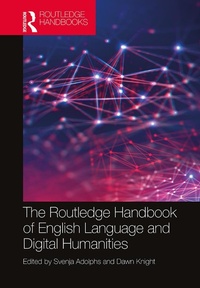
The Routledge Handbook of English Language and Digital Humanities
1st Edition
Published on 16. April 2020
628 pages
978-1-000-04972-5 (ISBN)
Description

The Routledge Handbook of English Language and Digital Humanities serves as a reference point for key developments related to the ways in which the digital turn has shaped the study of the English language and of how the resulting methodological approaches have permeated other disciplines. It draws on modern linguistics and discourse analysis for its analytical methods and applies these approaches to the exploration and theorisation of issues within the humanities.
Divided into three sections, this handbook covers:
sources and corpora;
analytical approaches;
English language at the interface with other areas of research in the digital humanities.
In covering these areas, more traditional approaches and methodologies in the humanities are recast and research challenges are re-framed through the lens of the digital. The essays in this volume highlight the opportunities for new questions to be asked and long-standing questions to be reconsidered when drawing on the digital in humanities research.
This is a ground-breaking collection of essays offering incisive and essential reading for anyone with an interest in the English language and digital humanities.
Divided into three sections, this handbook covers:
sources and corpora;
analytical approaches;
English language at the interface with other areas of research in the digital humanities.
In covering these areas, more traditional approaches and methodologies in the humanities are recast and research challenges are re-framed through the lens of the digital. The essays in this volume highlight the opportunities for new questions to be asked and long-standing questions to be reconsidered when drawing on the digital in humanities research.
This is a ground-breaking collection of essays offering incisive and essential reading for anyone with an interest in the English language and digital humanities.
More details
Series
Edition
1. Auflage
Language
English
Place of publication
London
United Kingdom
Publishing group
Taylor & Francis Ltd
Target group
College/higher education
Illustrations
31 Tables, black and white; 60 Line drawings, black and white; 12 Halftones, black and white
ISBN-13
978-1-000-04972-5 (9781000049725)
Copyright in bibliographic data and cover images is held by Nielsen Book Services Limited or by the publishers or by their respective licensors: all rights reserved.
Schweitzer Classification
Other editions
Additional editions
Svenja Adolphs | Dawn Knight
The Routledge Handbook of English Language and Digital Humanities
Book
05/2023
1st Edition
Routledge
€78.17
Shipment within 10-20 days
Svenja Adolphs | Dawn Knight
The Routledge Handbook of English Language and Digital Humanities
Book
05/2020
Routledge
€314.20
Shipment within 10-20 days
Persons
Svenja Adolphs is a Professor of English Language and Linguistics at the University of Nottingham, UK. Her research interests are in the areas of corpus linguistics (in particular multimodal spoken corpus linguistics), pragmatics and discourse analysis. She has published widely in these areas, including Introducing Electronic Text Analysis (2006, Routledge), Corpus and Context: investigating pragmatics functions in spoken discourse (2008, John Benjamins), Introducing Pragmatics in Use (2011, Routledge, with Anne O'Keeffe and Brian Clancy) and Spoken corpus linguistics: from monomodal to multimodal (2013, Routledge, with Ronald Carter).
Dawn Knight is a Reader in Applied Linguistics at Cardiff University. Her research interests lie in the areas of corpus linguistics, discourse analysis, digital interaction, non-verbal communication and the socio-linguistic contexts of communication. The main contribution of her work has been to pioneer the development of a new research area in applied linguistics: multimodal corpus-based discourse analysis. Dawn is the principal investigator on the ESRC/AHRC funded CorCenCC (Corpws Cenedlaethol Cymraeg Cyfoes - the National Corpus of Contemporary Welsh) project (2016 - 2020) and is currently the Chair of BAAL, the British Association for Applied Linguistics, representing over 1000 applied linguists within the UK (2018 - 2021).
Dawn Knight is a Reader in Applied Linguistics at Cardiff University. Her research interests lie in the areas of corpus linguistics, discourse analysis, digital interaction, non-verbal communication and the socio-linguistic contexts of communication. The main contribution of her work has been to pioneer the development of a new research area in applied linguistics: multimodal corpus-based discourse analysis. Dawn is the principal investigator on the ESRC/AHRC funded CorCenCC (Corpws Cenedlaethol Cymraeg Cyfoes - the National Corpus of Contemporary Welsh) project (2016 - 2020) and is currently the Chair of BAAL, the British Association for Applied Linguistics, representing over 1000 applied linguists within the UK (2018 - 2021).
Content
Chapter 1 Introduction
Svenja Adolphs and Dawn Knight
Chapter 2 Spoken Corpora
Karin Aijmer
Chapter 3 Written Corpora
Sheena Gardner and Emma Moreton
Chapter 4 Digital Interaction
Jai Mackenzie
Chapter 5 Multimodality I: Speech, Prosody and Gestures
Phoebe Lin and Yaoyao Chen
Chapter 6 Multimodality II: Text and Image
Sofia Malamatidou
Chapter 7 Digital Pragmatics of English
Irma Taavitsainen and Andreas H. Jucker
Chapter 8 Metaphor
Wendy Anderson and Elena Semino
Chapter 9 Grammar
Anne O'Keeffe and Geraldine Mark
Chapter 10 Lexis
Marc Alexander and Fraser Dallachy
Chapter 11 Ethnography
Piia Varis
Chapter 12 Mediated Discourse Analysis
Rodney H. Jones
Chapter 13 Critical Discourse Analysis
Paul Baker and Mark McGlashan
Chapter 14 Conversation Analysis
Jack Sidnell and Maria Martika
Chapter 15 Cross-Cultural Communication
Eric Friginal and Cassie Dorothy Leymarie
Chapter 16 Sociolinguistics
Lars Hinrichs and Axel Bohmann
Chapter 17 Literary Stylistics
Michaela Mahlberg and Viola Wiegand
Chapter 18 Historical Linguistics
Freek Van de Velde and Peter Petre
Chapter 19 Forensic Linguistics
Nicci MacLeod and David Wright
Chapter 20 Corpus Linguistics
Gavin Brookes and Tony McEnery
Chapter 21 English Language and Classics
Alexandra Trachsel
Chapter 22 English Language and History
Ian N. Gregory and Laura L. Paterson
Chapter 23 English Language and Philosophy
Jonathon Tallant and James Andow
Chapter 24 English Language and Multimodal Narrative
Riki Thompson
Chapter 25 English Language and Digital Literacies
Paul Spence
Chapter 26 English Language and Literature
Kathy Conklin and Josephine Guy
Chapter 27 English Language and Digital Health Humanities
Brian Brown
Chapter 28 English Language and Public Humanities
Ben Clarke, Glenn Hadikin, Mario Saraceni, John Williams
Chapter 29 English Language and Digital Cultural Heritage
Lorna M. Hughes, Agiatis Benardou and Ann Gow
Chapter 30 English Language and Social Media
Caroline Tagg
Svenja Adolphs and Dawn Knight
Chapter 2 Spoken Corpora
Karin Aijmer
Chapter 3 Written Corpora
Sheena Gardner and Emma Moreton
Chapter 4 Digital Interaction
Jai Mackenzie
Chapter 5 Multimodality I: Speech, Prosody and Gestures
Phoebe Lin and Yaoyao Chen
Chapter 6 Multimodality II: Text and Image
Sofia Malamatidou
Chapter 7 Digital Pragmatics of English
Irma Taavitsainen and Andreas H. Jucker
Chapter 8 Metaphor
Wendy Anderson and Elena Semino
Chapter 9 Grammar
Anne O'Keeffe and Geraldine Mark
Chapter 10 Lexis
Marc Alexander and Fraser Dallachy
Chapter 11 Ethnography
Piia Varis
Chapter 12 Mediated Discourse Analysis
Rodney H. Jones
Chapter 13 Critical Discourse Analysis
Paul Baker and Mark McGlashan
Chapter 14 Conversation Analysis
Jack Sidnell and Maria Martika
Chapter 15 Cross-Cultural Communication
Eric Friginal and Cassie Dorothy Leymarie
Chapter 16 Sociolinguistics
Lars Hinrichs and Axel Bohmann
Chapter 17 Literary Stylistics
Michaela Mahlberg and Viola Wiegand
Chapter 18 Historical Linguistics
Freek Van de Velde and Peter Petre
Chapter 19 Forensic Linguistics
Nicci MacLeod and David Wright
Chapter 20 Corpus Linguistics
Gavin Brookes and Tony McEnery
Chapter 21 English Language and Classics
Alexandra Trachsel
Chapter 22 English Language and History
Ian N. Gregory and Laura L. Paterson
Chapter 23 English Language and Philosophy
Jonathon Tallant and James Andow
Chapter 24 English Language and Multimodal Narrative
Riki Thompson
Chapter 25 English Language and Digital Literacies
Paul Spence
Chapter 26 English Language and Literature
Kathy Conklin and Josephine Guy
Chapter 27 English Language and Digital Health Humanities
Brian Brown
Chapter 28 English Language and Public Humanities
Ben Clarke, Glenn Hadikin, Mario Saraceni, John Williams
Chapter 29 English Language and Digital Cultural Heritage
Lorna M. Hughes, Agiatis Benardou and Ann Gow
Chapter 30 English Language and Social Media
Caroline Tagg
