

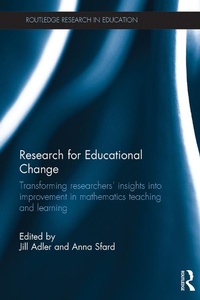
Research for Educational Change
Transforming researchers' insights into improvement in mathematics teaching and learning
Published on 17. June 2016
292 pages
978-1-317-28539-7 (ISBN)
Description

Research for Educational Change presents ways in which educational research can fulfil its commitments to educational practice. Focussing its discussion within the context of mathematics education, it argues that while research-generated insights can have beneficial effects on learning and teaching, the question of how these effects are to be generated and sustained is far from evident. The question of how to turn research into educational improvement is discussed here in the context of learning and teaching hindered by poverty and social injustice.
In the first part of the book, four teams of researchers use different methodologies while analysing the same corpus of data, collected in a South African mathematics classroom. In the second part, each of these teams makes a specific proposal about what can be done and how so that its research-generated insights have a tangible, beneficial impact on what is happening in mathematical classrooms. Combining two discourses - that of researchers speaking to one another, and that of researchers communicating their insights to those responsible for educational practice - the book deals with the perenial question of communication between those who study educational processes and those who are directly responsible for teacher education, educational research and classroom practices.
This book will be key reading for postgraduates, researchers and academics in education and particularly in the areas of mathematics education, education research, teacher education and classroom practice. It will also appeal to teacher educators, practitioners and undergraduate students interested in educational research.
In the first part of the book, four teams of researchers use different methodologies while analysing the same corpus of data, collected in a South African mathematics classroom. In the second part, each of these teams makes a specific proposal about what can be done and how so that its research-generated insights have a tangible, beneficial impact on what is happening in mathematical classrooms. Combining two discourses - that of researchers speaking to one another, and that of researchers communicating their insights to those responsible for educational practice - the book deals with the perenial question of communication between those who study educational processes and those who are directly responsible for teacher education, educational research and classroom practices.
This book will be key reading for postgraduates, researchers and academics in education and particularly in the areas of mathematics education, education research, teacher education and classroom practice. It will also appeal to teacher educators, practitioners and undergraduate students interested in educational research.
Reviews / Votes
"The key strength of the book is its systematic inquiry into how teaching and learning crystallizes. More than that, the book takes the findings from the inquiry to inform what might be done to improve classroom experiences. Illuminating and building on the analyses of the lesson event, and with genuine respect for the efforts of the teacher (Mr T), are practical proposals for pedagogical change."- Margaret Walshaw,Educational Studies in Mathematics, March 2017More details
Series
Language
English
Place of publication
London
United Kingdom
Publishing group
Taylor & Francis Ltd
Target group
Professional and scholarly
College/higher education
Product notice
Reflowable
Illustrations
16 s/w Tabellen, 18 s/w Photographien bzw. Rasterbilder, 11 s/w Zeichnungen
16 Tables, black and white; 26 Line drawings, black and white; 3 Halftones, black and white
File size
11,24 MB
ISBN-13
978-1-317-28539-7 (9781317285397)
Copyright in bibliographic data and cover images is held by Nielsen Book Services Limited or by the publishers or by their respective licensors: all rights reserved.
Schweitzer Classification
Other editions
Additional editions
Jill Adler | Anna Sfard
Research for Educational Change
Transforming researchers' insights into improvement in mathematics teaching and learning
Book
01/2018
1st Edition
Routledge
€81.99
Shipment within 15-20 days
Jill Adler | Anna Sfard
Research for Educational Change
Transforming researchers' insights into improvement in mathematics teaching and learning
Book
07/2016
1st Edition
Routledge
€243.70
Shipment within 10-20 days
Persons
Jill Adler holds the SARChI-FRF Mathematics Education Chair at the University of the Witwatersrand, South Africa, and is Visiting Professor of Mathematics Education at King's College London, UK. She is the 2012 recipient of the Academy of Science of South Africa (ASSAf) Gold Medal for Science in the Service of Society and of the 2015 Freudenthal Award.
Anna Sfard is a Professor of Education at the University of Haifa, Israel. She served as the first Lappan-Philips-Fitzgerald Professor at Michigan State University, USA, and is the Visiting Professor in the Institute of Education, University College London, UK. She is the recipient of 2007 Freudenthal Award and a Fellow of the American Educational Research Association (AERA).
Anna Sfard is a Professor of Education at the University of Haifa, Israel. She served as the first Lappan-Philips-Fitzgerald Professor at Michigan State University, USA, and is the Visiting Professor in the Institute of Education, University College London, UK. She is the recipient of 2007 Freudenthal Award and a Fellow of the American Educational Research Association (AERA).
Content
Introducation Part I In School: The South African Experience 1. Mathematics Education in South Africa 2. Setting the Scene: School M, Teacher T, the Lesson and the Data Part II Away From School: Trying to Learn From the Experience Introduction 3. Ritual for Ritual, Exploration for Exploration or What Learners Are Offered Is What They Present Back to You in Return 4. Mathematical Discourse in Instruction Matters 5. Dialogic and argumentation structures in one quadratic inequalties lesson 6. "Eish, Iyangbhavizisa (It's Confusing)": a Critical Discourse Analysis of What Learners Say and Do in a Research Interview Part III Back to School: Sharing Insights with the Teacher and Others Introduction 7. Teaching Mathematics as an Exploratory Activity - a Letter to the Teacher 8. A Lesson to Learn from - from Research Insights to Teaching the Lesson 9. Towards a Dialogic Discourse in a Mathematics Classroom: Opening and Closing Verbal Interaction 10. Poor Mathematics Performance is Created in Multiple Places Part IV Beyond School: Some Meta-level Learning 11. A Meta-level Reflection on Dialogue Between Discourses 12. Connecting Research and Mathematics Teacher Development Through the Development of Boundary Objects 13. The Adventure of Moving Mathematics Teacher Education Forward: a Commentary Afterword Re-Thinking The Nexus Between Research and Practice
