

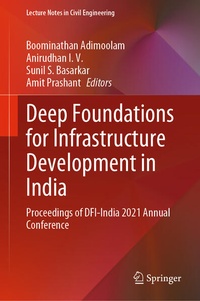
Deep Foundations for Infrastructure Development in India
Description

This book contains select proceedings of the 10th annual conference of Deep Foundations Institute of India, DFI India, 2021. It presents papers on 1) Geotechnical Investigation, Testing, Instrumentation, Monitoring, and Quality Management, 2) Ground Improvement Techniques, 3) Piling and Deep Foundation Techniques, 4) Earth Retention and Deep Excavation Support, 5) Research, Experimental and Numerical Methods in Deep Foundations and Deep Excavation Technologies, and 6) Safe and Efficient Geo-Construction. This book has seventeen articles, each with a specific field application value. The probabilistic approach in evaluating the field data, namely SPT N and pressure meter modulus for arriving at the geotechnical design parameters, multiphase site investigation program for complex underground construction activity, the safety of working platforms in foundation construction projects, usage of liner piles to support the reaction platform for static loading tests for piles, choice of foundation system for three bridges, emphasis on the importance of selecting an appropriate foundation system for the safe and timely completion of the project, challenges in deep excavations, constructions in confined spaces, groundwater level variations, and their influence on tunneling have been discussed. The usefulness of numerical analysis in the design of deep excavations and ground improvement projects is highlighted. The articles covered in this book are of immense value to professionals and academicians for improving their work practice.
More details
Other editions
Additional editions
Persons
Anirudhan I. V. is a Geotechnical Consultant based in Chennai, India. His career as an independent consultant started in 1987 after associating with a leading consultancy ?rm for seven years. His major ?eld of expertise are in deep foundations, ground improvement and geotechnical characterisation. His organisation, Geotechnical Solutions, executed more than 2000 small and medium geotechnical investigations andprovided foundation recommendations. He graduated in Civil Engineering with a specialisation in Geotechnical Engineering from IIT Kanpur, India, in 1981 after obtaining B.Sc. Engg. (Hons) in Civil Engineering from the University of Calicut in the year 1979. He is actively involved in the activities of the Indian Geotechnical Society and Deep Foundations Institute of India, and he has conducted several conferences, workshops and seminars. He was a member of TC-302 of ISSMGE on Forensic Engineering, TC-301 of ISSMGE on Historic Sites and the convener of TC-04 of the Indian Geotechnical Society on Geotechnical Investigation. He has authored and published several technical papers,the guideline manuals on lateritic soils, the guideline manual on geotechnical investigation, the design manual for continuous ?ight augured piles. He is currently the chairman of Deep Foundations Institute of India, and he also served as the chairman and honorary secretary ofthe Chennai Chapter of the IGS.
Dr. Sunil S. Basarkar is the Head of Geotechnical Engineering Department at Afcons Infrastructure Ltd Mumbai. He has a total experience of about 18 years in the ?eld and 16 years association with Academia in area of geotechnical engineering. Dr. Basarkar has published more than 50 papers in various national and international conferences and reputed journals. He is a Core Committee Member of DFI of India. Dr. Basarkar is also a fellow of the Institution of Engineers (India), Indian Geotechnical Society, and Institute of Bridge Engineering. Dr. Basarkar also serves as an Editor of DFI Journal (USA).
Dr. Amit Prashant is Professor of Civil Engineering and Dean of Research and Development at IIT Gandhinagar. He is currently the Chairman of the Ahmedabad chapter of Indian Geotechnical Society and also a Member of the Board of Governors of SVNIT Surat. He completed his Bachelors of Engineering degree from IIT Roorkee in 1997. After two years of consulting experience, he went for higher studies at ClarksonUniversity,NY and then to University of Tennessee, Knoxville. After completing his doctoral studies and one year of post-doctoral research, he worked at IIT Kanpur as Assistant Professor during 2005-2010, and then moved to IIT Gandhinagar in 2010. He has been actively involved in academic administration, as Chairman, SUGC at IIT Kanpur earlier and for six years as Dean, Academic Affairs at IIT Gandhinagar. With that experience, he was also appointed as the Of?ciating Director of IIT Gandhinagar during July-September 2019. His research interests are in constitutive modelling of soils, earthquake geotechnical engineering and applications of geosynthetics, which including experimental investigations and numerical modelling. He has done ?eld projects related to hill slopes, excavations, canals, ash-dyke, bridge foundations and barrage, etc. He has conducted several industry courses in earthquake engineering, FEM and geotechnical investigations, which have been quite popular. He also coordinates faculty development programs for last six years under the aegis of TEQIP Scheme of the Government of India for engineering colleges in the country.
