

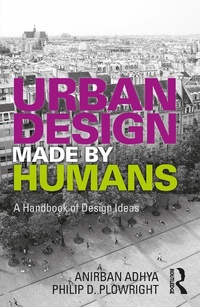
Urban Design Made by Humans
A Handbook of Design Ideas
1st Edition
Published on 29. September 2022
224 pages
978-1-000-65263-5 (ISBN)
Description

The design of urban environments is complex and involves diverse needs, organisations, professions, authorities, and communities. It requires relationships to be constructed and sustained between infrastructure, resources, and populations across multiple scales. This can be quite daunting. However, at the core of urban design is a simple idea-our urban spaces are designed to allow people and communities to thrive. For that reason, a good starting point for urban designers is to focus on the way people think when engaging our built environment. This thinking is embodied, developed through the interactions between our mind, body, and the environment around us. These embodied concepts are central to how we see the world, how we move and gather, and how we interact with others. They are also the same ideas we use to design our environments and cities.
Urban Design Made by Humans is a reference book that presents 56 concepts, notions, ideas, and agreements fundamental to the design and interpretation of our human settlements. The ideas here parallel those found in Making Architecture Through Being Human but extends them into urban environments. Urban Design Made by Humans distinctly highlights priorities in urban design in how we produce meaningful environments catering to wider groups of people. Each idea is isolated for clarity with short and concise definitions, examples, and illustrations. They are organised in five sections of increasing complexity. Taken as a whole, the entries frame the priorities and values of urban design while also being instances of a larger system of human thinking.
Urban Design Made by Humans is a reference book that presents 56 concepts, notions, ideas, and agreements fundamental to the design and interpretation of our human settlements. The ideas here parallel those found in Making Architecture Through Being Human but extends them into urban environments. Urban Design Made by Humans distinctly highlights priorities in urban design in how we produce meaningful environments catering to wider groups of people. Each idea is isolated for clarity with short and concise definitions, examples, and illustrations. They are organised in five sections of increasing complexity. Taken as a whole, the entries frame the priorities and values of urban design while also being instances of a larger system of human thinking.
Reviews / Votes
"Urban Design Made by Humans: A Handbook of Design Ideas offers a visual glossary of common urban design terms. The authors introduce, interpret, and illustrate key concepts with descriptive text and simple diagrams, creating a valuable foundation and tool for learning."Anne-Marie Lubenau, Director of the Rudy Bruner Award for Urban Excellence at the Bruner Foundation and author of Urban Placemaking: Building Equity by Design
"A skillful disaggregation as well as a synthetic compilation of the fundamental tools that define the practice of Urban Design. The book goes beyond being a mere glossary or dictionary and serves as a comprehensive as well as operational kit of parts which will be extremely valuable for the teaching as well as practice of Urban Design."
Rahul Mehrotra, John T. Dunlop Professor in Housing and Urbanisation, Harvard University Graduate School of Design and author of The Kinetic City and Other Essays
"Urban Design Made by Humans offers a robust, annotated glossary of terms and concepts essential to urban design. Rarely does one find a book that brings together so many basic ideas, with clear, crisp explanations, and highly legible illustrations. It brings depth and perspective to technical knowledge in an approachable format. This book will be a valuable resource for a range of designers, from beginning urban design students, to design faculty, to seasoned professionals."
Carlton Basmajian, Associate Professor of Urban Design, Community and Regional Planning, Iowa State University and author of Atlanta Unbound: Enabling Sprawl Through Policy and Planning
"Students of urban design have long missed a clearly composed primer explaining fundamental concepts and foundational ideas of the field in an easy-to-understand manner. Adhya and Plowright cleverly combine meaningful insights and explanatory graphics to illustrate a wide range of basic building blocks helpful both for understanding the scholarly literature and professional practice of urban design."
Sanjeev Vidyarthi, Professor of City Design, University of Illinois Chicago and author of City Planning in India: 1947-2017 and One Idea, Many Plans: An American City Design Concept in Independent India
"This is a masterful contribution aimed at unpacking the complexity of urban design. With great clarity and focus, the book provides a comprehensive illustration of complex, entangled and overlapping ideas of urban development in a structured, accessible and understandable way. The book is a great resource for students, and relevant for researchers and practitioners in urban design."
Ahmed Z. Khan, Professor and Chair Sustainable Architecture and Urbanism, Universite Libre de Bruxelles (ULB) and editor and author of Architecture and Sustainability: Critical Perspectives for Integrated Design
"In the form of a glossary of urban design key concepts, cleverly cross-referenced, Anirban Adhya and Philip D. Plowright's Urban design made by humans is an important contribution to structure a common language of our field, accessible to everyone involved in the daily construction of this magnificent artefact called city. This is a much-needed tool in the era of collaboration and interoperability."
Luiz Amorim, Professor of Architectural Morphology, Universidade Federal de Pernambuco, Brasil and author of Cidades: urbanismo, patrimonio e sociedade
More details
Edition
1. Auflage
Language
English
Place of publication
London
United Kingdom
Publishing group
Taylor & Francis Ltd
Target group
College/higher education
Professional and scholarly
Illustrations
99 Halftones, black and white; 99 Illustrations, black and white
ISBN-13
978-1-000-65263-5 (9781000652635)
Copyright in bibliographic data and cover images is held by Nielsen Book Services Limited or by the publishers or by their respective licensors: all rights reserved.
Schweitzer Classification
Other editions
Additional editions
Book
09/2022
1st Edition
Routledge
€155.99
Shipment within 10-20 days
Book
09/2022
1st Edition
Routledge
€30.00
Shipment within 10-20 days
Persons
Anirban Adhya is Associate Professor of Architecture and Urban Design at Lawrence Technological University, USA. He focuses on highlighting underlying dimensions of architecture in the city that connects urban ecology, spatial typology, and everyday urbanism. His previous book, Shrinking Cities and First Suburbs: The Case of Detroit and Warren, Michigan (Palgrave, 2017) illustrated the ecology of problems and responses in metro Detroit. He has also written on evolving notions of publicness in The Public Realm as a Place of Everyday Urbanism (University of Michigan Press, 2008), and worked with communities in Buffalo, New York; Warren, Michigan; Seattle, Washington; and Monteverde, Costa Rica.
Philip D. Plowright is Professor of Architecture and Design Theory at Lawrence Technological University, USA. His interest focuses on developing clarity around foundational knowledge in the applied design disciplines for use in teaching and production environments. His previous book, Making Architecture by Being Human (Routledge, 2020), presented the cognitive building blocks of spatial semantics between individuals and spaces in relation to architectural values. He has also explored cognitive methodology in Revealing Architectural Design (Routledge, 2014), and embodied meaning in Qualitative Embodiment in English Architectural Discourse (Universidad de Castilla-La Mancha, 2017).
Philip D. Plowright is Professor of Architecture and Design Theory at Lawrence Technological University, USA. His interest focuses on developing clarity around foundational knowledge in the applied design disciplines for use in teaching and production environments. His previous book, Making Architecture by Being Human (Routledge, 2020), presented the cognitive building blocks of spatial semantics between individuals and spaces in relation to architectural values. He has also explored cognitive methodology in Revealing Architectural Design (Routledge, 2014), and embodied meaning in Qualitative Embodiment in English Architectural Discourse (Universidad de Castilla-La Mancha, 2017).
Content
What This Book is About
Thinking is Designing
Urban Design is Not Big Architecture
How To Use This Book
Formal Concepts
Axis
Balance
Boundary
Centre
Compactness
Complexity
Containment
Density
Edge
Expansion
Figure-Ground
Grain
Grid
Motion
Node
Path
Pattern
Situated Notions
Block
Capacity
Co-Awareness
Connectedness
Co-Presence
Corridor
District
Frontage
Landmark
Legibility
Mobility
Permeability
Rhyme
Rhythm
Space
Visibility
Walkability
Socio-spatial Ideas
Accessibility
Activation
Coherence
Control
Locality
Presence
Publicness
Resilience
Sensibility
Separation
Stability
Typology
Use
Socially Constructed Agreements
Authenticity
Character
Choice
Diversity
Identity
Interest
Place
Symbol
Typo-morphology
Thinking is Designing
Urban Design is Not Big Architecture
How To Use This Book
Formal Concepts
Axis
Balance
Boundary
Centre
Compactness
Complexity
Containment
Density
Edge
Expansion
Figure-Ground
Grain
Grid
Motion
Node
Path
Pattern
Situated Notions
Block
Capacity
Co-Awareness
Connectedness
Co-Presence
Corridor
District
Frontage
Landmark
Legibility
Mobility
Permeability
Rhyme
Rhythm
Space
Visibility
Walkability
Socio-spatial Ideas
Accessibility
Activation
Coherence
Control
Locality
Presence
Publicness
Resilience
Sensibility
Separation
Stability
Typology
Use
Socially Constructed Agreements
Authenticity
Character
Choice
Diversity
Identity
Interest
Place
Symbol
Typo-morphology
