

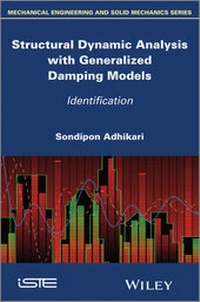
Structural Dynamic Analysis with Generalized Damping Models
Identification
Published on 17. January 2014
248 pages
978-1-118-86303-9 (ISBN)
Description

Since Lord Rayleigh introduced the idea of viscous damping in hisclassic work "The Theory of Sound" in 1877, it has become standardpractice to use this approach in dynamics, covering a wide range ofapplications from aerospace to civil engineering. However, in themajority of practical cases this approach is adopted more formathematical convenience than for modeling the physics of vibrationdamping.
Over the past decade, extensive research has been undertaken onmore general "non-viscous" damping models and vibrationof non-viscously damped systems. This book, along with a relatedbook Structural Dynamic Analysis with Generalized Damping Models:Analysis, is the first comprehensive study to cover vibrationproblems with general non-viscous damping. The author draws on hisconsiderable research experience to produce a text covering:parametric senistivity of damped systems; identification of viscousdamping; identification of non-viscous damping; and some tools forthe quanitification of damping. The book is written from avibration theory standpoint, with numerous worked examples whichare relevant across a wide range of mechanical, aerospace andstructural engineering applications.
Contents
1. Parametric Sensitivity of Damped Systems.
2. Identification of Viscous Damping.
3. Identification of Non-viscous Damping.
4. Quantification of Damping.
About the Authors
Sondipon Adhikari is Chair Professor of Aerospace Engineering atSwansea University, Wales. His wide-ranging and multi-disciplinaryresearch interests include uncertainty quantification incomputational mechanics, bio- and nanomechanics, dynamics ofcomplex systems, inverse problems for linear and nonlineardynamics, and renewable energy. He is a technical reviewer of 97international journals, 18 conferences and 13 funding bodies.He haswritten over 180 refereed journal papers, 120 refereed conferencepapers and has authored or co-authored 15 book chapters.
More details
Other editions
Additional editions
Software
01/2014
Wiley
€208.18
No shipping information available
Book
12/2013
1st Edition
Wiley-ISTE
€206.42
Article exhausted; check different version
Person
Sara J. Wilkinson is Associate Professor of Property andConstruction at the University of
Technology, Sydney, Australia
Hilde Remøy is Assistant Professor of Real EstateManagement at Delft University of
Technology, The Netherlands
Craig Langston is Professor of Construction and FacilitiesManagement at Bond University,
Queensland, Australia
Content
Preface ix
Nomenclature xiii
Chapter 1. Parametric Sensitivity of Damped Systems 1
1.1. Parametric sensitivity of undamped systems 2
1.1.1. Sensitivity of the eigenvalues 2
1.1.2. Sensitivity of the eigenvectors 3
1.2. Parametric sensitivity of viscously damped systems 5
1.2.1. Sensitivity of the eigenvalues 6
1.2.2. Sensitivity of the eigenvectors 9
1.3. Parametric sensitivity of non-viscously damped systems22
1.3.1. Sensitivity of the eigenvalues 23
1.3.2. Sensitivity of the eigenvectors 25
1.4. Summary 41
Chapter 2. Identification of Viscous Damping 43
2.1. Identification of proportional viscous damping 44
2.1.1. Damping identification using generalized proportionaldamping 45
2.1.2. Error propagation in the damping identificationmethod 48
2.1.3. Numerical examples 49
2.1.4. Experimental results 51
2.1.5. Synopsis 67
2.2. Identification of non-proportional viscous damping 69
2.2.1. The theory of damping identification 71
2.2.2. Numerical examples 75
2.2.3. Error analysis 88
2.2.4. Synopsis 90
2.3. Symmetry-preserving damping identification 91
2.3.1. The theory of symmetric damping matrixidentification 91
2.3.2. Numerical examples 97
2.3.3. Synopsis 104
2.4. Direct identification of the damping matrix 104
2.4.1. The modified Lancaster's method 105
2.4.2. Numerical examples 111
2.4.3. Synopsis 117
2.5. Summary 118
Chapter 3. Identification of Non-viscous Damping 121
3.1. Identification of exponential non-viscous dampingmodel 123
3.1.1. Background of complex modes 123
3.1.2. Fitting of the relaxation parameter 125
3.1.3. Fitting of the coefficient matrix 140
3.1.4. Synopsis 149
3.2. Symmetry preserving non-viscous dampingidentification 151
3.2.1. Theory 151
3.2.2. Numerical examples 155
3.2.3. Synopsis 159
3.3. Direct identification of non-viscous damping 160
3.3.1. Lancaster's method for non-viscously dampedsystems 161
3.3.2. Numerical examples 165
3.3.3. Synopsis 167
3.4. Summary 168
Chapter 4. Quantification of Damping 169
4.1. Quantification of non-proportional damping 169
4.1.1. Optimal normalization of complex modes 171
4.1.2. An index of non-proportionality 182
4.1.3. Alternative normalization methods 187
4.1.4. Synopsis 193
4.2. Quantification of non-viscous damping 193
4.2.1. Non-viscosity indices 195
4.2.2. Numerical examples 203
4.2.3. Error analysis 208
4.2.4. Synopsis 211
4.3. Summary 211
Bibliography 213
Author Index 243
Index 245
Nomenclature
diagonal element of the modal damping matrix terms in the expansion of approximate complex modes α1, α2 proportional damping constants αj coefficients in Caughey series, j = 0, 1, 2, ··· 0j a vector of j zeros A state-space system matrix aj a coefficient vector for the expansion of jth complex mode α a vector containing the constants in Caughey series frequency response function of an SDOF system B state-space system matrix bj a vector for the expansion of jth complex mode forcing vector in the Laplace domain modal forcing function in the Laplace domain effective forcing vector in the Laplace domain response vector in the Laplace domain Laplace transform of the state-vector of the first-order system modal coordinates in the Laplace domain Laplace transform of the internal variable yk(t) positive real line C viscous damping matrix C′ modal damping matrix C0 viscous damping matrix (with a non-viscous model) Ck coefficient matrices in the exponential model for k = 0, …, n, where n is the number of kernels non-viscous damping function matrix in the time domain ΔK error in the stiffness matrix ΔM error in the mass matrix β non-viscous damping factor βc critical value of β for oscillatory motion, βi(•) proportional damping functions (of a matrix) βk(s) coefficients in the state-space modal expansion βmU the value of β above which the frequency response function always has a maximum F linear matrix pencil with time step in state-space, F = B – A F1, F2 linear matrix pencils with time step in the configuration space Fj regular linear matrix pencil for the jth mode f′(t) forcing function in the modal coordinates f(t) forcing function G(s) non-viscous damping function matrix in the Laplace domain G0 the matrix G(s) at s → 0 G∞ the matrix G(s) at s → ∞ H(s) frequency response function matrix real part of imaginary part of jth measured complex mode I identity matrix K stiffness matrix M mass matrix Oij a null matrix of dimension i × j Ω diagonal matrix containing the natural frequencies p parameter vector (in Chapter 1 ) Pj a diagonal matrix for the expansion of jth complex mode ϕj eigenvectors in the state-space ψj left eigenvectors in the state-space q(t) displacement response in the time domain q0 vector of initial displacements Qj an off-diagonal matrix for the expansion of jth complex mode r(t) forcing function in the state-space Rk rectangular transformation matrices (in Chapter 4, [ADH 14] ) Rk residue matrix associated with pole sk S a diagonal matrix containing eigenvalues sj T a temporary matrix, (Chapter 2) Tk Moore-Penrose generalized inverse of Rk Tk a transformation matrix for the optimal normalization of the kth complex mode Θ normalization matrix u(t) the state-vector of the first-order system u0 vector of initial conditions in the state-space uj displacement at the time step j v(t) velocity vector vj a vector of the j-modal derivative in Nelson’s methods (in Chapter 1) vj velocity at the time step j εj error vector associated with jth complex mode φk(s) eigenvectors of the dynamic stiffness matrix W coefficient matrix associated with the constants in Caughey series X matrix containing the undamped normal modes xj xj undamped eigenvectors, j = 1, 2, ···, N y(t) modal coordinate vector (in Chapter 2, [ADH 14]) yk(t) vector of internal variables, k = 1, 2, ···, n yk,j internal variable yk at the time step j Z matrix containing the complex eigenvectors zj zj complex eigenvectors in the configuration space ζ diagonal matrix containing the modal damping factors ζv a vector containing the modal damping factors χ merit function of a complex mode for optimal normalization χR, χI merit functions for real and imaginary parts of a complex mode Δ perturbation in the real eigenvalues δ perturbation in complex conjugate eigenvalues initial velocity (SDOF systems) small error η ratio between the real and imaginary parts of a complex mode dissipation function γ non-dimensional characteristic time constant γj complex mode normalization constant γR, γI weights for the normalization of the real and imaginary parts of a complex...