

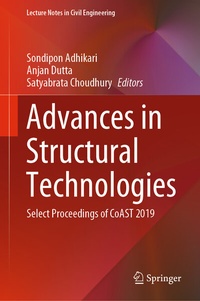
Advances in Structural Technologies
Select Proceedings of CoAST 2019
1st Edition
Published on 25. September 2020
XIII, 428 pages
978-981-15-5235-9 (ISBN)
Description

This book comprises select proceedings of the National Conference on Advances in Structural Technology (CoAST 2019). It brings together different applied and technological aspects of structural engineering. The main topics covered in this book include solid mechanics, composite structures, fluid-structure interaction, soil-structure interaction, structural safety, and structural health monitoring. The book also focuses on emerging structural materials and the different behavior of civil, mechanical, and aerospace structural systems. Given its contents, this book will be a useful reference for researchers and practitioners working in structural safety and engineering.
More details
Series
Language
English
Place of publication
Singapore
Singapore
Publishing group
Springer Singapore
Target group
Professional and scholarly
Product notice
Reflowable
Illustrations
XIII, 428 p. 290 illus., 219 illus. in color.
File size
24,37 MB
ISBN-13
978-981-15-5235-9 (9789811552359)
DOI
10.1007/978-981-15-5235-9
Schweitzer Classification
Other editions
Additional editions
Sondipon Adhikari | Anjan Dutta | Satyabrata Choudhury
Advances in Structural Technologies
Select Proceedings of CoAST 2019
Book
09/2020
Springer
€353.09
Shipment within 3-4 weeks
Persons
Prof.Sondipon Adhikari
is the chair of Aerospace Engineering in the College of Engineering of Swansea University (from April 2007) and a Fellow of the Royal Aeronautical Society (from April 2017). In 2010 he received the Wolfson Research Merit Award from the Royal Society (UK academy of sciences). He was an Engineering and Physical Science Research Council (EPSRC) Advanced Research Fellow (2004-09) and winner of the Philip Leverhulme Prize (2007) in Engineering (given to an outstanding scholar under the age of 35). He received his PhD in 2001 as a Jawaharlal Nehru Memorial Trust scholar at the Trinity College from the University of Cambridge. He was a lecturer at the Bristol University (2003-07) and a Junior Research Fellow at Fitzwilliam College, Cambridge (2001-03). From 2015 he has been a Distinguished Visiting Professor at the University of Johannesburg. He was a visiting Professor at Carleton University (Canada, 2006) and a visiting scientist at the Los Alamos NationalLaboratory (USA, 2006). In 2008 he was an official visitor to the Cambridge University Engineering Department and a visiting Fellow of Fitzwilliam College, Cambridge. In January 2016, he was a visiting Professor at the University of Paris East.Professor Adhikari's research stands on three fundamental footings - structural dynamics, probabilistic methods and computational mechanics. Specific research areas include uncertainty quantification in computational mechanics, dynamics of complex systems, inverse problems for linear and non-linear dynamics, vibration energy harvesting, wind turbines and dynamics of nanoscale systems. He has obtained more than £2.5M of competitive research funding as a principal investigator, published 5 books, 286 peer-reviewed journal papers (Scopus h-index=51) and more than 185 conference papers in these areas. He was the recipient of the Jawaharlal Nehru Memorial Trust (London) scholarship at the Trinity College, Cambridge (1997). In 1999 he won the best student paper prize (John Winbolt Prize) from the Cambridge University for a single-authored paper in the AIAA Journal. In 2001 he won the second prize from the Acoustical Society of America for the best student paper/presentation in the 141st Meeting in Chicago. Later that year he received the junior research fellowship (in science and engineering) from Fitzwilliam College, Cambridge. Professor Adhikari received the EPSRC advanced research fellowship award in 2004. He was a member of the winning project team in the EPSRC Ideas factory Workshop (January 2006) on Scientific Uncertainty and Decision Making (awarded £338,591). Prof Adhikari won three highly competitive Newton Fellowships, two Marie Curie International Fellowships and the Newton-Bhabha award. Prof.Adhakari has been an Associate Editor for the Shock and Vibration Journal between 2006-2011. He is a technical reviewer for over 120 international journals, 20 conferences and 15 funding bodies. He is a memberof the American Institute of Aeronautics and Astronautics (AIAA) Non-Deterministic Approaches Technical Committee (NDA-TC) and Uncertainty Quantification and Model Validation (UQMV) technical division of the Society for Experimental Mechanics (SEM). Professor Adhikari is a member of the Engineering and Physical Sciences Research Council (EPSRC) peer review college. He has been a research grant reviewer for Nuffield foundation, NRF (National Research Foundation), South Africa, US Department of Energy and Science and Technology, book reviewer for Wiley, Elsevier/Butterworth-Heinemann Publishers and Royal Aeronautical Society.
Professor Anjan Dutta is HAG Professor in the Department of Civil Engineering, IIT Guwahati, India. He had his Bachelor degree from REC Silchar, Master's degree in Structural Engg from IIT Madras and Ph.D. from IIT Delhi. He worked as Lecturer at REC Silchar, as assistant professor and associate professor at IIT Guwahati and is presently a professor in the same institute.He has 59 publications in international referred journals, many papers in international and national conferences. His research interests are: Finite Element method, Bridge Engineering, Optimization, Structural Control, Health Monitoring, Structural Retrofitting. He was a Gold medalist of Gauhati University (B.E.), received Commendation certificate from IRC and was felicitated as Eminent Engineer by Institute of Engineers (India). He has a patent on "Elastomeric Seismic Isolation with High Damping Capacity and Manufacturing Method Thereof". Based on this patent philosophy, a two-storey Masonry building supported on isolators has been constructed in Tawang, Arunachal Pradesh, India. This is the first prototype building in the world on Fibre Reinforced Elastomeric Isolators. He has guided 11 Ph.D. and is currently supervising another half a dozen scholars. He has completed 9 sponsored research projects. He has published one book chapter. Prof. Dutta has contributed a large number of consultancy services to many prestigious projects. He is member of various committees and has rendered services to IIT Guwahati in various capacities like Dean (Institute Works), Head of the Department etc.
Prof. Satyabrata Choudhury is working as Professor in the Department of Civil Engineering, NIT Silchar, India. He has been a faculty of this institute since 1983, first as Lecturer and then as Assistant Professor and, now as Professor. Prof. Choudhury obtained his bachelor degree in Civil Engineering from REC Silchar (Now NIT Silchar), India. He obtained his master's degree in Structural Engineering from IIT Kharagpur and Ph.D. in Earthquake Engineering from IIT Roorkee. He has served in various administrative positions in the institute including: Head of the Department, Dean (P&D), Coordinator of various activities. He has received various awards including President of India's prize, Dr. Jai Krishna Gold medal (two times), Institution prize (IEI) etc. His area of research is Performance-based seismic design. He has 12 papers in international peer reviewed journals, 6 papers in national journal and number of papers in international and national conferences. He has supervised about 50 M.Tech. dissertations, produced one Ph.D. and working with another 10 Ph.D. scholars. He has evolved a new design methodology named as Unified performance-based design (UPBD) which accommodates both drift and performance level as target design objectives. This method also provides member sizes.
Professor Anjan Dutta is HAG Professor in the Department of Civil Engineering, IIT Guwahati, India. He had his Bachelor degree from REC Silchar, Master's degree in Structural Engg from IIT Madras and Ph.D. from IIT Delhi. He worked as Lecturer at REC Silchar, as assistant professor and associate professor at IIT Guwahati and is presently a professor in the same institute.He has 59 publications in international referred journals, many papers in international and national conferences. His research interests are: Finite Element method, Bridge Engineering, Optimization, Structural Control, Health Monitoring, Structural Retrofitting. He was a Gold medalist of Gauhati University (B.E.), received Commendation certificate from IRC and was felicitated as Eminent Engineer by Institute of Engineers (India). He has a patent on "Elastomeric Seismic Isolation with High Damping Capacity and Manufacturing Method Thereof". Based on this patent philosophy, a two-storey Masonry building supported on isolators has been constructed in Tawang, Arunachal Pradesh, India. This is the first prototype building in the world on Fibre Reinforced Elastomeric Isolators. He has guided 11 Ph.D. and is currently supervising another half a dozen scholars. He has completed 9 sponsored research projects. He has published one book chapter. Prof. Dutta has contributed a large number of consultancy services to many prestigious projects. He is member of various committees and has rendered services to IIT Guwahati in various capacities like Dean (Institute Works), Head of the Department etc.
Prof. Satyabrata Choudhury is working as Professor in the Department of Civil Engineering, NIT Silchar, India. He has been a faculty of this institute since 1983, first as Lecturer and then as Assistant Professor and, now as Professor. Prof. Choudhury obtained his bachelor degree in Civil Engineering from REC Silchar (Now NIT Silchar), India. He obtained his master's degree in Structural Engineering from IIT Kharagpur and Ph.D. in Earthquake Engineering from IIT Roorkee. He has served in various administrative positions in the institute including: Head of the Department, Dean (P&D), Coordinator of various activities. He has received various awards including President of India's prize, Dr. Jai Krishna Gold medal (two times), Institution prize (IEI) etc. His area of research is Performance-based seismic design. He has 12 papers in international peer reviewed journals, 6 papers in national journal and number of papers in international and national conferences. He has supervised about 50 M.Tech. dissertations, produced one Ph.D. and working with another 10 Ph.D. scholars. He has evolved a new design methodology named as Unified performance-based design (UPBD) which accommodates both drift and performance level as target design objectives. This method also provides member sizes.
Content
Seismic Control and Performance of Passive Hybrid Damper under Near-Field Earthquakes.- Wall Effects on Terminal Velocity of Test Fuel Bundle in the Fuel Test Loop of High Flux Research Reactor.- Comparison of Seismic Performance of Composite (RCS) Frame with RC Frame using Pushover Analysis.- Investigating Load Withstand by L-Shape Concrete Cube, RCC Slab and To Safeguard Reinforcement of RCC Slab in Salt-Water Environment Using Cathodic Protection.- Performance Evaluation of Two-Way RC Slab Subjected to Blast Loading Using Finite Element Analysis.- Development of Fragility Curves for Different Types of RC Frame Structures.- Smart light weight MR Damper for Enhancement of Seismic Mitigation.- Rheological Behavior of Geopolymer Mortar with Fly ash, Slag and their Blending.- Effect of Pile Spacing and Raft Thickness on Behaviour of Piled-Raft Foundation - A Parametric Study Using Fem.- Removal of VOCs and Improvement of Indoor Air Quality Using Activated Carbon Air Filter.
