

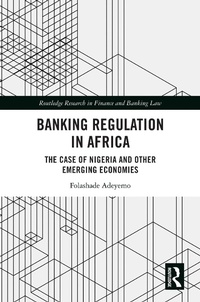
Banking Regulation in Africa
The Case of Nigeria and Other Emerging Economies
1st Edition
Published on 28. December 2021
200 pages
978-1-000-51706-4 (ISBN)
Description

There is little literature on the development of banking regulation in Nigeria, or the scope of powers of the Central Bank of Nigeria, which is its core banking sector regulator. The critical impetus of this book is to contribute to the literature of this area, with a detailed exploration of the Nigerian regulatory architecture. In addition, the book also engages in a comparative analysis with two emerging economies in Africa: South Africa and Kenya. It also considers the UK and the US as comparator jurisdictions in light of their regulatory responses to the global financial crisis of 2008. This book contributes to the ongoing discourse in this area by exploring, in detail, the theoretical underpinnings of regulation and supervision, to determine whether there is an understanding of what constitutes effective regulation in these jurisdictions.
Given that Nigeria is the core jurisdictional focus, a historical account of banking exchanges from the pre-colonial era to more recent times is provided. Offering an understanding of how political, local and economic settings, in conjunction with the theories of regulation, have impacted and influenced regulatory development in Nigeria, the book engages in an examination of Nigeria's historical experiences with bank failures, including the banking crisis it experienced in 2008. The newly enacted Banks and Other Financial Institutions Act 2020 is also explored as part of this discourse. Through a critical analysis of the law, the book demonstrates that the Nigerian regulator has historically adopted a reactionary strategy, instead of a proactive and pragmatic approach, which is imperative for an effective regulatory regime. The outcome of this analysis is that there are lessons to be learned, and proposals are discussed in order to rethink the act of banking regulation.
Given that Nigeria is the core jurisdictional focus, a historical account of banking exchanges from the pre-colonial era to more recent times is provided. Offering an understanding of how political, local and economic settings, in conjunction with the theories of regulation, have impacted and influenced regulatory development in Nigeria, the book engages in an examination of Nigeria's historical experiences with bank failures, including the banking crisis it experienced in 2008. The newly enacted Banks and Other Financial Institutions Act 2020 is also explored as part of this discourse. Through a critical analysis of the law, the book demonstrates that the Nigerian regulator has historically adopted a reactionary strategy, instead of a proactive and pragmatic approach, which is imperative for an effective regulatory regime. The outcome of this analysis is that there are lessons to be learned, and proposals are discussed in order to rethink the act of banking regulation.
Reviews / Votes
"...Providing a comprehensive historical background to the study, Dr Adeyemo examines the socio-political and economic context from which Nigerian banking regulatory approach developed. This contextualises for readers the backdrop for the discussion of the banking failures which plagued the country for decades and also the impact of the 2008 financial crisis on the banking sector."- Dr Olufemi Amao, Reader in Law, Sussex University
"Dr Adeyemo has produced a fascinating and thought-provoking work which makes an important and original contribution to the subject of regulating banks in general, and by focusing on regulating banks in developing countries in particular... Sub-Saharan Africa provides the perfect backdrop for such a study. This book will be a major reference point for everyone with an interest in the regulation of banks. Those of us who have only focused on developed countries will learn much from reading about the issues faced by countries such as Nigeria, South Africa and Kenya."
- Professor Andrew Campbell, Emeritus Professor of International Banking and Financial Law, University of Leeds. "...Providing a comprehensive historical background to the study, Dr Adeyemo examines the socio-political and economic context from which Nigerian banking regulatory approach developed. This contextualises for readers the backdrop for the discussion of the banking failures which plagued the country for decades and also the impact of the 2008 financial crisis on the banking sector."
- Dr Olufemi Amao, Reader in Law, Sussex University
"Dr Adeyemo has produced a fascinating and thought-provoking work which makes an important and original contribution to the subject of regulating banks in general, and by focusing on regulating banks in developing countries in particular... Sub-Saharan Africa provides the perfect backdrop for such a study. This book will be a major reference point for everyone with an interest in the regulation of banks. Those of us who have only focused on developed countries will learn much from reading about the issues faced by countries such as Nigeria, South Africa and Kenya."
- Professor Andrew Campbell, Emeritus Professor of International Banking and Financial Law, University of Leeds.
More details
Series
Edition
1. Auflage
Language
English
Place of publication
London
United Kingdom
Publishing group
Taylor & Francis Ltd
Target group
College/higher education
ISBN-13
978-1-000-51706-4 (9781000517064)
Copyright in bibliographic data and cover images is held by Nielsen Book Services Limited or by the publishers or by their respective licensors: all rights reserved.
Schweitzer Classification
Other editions
Additional editions
Book
01/2024
1st Edition
Routledge
€64.80
Shipment within 10-20 days
Book
12/2021
1st Edition
Routledge
€207.40
Shipment within 15-20 days
Person
Folashade Adeyemo is a Lecturer in Law at University of Reading, UK
Content
1. The Nigerian Banking System 2. Banking Regulation: Justification, Theory and Rationale 3. Banking Regulation in Nigeria 4. Regulatory Responses to Financial Crises 5. Understanding Nigerian Bank Regulation: A Closer Look at Bank Licence Revocation 6. A Scheme for Reform
