

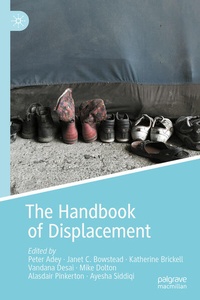
The Handbook of Displacement
1st Edition
Published on 11. December 2020
XXXI, 825 pages
978-3-030-47178-1 (ISBN)
Description

This Handbook provides the knowledge and tools needed to understand how displacement is lived, governed, and mediated as an unfolding and grounded process bound up in spatial inequities of power and injustice. The handbook ensures, first, that internal displacements and their everyday (re)occurrences are not overlooked; second, it questions 'who counts' by including 'displaced' people who are less obviously identifiable and a clearly circumscribed or categorised group; third, it stresses that while displacement suggests mobility, there are also periods and spaces of enforced stillness that are not adequately reflected in the displacement literature; and fourth, it re-evokes and explores the 'place' in displacement by critically interrogating peoples' 'right to place' and the significance of placemaking, unmaking, and remaking in the contemporary world.
The 50-plus chapters are organised across seven themes designed to further develope interdisciplinary study ofthe technologies, journeys, traces, governance, more-than-human, representation, and resisting of displacement. Each of these thematic sections begin with an intervention which spotlights actions to creatively and strategically intervene in displacement. The interventions explore myriad meanings and manifestations of displacement and its contestation from the perspective of displaced people, artists, writers, activists, scholar-activists, and scholars involved in practice-oriented research.
The Handbook will be an essential companion for academics, students, and practitioners committed to forging solidarity, care, and home in an era of displacement.
The 50-plus chapters are organised across seven themes designed to further develope interdisciplinary study ofthe technologies, journeys, traces, governance, more-than-human, representation, and resisting of displacement. Each of these thematic sections begin with an intervention which spotlights actions to creatively and strategically intervene in displacement. The interventions explore myriad meanings and manifestations of displacement and its contestation from the perspective of displaced people, artists, writers, activists, scholar-activists, and scholars involved in practice-oriented research.
The Handbook will be an essential companion for academics, students, and practitioners committed to forging solidarity, care, and home in an era of displacement.
Reviews / Votes
"The book as is offers a never-before-seen set of case studies that ties together displacement-related experiences and policies from the Global North and the South. I think that the editors have done a marvelous job. . this book could be used as a supplementary text for a variety of courses in the fields of geography and urban studies. It is truly a valuable 'handbook' of displacement for many fields of study." (Aysegul Can, Journal of Urban Affairs, August 17, 2021)More details
Other editions
Additional editions
Peter Adey | Janet C. Bowstead | Katherine Brickell
The Handbook of Displacement
Book
12/2020
Palgrave Macmillan
€192.59
Shipment within 7-9 days
Persons
Peter Adey
is Professor in Human Geography at Royal Holloway, University of London, UK.
Janet Bowstead is a researcher at Royal Holloway, University of London, UK.
Katherine Brickell is Professor of Human Geography at Royal Holloway, University of London, UK.
Mike Dolton is Senior Lecturer in Human Geography at Royal Holloway, University of London, UK.
Vandana Desai is Senior Lecturer in Development Geography at Royal Holloway, University of London, UK.
Alasdair Pinkerton is Reader and Associate Professor in Geopolitics at Royal Holloway University of London, UK.
Ayesha Siddiqi is Lecturer in Human Geography at the University of Cambridge, UK.
Janet Bowstead is a researcher at Royal Holloway, University of London, UK.
Katherine Brickell is Professor of Human Geography at Royal Holloway, University of London, UK.
Mike Dolton is Senior Lecturer in Human Geography at Royal Holloway, University of London, UK.
Vandana Desai is Senior Lecturer in Development Geography at Royal Holloway, University of London, UK.
Alasdair Pinkerton is Reader and Associate Professor in Geopolitics at Royal Holloway University of London, UK.
Ayesha Siddiqi is Lecturer in Human Geography at the University of Cambridge, UK.
Content
Chapter 1. Introduction to Displacement Studies: Knowledges, Concepts, Practices; Peter Adey, Janet C. Bowstead, Katherine Brickell, Vandana Desai, Mike Dolton, Alasdair Pinkerton, Ayesha Siddiqi.- Section One: Conceptualising Displacement.- Chapter 2. Mobilities and Displacement; Mimi Sheller.- Chapter 3. Political Ecologies of Displacement; Rebecca Elmhirst.- Chapter 4. Displacement Economies: A Relational Approach to Displacement; Amanda Hammar.- Chapter 5. The Slow and the Fast Violence of Displacement; James A. Tyner.- Chapter 6. Assembling Climate Change-Related Displacement; Leonie Tuitjer.- Chapter 7. Affect and Displacement; Mark Griffiths.- Chapter 8. Protection of Displaced Persons and the Rights-Based Approach; Rónán McDermott, Pat Gibbons, and Sinéad McGrath.- Chapter 9. Queering Displacement/The Displacement of Queers; Scott McKinnon.- Chapter 10. Gendered and Feminist Approaches to Displacement; Katherine Brickell and Jessie Speer.- Chapter 11. 'Race,' Ethnicity and Forced Displacement; Luisa Feline Freier, Matthew D. Bird, and Soledad Castillo Jara.- Chapter 12. Conceptualising Postcolonial Displacement Beyond Aid and Protection; Jose Jowel Canuday.- Section Two: Technologies of Displacement.- Chapter 13. Intervention: Displacement Aesthetics; Kaya Barry and Pete Adey.- Chapter 14. The Artwashing of Gentrification and Social Cleansing; Stephen Pritchard.- Chapter 15. Taking the Weather with You: Remittances, Translocality, and the Climate Migrant Within; Laurie Parsons.- Chapter 16. Barbed Displacement: Walls to the Disciplined Migrant; Bénédicte Michalon.- Chapter 17. Technologies of Deportation; William Walters.- Chapter 18. Street Technologies of Displacement: Disposable Bodies, Dispossessed Space; Elijah Adiv Edelman.- Chapter 19. Olympic Favela Evictions in Rio de Janeiro: The Consolidation of a Neoliberal Displacement Regime; James Freeman.- Section Three: Journeys of Displacement.- Chapter 20. Intervention: Women's Narratives from Refugee Camps in the Kurdistan Region of Iraq; Nazand Begikhani.- Chapter 21. Constraints and Transgressions in Journeys of Displacement; Joris Schapendonk and Milena Belloni.- Chapter 22. Migrants' Displacements at the Internal Frontiers of Europe; Martina Tazzioli.- Chapter 23. Carceral Journeys; Nick Gill and Oriane Simon.- Chapter 24. Precarious Migrations and Maritime Displacement; Vicki Squire and Maurice Stierl.- Chapter 25. Maintaining Health on the Move: Access and Availability for Displaced People; Jennifer Cole.- Section Four: Traces of Displacement.- Chapter 26. Intervention: Disasters and Displacement: When There Is No Time to Stop; Ayesha Siddiqi.- Chapter 27. Antipodean Architectures of Displacement; Anoma Pieris.- Chapter 28. Spiritual Geographies of Displacement and Resilience; Julia Christensen and Veronica Madsen.- Chapter 29. Mapping Trajectories of Displacement; Nishat Awan.- Chapter 30. Uncovering Internally Displaced People in the Global North through Administrative Data: Case Studies of Residential Displacement in the UK; Janet C. Bowstead, Stuart Hodkinson, and Andy Turner.- Section Five: Governing Displacement.- Chapter 31. Intervention: Forensic Oceanography: Tracing Violence within and Against the Mediterranean Frontier's Aesthetic Regime; Charles Heller and Lorenzo Pezzani.- Chapter 32. Governing the Displaced: Contradictory Constellations of Actors, Ideas, and Strategies; Lama Tawakkol, Ali Bhagat, Sarah Sharma.- Chapter 33. Bureaucracies of Displacement: From Immigrants' Social and Physical Exclusion to Their Judicial Removal; Cecilia Menjívar and Andrea Gómez Cervantes.- Chapter 34. Police, Bailiffs, and Hired Hands: Researching the Distribution and Dissolution of Eviction Enforcement; Alexander G. Baker.- Chapter 35. Governing the Unwanted: Measuring European Migration Enforcement at Street Level; Lisa Marie Borrelli.- Chapter 36. A Forced Displacement and Atrocity Crime Nexus: Displacement as Transfer, Annihilation, and Homogenisation; Andrew R. Basso.- Section Six: More-Than-Human Displacements.- Chapter 37. Intervention: Flower Power: Khmer Women's Protests against Displacement in Cambodia and the United States; Katherine Brickell.- Chapter 38. Animals, People, and Places in Displacement; Benjamin Thomas White.- Chapter 39. Energy on the Move: Displaced Objects in Knowledge and Practice; Jamie Cross, Craig Martin, and G. Arno Verhoeven.- Chapter 40. Smartphones: Digital Infrastructures of the Displaced; Koen Leurs and Jeffrey Patterson.- Chapter 41. Family Photographs in Displacement; Penelope Pitt.- Chapter 42. Displaced Home-Objects in Homing Experiences; Mastoureh Fathi.- Chapter 43. The Role of Design in Displacement: Moving beyond Quick-Fix Solutions in Rebuilding Housing after Disaster; Esther Charlesworth and John Fien.- Section Seven: Representing Displacement.- Chapter 44: Intervention: Activism, Research and Film-Making: Fighting for the Right to Housing in Bucharest, Romania; Michele Lancione.- Chapter 45. How Not to Eat Human Stories: Ruts, Complicities and Methods in Visual Representations of Refugees; Dominika Blachnicka-Ciacek.- Chapter 46. Displacements of Experience: The Case of Immersion and Virtual Reality; Emma Bond.- Chapter 47. Displacement in Contemporary Art; John Potts.- Chapter 48. Reclaiming Safe Spaces: Arts-Based Research, Advocacy, and Social Justice; Nelli Stavropoulou.- Section Eight: Resisting Displacement.- Chapter 49. Intervention: An Interview with Anna Minton; Vandana Desai.- Chapter 50. 'Housing is a Human Right. Here to Stay, Here to Fight': Resisting Housing Displacement through Gendered, Legal and Tenured Activism; Mel Nowicki.- Chapter 51. Contesting Displacement through Radical Emplacement and Occupations in Austerity Europe; Mara Ferreri.- Chapter 52. Legal Geographies of Resistance to Gentrification and Displacement: Lessons from the Aylesbury Estate in London; Loretta Lees and Phil Hubbard.- Chapter 53: Local Faith Communities and Responses to Displacement;Susanna Trotta and Olivia Wilkinson.- Chapter 54. Hosting the Displaced: From Sanctuary Cities to Hospitable Homes; Jonathan Darling.- Chapter 55. Food and the Politics of Refuge: The Transformative Power of Asylum Seeker and Refugee Food Initiatives; Fiona Murphy.
