

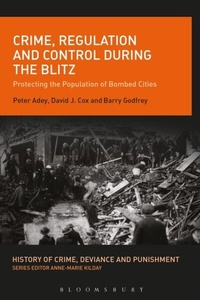
Crime, Regulation and Control During the Blitz
Protecting the Population of Bombed Cities
1st Edition
Published on 10. March 2016
240 pages
978-1-4411-4358-7 (ISBN)
Description

Crime, Regulation and Control during the Blitz looks at the social effect of bombing on urban centres like Liverpool, Coventry and London, critically examining how the wartime authorities struggled to regulate and control crime and offending during the Blitz. Focusing predominantly on Liverpool, it investigates how the authorities and citizens anticipated the aerial war, and how the State and local authorities proposed to contain and protect a population made unruly, potentially deviant and drawn into a new landscape of criminal regulation.
Drawing on a range of contemporary sources, the book throws into relief today's experiences of war and terror, the response in crime and deviancy, and the experience and practices of preparedness in anticipation of terrible threats. The authors reveal how everyday activities became criminalised through wartime regulations and explore how other forms of crime such as looting, theft and drunkenness took on a new and frightening aspect. Crime, Regulation and Control during the Blitz offers a critical contribution to how we understand crime, security, and regulation in both the past and the present.
Drawing on a range of contemporary sources, the book throws into relief today's experiences of war and terror, the response in crime and deviancy, and the experience and practices of preparedness in anticipation of terrible threats. The authors reveal how everyday activities became criminalised through wartime regulations and explore how other forms of crime such as looting, theft and drunkenness took on a new and frightening aspect. Crime, Regulation and Control during the Blitz offers a critical contribution to how we understand crime, security, and regulation in both the past and the present.
Reviews / Votes
Second to London, Liverpool and the wider Merseyside area was the most continuously bombed city in Britain during the Blitz, largely because it was a major port. In the ten months of air raids, some 4,000 people died, and the area suffered enormous loss of property. This is not a military history and is not concerned with theoretical arguments or even many literary accounts-it is truly administrative history on the ground. The authors describe how the city regulated itself to cope with the bombing. This meant burdensome restrictions on virtually all aspects of civic life, including prewar planning, enforcement of blackout regulations, rescue work, damage control, civilian evacuation, and the need to rehouse people and keep schools open. The blackout provided ample opportunity for theft from dock areas and looting of damaged property. Stolen goods often made their way to a thriving black market. In spite of some false news reports, there were no gas attacks and no widespread panic, and although many people despaired, the city managed to carry on. A fascinating, scholarly, well-documented book that will expand the history of that grim time. Summing Up: Highly recommended. All academic levels/libraries. * CHOICE * Refreshingly, the text is not London-centric ... A rich and detailed account of Liverpool during the Blitz, both froma crime history perspective, and as a work of wider social history/ historical human geography. * Law, Crime & History * There has been little detailed research on wartime policing ... so this is a welcome contribution. * Police History Society Newsletter *
More details
Series
Edition
1. Auflage
Language
English
Place of publication
New York
United States
Publishing group
Bloomsbury Publishing PLC (Digital)
Target group
Professional and scholarly
ISBN-13
978-1-4411-4358-7 (9781441143587)
Copyright in bibliographic data and cover images is held by Nielsen Book Services Limited or by the publishers or by their respective licensors: all rights reserved.
Schweitzer Classification
Other editions
Additional editions
Peter Adey | David J. Cox | Barry Godfrey
Crime, Regulation and Control During the Blitz
Protecting the Population of Bombed Cities
Book
09/2017
Bloomsbury Academic
€63.32
Shipment within 15-20 days
Peter Adey | David J. Cox | Barry Godfrey
Crime, Regulation and Control During the Blitz
Protecting the Population of Bombed Cities
Book
03/2016
Bloomsbury Academic USA
€177.70
Shipment within 15-20 days
Persons
Peter Adey is Professor of Human Geography at Royal Holloway University of London, UK.
David J. Cox is Reader in Criminal Justice History at the University of Wolverhampton, UK.
Barry Godfrey is Professor of Sociology, Social Policy and Criminology at the University of Liverpool, UK.
David J. Cox is Reader in Criminal Justice History at the University of Wolverhampton, UK.
Barry Godfrey is Professor of Sociology, Social Policy and Criminology at the University of Liverpool, UK.
Content
Introduction
Part I: Preparation
1. Anticipation and Preparation for the Blitz
2. The Nervous System of Police Control and War-Time Regulation
Part II: Blitz
3. Wartime Crime and Criminalisation
4. Measuring Crime and Disorder, and Maintaining Morale
5. Preventing and Dealing with Juvenile Delinquency
6. Controlling Movement in the City
7. The Black Market and Circuits of Criminality
Part III: Aftermath
8. The Legacy of the Blitz
Conclusion: Living with Terror
Bibliography
Index
Part I: Preparation
1. Anticipation and Preparation for the Blitz
2. The Nervous System of Police Control and War-Time Regulation
Part II: Blitz
3. Wartime Crime and Criminalisation
4. Measuring Crime and Disorder, and Maintaining Morale
5. Preventing and Dealing with Juvenile Delinquency
6. Controlling Movement in the City
7. The Black Market and Circuits of Criminality
Part III: Aftermath
8. The Legacy of the Blitz
Conclusion: Living with Terror
Bibliography
Index
