

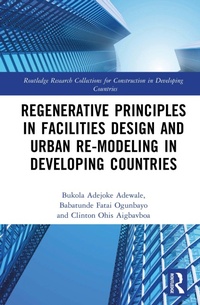
Regenerative Principles in Facilities Design and Urban Re-modelling in Developing Countries
Published on 4. March 2026
322 pages
978-1-040-83080-2 (ISBN)
Description

In the face of rapid urbanization and environmental challenges, the developing world stands at a crossroads. Conventional sustainable design, often modelled on Global North precedents, is proving insufficient to address the deep-seated infrastructural and socio-economic complexities of these unique contexts. This book argues for a radical shift from simply minimizing harm to actively healing and restoring our communities and ecosystems through regenerative architecture.
Moving beyond theory, this work provides a critical and practical roadmap for applying regenerative principles specifically in the challenging environments of developing nations. We delve into the core of what makes regeneration different, showcasing how it can produce net-positive energy and water systems, enhance biodiversity, foster social equity, and create economic value where it is needed most.
The heart of this book lies in its actionable insights and real-world evidence. Through a series of detailed case studies-from innovative adaptive reuse in Ghana and decentralized renewable systems in Rwanda to community-driven projects in South Africa, we demonstrate viable solutions. These are contrasted with lessons from pioneering examples in Sweden, the UK, and Canada, not as blueprints to copy, but as sources of adaptable strategies.
A significant focus is given to a deep-dive case study of Nigeria, offering a nuanced examination of its colonial architectural legacy, current urban pressures, and the emergent regenerative strategies that blend vernacular wisdom with modern innovation.
This book is more than a reference; it is a call to action. It provides policymakers with frameworks for supportive regulations, offers practitioners design strategies and performance metrics, and equips students and researchers with a comprehensive conceptual foundation. By championing an approach that is both context-sensitive and aspirational, this book serves as an essential guide for anyone committed to building resilient, vibrant, and equitable urban futures in the developing world and beyond.
Moving beyond theory, this work provides a critical and practical roadmap for applying regenerative principles specifically in the challenging environments of developing nations. We delve into the core of what makes regeneration different, showcasing how it can produce net-positive energy and water systems, enhance biodiversity, foster social equity, and create economic value where it is needed most.
The heart of this book lies in its actionable insights and real-world evidence. Through a series of detailed case studies-from innovative adaptive reuse in Ghana and decentralized renewable systems in Rwanda to community-driven projects in South Africa, we demonstrate viable solutions. These are contrasted with lessons from pioneering examples in Sweden, the UK, and Canada, not as blueprints to copy, but as sources of adaptable strategies.
A significant focus is given to a deep-dive case study of Nigeria, offering a nuanced examination of its colonial architectural legacy, current urban pressures, and the emergent regenerative strategies that blend vernacular wisdom with modern innovation.
This book is more than a reference; it is a call to action. It provides policymakers with frameworks for supportive regulations, offers practitioners design strategies and performance metrics, and equips students and researchers with a comprehensive conceptual foundation. By championing an approach that is both context-sensitive and aspirational, this book serves as an essential guide for anyone committed to building resilient, vibrant, and equitable urban futures in the developing world and beyond.
More details
Series
Language
English
Place of publication
London
United Kingdom
Publishing group
Taylor & Francis Ltd
Target group
College/higher education
Professional and scholarly
Product notice
Reflowable
Illustrations
1 Tables, black and white; 15 Line drawings, black and white; 4 Halftones, black and white; 19 Illustrations, black and white
File size
4,05 MB
ISBN-13
978-1-040-83080-2 (9781040830802)
Copyright in bibliographic data and cover images is held by Nielsen Book Services Limited or by the publishers or by their respective licensors: all rights reserved.
Schweitzer Classification
Other editions
Additional editions
Bukola Adejoke Adewale | Babatunde Fatai Ogunbayo | Clinton Ohis Aigbavboa
Regenerative Principles in Facilities Design and Urban Re-modelling in Developing Countries
Book
approx. 03/2026
1st Edition
Routledge
€248.50
Not yet published
Persons
Bukola Adejoke Adewale, PhD, Department of Architecture, Covenant University, Nigeria; and cidb Centre of Excellence & Sustainable Human Settlement and Construction Research Centre, Department of Construction Management & Quantity Surveying, Faculty of Engineering and the Built Environment Doornfontein Campus | John Orr Building, Johannesburg, South Africa.
Babatunde Fatai Ogunbayo, PhD, Department of Civil Engineering, College of Engineering and Technology, William V.S. Tubman University, East Harper, Maryland County, Republic of Liberia; and cidb Centre of Excellence & Sustainable Human Settlement and Construction Research Centre, Department of Construction Management & Quantity Surveying, Faculty of Engineering and the Built Environment, Doornfontein Campus | John Orr Building, Johannesburg, South Africa
Name: Clinton Aigbavboa, PhD, cidb Centre of Excellence & Sustainable Human Settlement and Construction Research Centre, Department of Construction Management & Quantity Surveying, Faculty of Engineering and the Built Environment, Doornfontein Campus | John Orr Building, Johannesburg, South Africa
Babatunde Fatai Ogunbayo, PhD, Department of Civil Engineering, College of Engineering and Technology, William V.S. Tubman University, East Harper, Maryland County, Republic of Liberia; and cidb Centre of Excellence & Sustainable Human Settlement and Construction Research Centre, Department of Construction Management & Quantity Surveying, Faculty of Engineering and the Built Environment, Doornfontein Campus | John Orr Building, Johannesburg, South Africa
Name: Clinton Aigbavboa, PhD, cidb Centre of Excellence & Sustainable Human Settlement and Construction Research Centre, Department of Construction Management & Quantity Surveying, Faculty of Engineering and the Built Environment, Doornfontein Campus | John Orr Building, Johannesburg, South Africa
Content
1. Background Information of the Book. 2. Overview of Regenerative Architecture. 3. Benefits of Regenerative Architecture. 4. Adapting Regenerative Architecture Principles for Facilities Design and Urban Remodelling. 5. Critical Success Factors for Implementing Regenerative Principles in Facilities Design and Urban Remodeling in Developing Countries. 6. Contextual Challenges in Regenerative Architecture Principles Application in Facilities Design and Urban Remodelling for Developing Countries Development. 7. Case Studies and Best Practices of Successful Regenerative Design Applications in Urban Facilities in Developed Countries. 8. Case Studies and Best Practices of Successful Regenerative Design Applications in Urban Facilities in Developing Countries. 9. Case Study of Nigeria. 10. Conclusions and Recommendations.
