

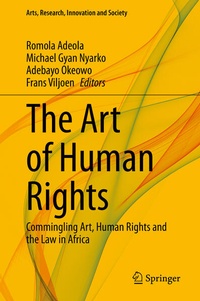
The Art of Human Rights
Description

This book highlights the use of art in human rights, specifically within Africa. It advances an innovative pattern of thinking that explores the intersection between art and human rights law. In recent years, art has become an important tool for engagement on several human rights issues. In view of its potency, and yet potential to be a danger when misused, this book seeks to articulate the use of arts in the human rights discourse in its different forms. Chapters cover how music, photography, literature, photojournalism, soap opera, commemorations, sculpting and theatre can be used as an expression of human rights. This book demonstrates how arts have become a formidable expression of thoughts and a means of articulating reality in a form that simplifies truth and congregates resolve to advance change.
More details
Other editions
Additional editions
Persons
Michael Gyan Nyarko is a legal practitioner and researcher at the Centre for Human Rights, University of Pretoria (South Africa). His experience has largely been in the areas of human rights and democratisation in Africa, implementation/impact of human rights treaties, litigation before African regional and sub-regional human rights courts and treaty bodies.
Adebayo Okeowo is an Advocacy Coordinator at the Centre for Human Rights, University of Pretoria (South Africa). He is responsible for developing effective strategies used in campaigning and advocating for specific human rights issues. He engages in activities which seek to enhance the human rights work being carried out by the Centre for Human Rights through its various programme areas.
Frans Viljoen is Director of the Centre for Human Rights in Faculty of Law, University of Pretoria (South Africa). He is also the Academic Coordinator of the LLM (Human Rights and Democratisation in Africa), presented by the Centre in collaboration with twelve partner law faculties across Africa, including the University of the Western Cape. He has been involved in advocacy and training in and on the African regional human rights system, and published widely on international human rights law.
