

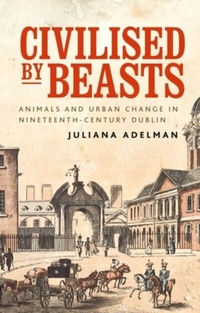
Civilised by Beasts
Animals and Urban Change in Nineteenth-Century Dublin
1st Edition
Published on 27. October 2020
248 pages
978-1-5261-4606-9 (ISBN)
Description

Civilised by beasts tells the story of nineteenth-century Dublin through human-animal relationships. It offers a unique perspective on ordinary life in the Irish metropolis during a century of significant change and reform. At its heart is the argument that the exploitation of animals formed a key component of urban change, from municipal reform to class formation to the expansion of public health and policing. It uses a social history approach but draws on a range of new and underused sources, including archives of the humane society and the zoological society, popular songs, visual ephemera and diaries. The book moves chronologically from 1830 to 1900, with each chapter focusing on specific animals and their relationship to urban changes. It will appeal to anyone fascinated by the history of cities, the history of Dublin or the history of Ireland. -- .
Reviews / Votes
'We get a fresh, different perspective on the distressed Victorian city where official attitudes to animal ownership reflected political, religious and class divisions'.Irish Times
'Adelman's approach is imaginative, well-paced, and accessible. The reader is not confronted with a heavy tome, but an impressive body of research skilfully crafted into a compelling narrative.'
Dublin Inquirer
'Civilised by beasts is a fascinating and engaging study that both reimagines nineteenth-century Dublin and encourages the reader to think differently about the processes and outcomes of urban improvement.'
Stuart Irwin, Irish Historical Studies
'Civilised by beasts offers a rich account of how Irish historical currents shaped Dublin's animal history. As Adelman shows, even as Dubliners responded at times to animals' presence in ways typical of other large cities, their experiences also reflected the specificities of their own urban and national settings. Readers interested in animals, urban history, the history of agriculture and food production, and even the history of colonialism, will find much of interest in this careful and discerning study.'
Jessica Wang, Urban History
'Adelman presents Dublin's growth and structural changes in a new light: in her lively, highly readable written account, she shows how human-animal relations changed in direct relation to class distinctions, economic inequalities and religious beliefs.'
Social History of Medicine
'Evocative and compellingly argued, this book brings a highly charged period of Dublin's history to life with sensitivity and purpose. Adelman sheds new light on a fascinating city through the complex human-animal relationships that shaped it.'
Thomas Almeroth-Williams, author of City of beasts: How animals shaped Georgian London
'In James Joyce's imagined Dublin, readers encounter pumas and alligators, camels and whales. But the animals that populated every street in the real Dublin of Joyce's childhood were less exotic - dogs and pigs, horses and cattle, and vast numbers of them. Their history has never been told until now and it is something of a revelation: Juliana Adelman's remarkable study of everyday animals in the development of the Irish capital provides an entirely fresh perspective on the troubled history of the Victorian city, riven as it was by political, religious and class divisions. Public and official attitudes towards animal ownership and animal welfare reflected these tensions, and different animals were credited with very distinctive cultural meaning. From the Dublin Zoo to the first dog shows, from the dingy piggeries to the new-style dairies, Adelman opens up a new debate on animal-human relations and thereby reconceptualises the old debate on the modernisation of Irish society.'
David Dickson, Professor of Modern History, Trinity College Dublin
'Juliana Adelman brilliantly re-imagines the social and commercial geographies of nineteenth-century Dublin as alive with the rumbustious sights, smells and sounds of its exploited animal life. Middle-class "improvers" mobilised on the understanding that the city could only become "civilised" if new regulatory regimes expunged this animal presence, reforming the incorrigible ruralism of its lower-class inhabitants along the way. This is the fascinating story Civilised by beasts sets out to tell.'
Matthew Kelly, Professor of Modern History, Northumbria University
'A brilliant and ground-breaking study of shifting relationships between animal and human, rural and urban, nature and culture in nineteenth-century Dublin. Civilised by beasts retrieves the exotic animals in the Zoological Gardens, the horses pulling carriages on the city streets and the pigs in backyards. Detailed, engaging and lucid, it is invaluable for a historical understanding of the environmental, social and political tensions of nineteenth-century Dublin and Ireland. More broadly, this book is an important contribution to the fields of social and environmental history, urban studies and Irish Studies. A fascinating and highly readable account of a neglected aspect of Dublin's social history.'
Helen O'Connell, Associate Professor of English Studies, Durham University -- .
More details
Series
Language
English
Place of publication
Manchester
United Kingdom
Target group
College/higher education
Professional and scholarly
Edition type
Digital original
Illustrations
27 black & white illustrations
27 black & white illustrations
ISBN-13
978-1-5261-4606-9 (9781526146069)
Copyright in bibliographic data and cover images is held by Nielsen Book Services Limited or by the publishers or by their respective licensors: all rights reserved.
Schweitzer Classification
Other editions
Additional editions
Book
10/2021
Manchester University Press
€24.60
Shipment within 15-20 days
Person
Juliana Adelman is Assistant Professor of History at Dublin City University -- .
Content
Introduction
1 Political zoology: class, religion and animal exploitation, 1830-45
2 How to live on your pig: improvement and the poor during the Great Famine, 1845-50
3 The market metropolis: cattle and urban development, 1850-65
4 Enforcing values and controlling animals: dogs, pigs and police, 1865-80
5 Progress or decline? Associating animals with urban success and failure, 1880-1900
Epilogue
Bibliography
Index -- .
1 Political zoology: class, religion and animal exploitation, 1830-45
2 How to live on your pig: improvement and the poor during the Great Famine, 1845-50
3 The market metropolis: cattle and urban development, 1850-65
4 Enforcing values and controlling animals: dogs, pigs and police, 1865-80
5 Progress or decline? Associating animals with urban success and failure, 1880-1900
Epilogue
Bibliography
Index -- .
