

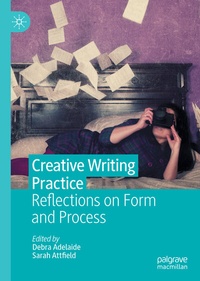
Creative Writing Practice
Description

Creative Writing Practice: reflections on form and process explores the craft of creative writing by illuminating the practices of writers and writer-educators. Demonstrating solutions to problems in different forms and genres, the contributors draw on their professional and personal experiences to examine specific and practical challenges that writers must confront and solve in order to write.
This book discusses a range of approaches to writing, such as the early working out of projects, the idea of experimentation, of narrative time, and of failure. With its strong focus on process, Creative Writing Practice is a valuable guide for students, scholars and practitioners of creative writing.
More details
Other editions
Additional editions
Persons
Content
PART ONE.- THEORETICAL CHALLENGES: WORKING IT OUT.- CHAPTER 1 Debra Adelaide and Sarah Attfield - Introduction.- CHAPTER 2: Sarah Attfield - The Ethics of Working-Class Realism in Poetry.- CHAPTER 3: Sunil Badami - The Golden Rules [TO COME].- CHAPTER 4: Craig Batty - Screenwriting Beyond the Paradigms: creative thinking and script development [TO COME].- CHAPTER 5: Claire Corbett - Everything You Can Imagine is Real: worldbuilding, the donnée and the magic of writing.- CHAPTER 6: Margot Nash - Adaptation: essence and originality and radical transformation .- PART TWO PRACTICAL CHALLENGES: STARTING, STOPPING AND FAILING.- CHAPTER 7: Delia Falconer - The Writer's Notebook.- CHAPTER 8: Mark Rossiter - Prompting Creativity: revisiting Aristotle's advice on plot and character.- CHAPTER 9: Andrew Pippos - Trading hours: time, order, and narration in Lucky's .- CHAPTER 10: Gregory Ferris - Writing Without Frames.- CHAPTER 11: Debra Adelaide - The Corrections: succeeding at failure in the creative process.- PART THREE CONSOLIDATING THE PROCESS: SUCCESS AND RESILIENCE.- CHAPTER 12: Dave Drayton - Counting Coco Pops: on constraint and creativity.- CHAPTER 13: Sue Joseph - When Your Subjects Do Not Agree [DRAFT ONLY].- CHAPTER 14: Liz Giuffre - Critical Distance: creative writing as a critic-fan.- CHAPTER 15: Tom Lee - Art, Design and Communicating the Story: the cover of Coach Fitz.- CHAPTER 16: Mark Isaacs - Behrouz Boochani: writing as resilience and resistance.
