

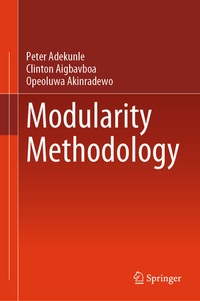
Modularity Methodology
Description

This book introduces the principles of modular construction, standardisation, flexibility and scalability and then demonstrates how they can revolutionise construction workflows, reduce project timelines, and enhance sustainability. Transforming the Built Environment: A Guide to Modular Construction Methodologies is a groundbreaking resource that redefines how buildings are designed, constructed and delivered. Packed with practical case studies, detailed illustrations and accessible explanations, this book bridges the gap between theory and practice, offering actionable insights for industry professionals, students and innovators. Whether you're an architect, engineer, contractor or policymaker, this book provides the tools and strategies to adopt modularity and stay ahead in an evolving industry. Discover how modular construction can optimise efficiency, improve quality, and contribute to greener, more cost-effective building solutions. Modularity Methodology is your ultimate roadmap to navigating and leading the future of construction.
More details
Other editions
Additional editions
Persons
Peter Adekunle, Construction Management and Quantity Surveying, University of Johannesburg, Johannesburg, South Africa.
Dr. Peter Adekunle is an academic and professional in Quantity Surveying and Construction Management. He is a postdoctoral research fellow at the University of Johannesburg, with a Ph.D. and M.Sc. in Construction Management and Quantity Surveying from the same institution, a diploma in Blockchain from the University of Zurich, and a B.Tech. from the Federal University of Technology, Akure. He has authored over 50 peer-reviewed publications and has supervised numerous postgraduate students. His research focuses on construction information management, digitalisation, modular construction and sustainable practices, combining academic rigour with practical industry expertise.
Clinton Aigbavboa, Construction Management and Quantity Surveying, University of Johannesburg, Johannesburg, South Africa.
Professor Clinton Ohis Aigbavboa is a professor in the Department of Construction Management and Quantity Surveying and Director of CIDB Centre of Excellence & Sustainable Human Settlement and Construction Research Centre, University of Johannesburg, South Africa. Currently, he is the chair of DSI/NRF Research Chair in Sustainable Construction Management and Leadership in the Built Environment at the University of Johannesburg, South Africa.
Opeoluwa Akinradewo, Quantity Surveying and Construction Management, University of Free State, Bloemfontein, South Africa.
Dr. Opeoluwa Akinradewo is an academic and professional in Quantity Surveying and Construction Management. He is currently a senior lecturer at the University of the Free State, Bloemfontein, South Africa. His extensive education includes a Ph.D. in Construction Management from the University of Johannesburg, an M.Tech. in Quantity Surveying from the University of Johannesburg, a diploma in Blockchain from the University of Zurich, and a B.Tech. in Quantity Surveying at the Federal University of Technology, Akure. Dr. Akinradewo has published extensively, contributing to over 150 peer-reviewed journal articles and conference papers, with research interests in blockchain technology, construction automation and sustainable construction practices.
Content
Introduction To Modularity Methodology In The Construction Industry.- Modularity Methodology.- Theoretical Perspectives On Modularity Methodology.- Gaps In Modularity Methodology Theoretical Frameworks.- Global Perspective Of Modularity Methodology In The Construction Industry.- Conceptualising Modularity Methodology Model Adoption Framework.- Validation Of The Conceptual Framework.- Expert Opinions And Industry Insights Results.- Conclusion And Recommendation.
