

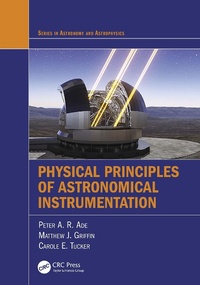
Physical Principles of Astronomical Instrumentation
1st Edition
Published on 15. November 2021
319 pages
978-1-4398-7190-4 (ISBN)
Description

Offering practical advice on a range of wavelengths, this highly accessible and self-contained book presents a broad overview of astronomical instrumentation, techniques, and tools.
Drawing on the notes and lessons of the authors' established graduate course, the text reviews basic concepts in astrophysics, spectroscopy, and signal analysis. It includes illustrative problems and case studies and aims to provide readers with a toolbox for observational capabilities across the electromagnetic spectrum and the knowledge to understand which tools are best suited to different observations. It is an ideal guide for undergraduates and graduates studying astronomy.
Features:
Presents a self-contained account of a highly complex subject.
Offers practical advice and instruction on a wide range of wavelengths and tools.
Includes case studies and problems for further learning opportunities.
Solutions Manual available upon qualifying course adoption.
Drawing on the notes and lessons of the authors' established graduate course, the text reviews basic concepts in astrophysics, spectroscopy, and signal analysis. It includes illustrative problems and case studies and aims to provide readers with a toolbox for observational capabilities across the electromagnetic spectrum and the knowledge to understand which tools are best suited to different observations. It is an ideal guide for undergraduates and graduates studying astronomy.
Features:
Presents a self-contained account of a highly complex subject.
Offers practical advice and instruction on a wide range of wavelengths and tools.
Includes case studies and problems for further learning opportunities.
Solutions Manual available upon qualifying course adoption.
More details
Series
Edition
1. Auflage
Language
English
Place of publication
Baton Rouge
United States
Publishing group
Taylor & Francis Inc
Target group
College/higher education
Professional and scholarly
Illustrations
6 Tables, black and white; 1 Line drawings, color; 236 Line drawings, black and white; 11 Halftones, color; 4 Halftones, black and white; 12 Illustrations, color; 240 Illustrations, black and white
ISBN-13
978-1-4398-7190-4 (9781439871904)
Copyright in bibliographic data and cover images is held by Nielsen Book Services Limited or by the publishers or by their respective licensors: all rights reserved.
Schweitzer Classification
Other editions
Additional editions
Peter A. R. Ade | Matthew J. Griffin | Carole E. Tucker
Physical Principles of Astronomical Instrumentation
Book
01/2024
1st Edition
CRC Press
€94.40
Shipment within 10-20 days
Peter A. R. Ade | Matthew J. Griffin | Carole E. Tucker
Physical Principles of Astronomical Instrumentation
Book
11/2021
1st Edition
CRC Press
€193.40
Shipment within 15-20 days
Persons
Professor Peter A. R. Ade
Professor Peter Ade received his PhD from Queen Mary College, London, in 1973, where he continued to build up a submillimetre wave instrumentation group specialising in producing state-of-the-art instruments for use in both atmospheric and astronomical research. In 2001 he relocated to Cardiff with other colleagues to form a larger instrumentation group. He is a member of the Royal Astronomical Society and is a chartered physicist with the Institute of Physics. He has over forty years' experience in instrumentation design and manufacture whilst pursuing his observational astrophysics and atmospheric science interests. He has been involved with the development and deployment of many astronomical instruments including ISO-LWS, Cassini-CIRS, Mars-PMIRR, SPT-pol, ACT-pol, EBEX, Pilot, BLAST, SCUBA, SCUBA-2, Spitzer, Herschel-SPIRE and Planck-HFI). In 1994 he was awarded a NASA public service medal for his contributions to fundamental advances in far infrared detector and sensor systems, which enabled critical measurements of atmospheric ozone chemistry. In 2009 he was presented with the Royal Astronomical Society Jackson-Gwilt Medal for contributions to astronomical instrumentation.
Professor Matt Griffin
Professor Matt Griffin studied Electrical Engineering at University College Dublin and Astrophysics at Queen Mary College London, receiving his PhD in 1985. His research work has included the development of instruments for both ground-based and space-borne observatories, and their use in the study of planetary atmospheres, star formation, galaxy evolution. He remained at Queen Mary until 2001, and was involved in various ground-based submillimetre instruments and in ESA's Infrared Space Observatory. Since 2001, he has been with the Astronomy Instrumentation Group at Cardiff University. As well as participating in the SCUBA, SCUBA-2, and Planck-HFI instruments, he was the Principal Investigator for the Herschel-SPIRE satellite instrument, for which he was awarded the Royal Astronomical Society Jackson-Gwilt Medal in 2011. He is a Fellow if the Institute of Physics and a Fellow of the Learned Society of Wales.
Professor Carole Tucker
Professor Carole Tucker studied Physics and Maths at Reading University, then Medical Radiation Physics at Queen Mary and Westfield College, London, completing her PhD in 2001. Having undertaken a great deal of cleanroom device fabrication and spectroscopy work, she took her first post-doctoral position with the Astronomy Instrumentation Group at QMW, working on hardware provision and characterisation for the Herschel and Planck satellite missions. In 2001 she moved with the instrumentation group to Cardiff University, where she took her first academic position in 2006. Carole manages the quasi-optical filter production facility at Cardiff, which leads to involvement with a great number of international FIR space and ground-based instrument teams. In addition she works with industry, supplying technology to scientific disciplines outside of astronomy. She is a Fellow of the Institute of Physics, the Royal Astronomical Society and of the Learned Society of Wales.
Professor Peter Ade received his PhD from Queen Mary College, London, in 1973, where he continued to build up a submillimetre wave instrumentation group specialising in producing state-of-the-art instruments for use in both atmospheric and astronomical research. In 2001 he relocated to Cardiff with other colleagues to form a larger instrumentation group. He is a member of the Royal Astronomical Society and is a chartered physicist with the Institute of Physics. He has over forty years' experience in instrumentation design and manufacture whilst pursuing his observational astrophysics and atmospheric science interests. He has been involved with the development and deployment of many astronomical instruments including ISO-LWS, Cassini-CIRS, Mars-PMIRR, SPT-pol, ACT-pol, EBEX, Pilot, BLAST, SCUBA, SCUBA-2, Spitzer, Herschel-SPIRE and Planck-HFI). In 1994 he was awarded a NASA public service medal for his contributions to fundamental advances in far infrared detector and sensor systems, which enabled critical measurements of atmospheric ozone chemistry. In 2009 he was presented with the Royal Astronomical Society Jackson-Gwilt Medal for contributions to astronomical instrumentation.
Professor Matt Griffin
Professor Matt Griffin studied Electrical Engineering at University College Dublin and Astrophysics at Queen Mary College London, receiving his PhD in 1985. His research work has included the development of instruments for both ground-based and space-borne observatories, and their use in the study of planetary atmospheres, star formation, galaxy evolution. He remained at Queen Mary until 2001, and was involved in various ground-based submillimetre instruments and in ESA's Infrared Space Observatory. Since 2001, he has been with the Astronomy Instrumentation Group at Cardiff University. As well as participating in the SCUBA, SCUBA-2, and Planck-HFI instruments, he was the Principal Investigator for the Herschel-SPIRE satellite instrument, for which he was awarded the Royal Astronomical Society Jackson-Gwilt Medal in 2011. He is a Fellow if the Institute of Physics and a Fellow of the Learned Society of Wales.
Professor Carole Tucker
Professor Carole Tucker studied Physics and Maths at Reading University, then Medical Radiation Physics at Queen Mary and Westfield College, London, completing her PhD in 2001. Having undertaken a great deal of cleanroom device fabrication and spectroscopy work, she took her first post-doctoral position with the Astronomy Instrumentation Group at QMW, working on hardware provision and characterisation for the Herschel and Planck satellite missions. In 2001 she moved with the instrumentation group to Cardiff University, where she took her first academic position in 2006. Carole manages the quasi-optical filter production facility at Cardiff, which leads to involvement with a great number of international FIR space and ground-based instrument teams. In addition she works with industry, supplying technology to scientific disciplines outside of astronomy. She is a Fellow of the Institute of Physics, the Royal Astronomical Society and of the Learned Society of Wales.
Content
1. Review of Electromagnetic Radiation. 2. Astrophysical Radiation. 3. Interaction of Electromagnetic Radiation with Matter. 4. Telescopes and Optical Systems. 5. Key Concepts in Astronomical Measurement. 6. Sensitivity and Noise in Electromagnetic Detection. 7. Astronomical Spectroscopy. 8. Radio Instrumentation. 9. Far Infrared to Millimetre Wavelength Instrumentation. 10. Infrared to UV Instrumentation. 11 X-ray, -ray and Astro-particle Detection.
