

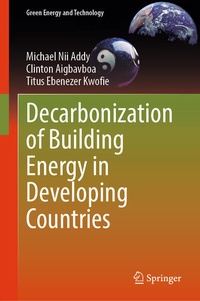
Decarbonization of Building Energy in Developing Countries
Description

This book focuses on the demand side approach in building decarbonisation within the context of developing countries. This book is embedded within the poverty-urbanisation framework and provides understanding of the unique challenges faced by developing countries. It provides key pathways for decarbonising the demand side of building energy in developing economies.
This book is divided into five parts. The first part provides introduction to the building energy industry within the developing context and a backdrop on decarbonisation. This establishes the main theme as well the key concepts that will undergird the discussion of the pathways within the book. The second part delves into building design and various elements that influence building decarbonisation at the design stage. The third part explores the building material and looks at local sustainable materials, emerging circular materials and various indigenous construction methods. The fourth part looks at the array of renewable technologies available, the challenges and the level of uptake. Further, it proffers solutions on increasing their usage within the developing country context. The final part goes into issues related with building assessment, building regulations and urbanisation.
This book provides a guide for emerging countries' demand-side decarbonisation of building energy.
More details
Other editions
Additional editions
Persons
Michael Nii Addy is a senior lecturer at the Kwame Nkrumah University of Science and Technology (KNUST) in Ghana. Michael is currently a senior research associate at the Sustainable Human Settlement and Construction Research Centre at the University of Johannesburg in South Africa. He holds a Ph.D. in Building Technology from KNUST and a Master of Science in Building Services Engineering from Loughborough University, UK. His areas of specialisation include building energy modelling, thermal comfort, building performance measurements and digital construction. His studies focus more on emerging countries particularly in Africa and explores the unique characteristics affecting sustainable development. He has served as a reviewer for several national and international journals and conferences. His global experience in building technology and training includes working as a visiting academic at Loughborough University, UK, and Linnaeus University, Sweden.
Clinton Aigbavboa, a distinguished professor and scholar with over 18 years of experience in the Built Environment and Construction sectors, is a professor of Sustainable Construction Digitalisation & Construction Industry Research at the University of Johannesburg. He holds a Ph.D. in Engineering Management, a Master's in Construction Management, and certifications in Good Governance and Artificial Intelligence from MIT. He has authored 39 research books, co-authored 12 edited books, and published over 1000 accredited journal articles and conference papers. As the director of the Sustainable Human Settlement and Construction Research Centre and an acting director of the South Africa Research Chair for Sustainable Construction Management, Prof. Aigbavboa has graduated over 230 Master's and 90 Ph.D. students. His research interests include Construction 4.0, smart cities, sustainable human development, and digitalisation in construction. Prof. Aigbavboa's extensive expertise, leadership roles, and prolific publication record make him ideally suited to author the proposed book on Decarbonization of building energy in Developing Countries: Pathways for Demand side management in developing economies.
Titus Ebenezer Kwofie is a chartered architect by profession and a senior lecturer at the Kwame Nkrumah University of Science and Technology (KNUST) in Kumasi Ghana. Before joining the Department of Architecture, he served as the director of works at the Koforidua Polytechnic (now Koforidua Technical University). He is currently a senior research associate at the Sustainable Human Settlement and Construction Research Centre at the University of Johannesburg in South Africa. He shares research interest in sustainable housing delivery, project team communication and managerial efficiency. This has culminated into various research outputs that have been published in high impact journals and presentation in indexed conferences. He also serves as a regular reviewer for various EMERALD, ASCE, Elsevier, Taylor & Frances and Springer built environment journals.
Content
General Introduction.- Climate Responsive Building Design.- Building Energy Simulation And Energy Decarbonisation.- Thermal Comfort.- Daylighting.- Building Occupancy And Management.- Local Sustainable Materials And Circularity.- Emerging Circular Materials.- Indigenous Construction Methods And Appropriate Technology.- Renewable: Solar Energy.
