

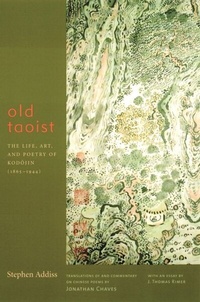
Old Taoist
The Life, Art, and Poetry of Kodojin (1865-1944)
1st Edition
Published on 23. September 2020
208 pages
978-0-231-50400-3 (ISBN)
Description

No detailed description available for "Old Taoist".
More details
Other editions
Additional editions

Stephen Addiss | Jonathan Chaves | J. Thomas Rimer
Old Taoist
The Life, Art and Poetry of Kodojin (1865-1944)
Book
03/2000
Columbia University Press
€76.88
Article exhausted; check different version
Persons
Stephen Addiss is Tucker-Boatwright Professor in the Humanities in the Department of Art at the University of Richmond. His many books include The Art of Zen: Paintings and Calligraphy by Japanese Monks 1600-1925 and How to Look at Japanese Art.
Jonathan Chaves is professor and chair of the Department of East Asian Languages and Literatures at George Washington University. He is the editor and translator of many works, including The Columbia Book of Later Chinese Poetry, and is the coauthor, with J. Thomas Rimer, of Japanese and Chinese Poems to Sing (Columbia 1998).
J. Thomas Rimer is chairman of the Department of East Asian Languages and Literatures at the University of Pittsburgh. His many works include Modern Japanese Fiction and Its Traditions: An Introduction, and he is the coauthor, with Jonathan Chaves, of Japanese and Chinese Poems to Sing (Columbia 1998).
Jonathan Chaves is professor and chair of the Department of East Asian Languages and Literatures at George Washington University. He is the editor and translator of many works, including The Columbia Book of Later Chinese Poetry, and is the coauthor, with J. Thomas Rimer, of Japanese and Chinese Poems to Sing (Columbia 1998).
J. Thomas Rimer is chairman of the Department of East Asian Languages and Literatures at the University of Pittsburgh. His many works include Modern Japanese Fiction and Its Traditions: An Introduction, and he is the coauthor, with Jonathan Chaves, of Japanese and Chinese Poems to Sing (Columbia 1998).
Content
Preface and Acknowledgments
1. Kodojin's Life and Art
2. Kodojin's Japanese Poetry
3. Kodojin and the T'ao Ch'ien Tradition in Kanshi Poetry, by Jonathan Chaves
4. Kodojin's Chinese Poetry, translated by Jonathan Chaves
5. A Note on Kodojin and the Art and Literature of His Period, by J. Thomas Rimer
Epilogue
Notes
Index
1. Kodojin's Life and Art
2. Kodojin's Japanese Poetry
3. Kodojin and the T'ao Ch'ien Tradition in Kanshi Poetry, by Jonathan Chaves
4. Kodojin's Chinese Poetry, translated by Jonathan Chaves
5. A Note on Kodojin and the Art and Literature of His Period, by J. Thomas Rimer
Epilogue
Notes
Index
