

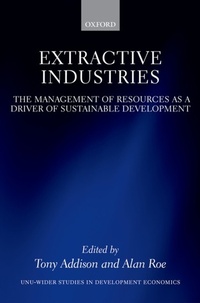
Extractive Industries
The Management of Resources as a Driver of Sustainable Development
1st Edition
Published on 19. September 2018
704 pages
978-0-19-254955-6 (ISBN)
Description

This is an open access title available under the terms of a CC BY-NC-SA 3.0 IGO licence. It is free to read at Oxford Scholarship Online and offered as a free PDF download from OUP and selected open access locations. New initiatives recognize that resource wealth can provide a means, when properly used, for poorer nations to decisively break with poverty by diversifying economies and funding development spending. Extractive Industries: The Management of Resources as a Driver of Sustainable Development explores the challenges and opportunities facing developing countries in using oil, gas, and mining to achieve inclusive change.
While resource wealth can yield prosperity it can also, when mismanaged, cause acute social inequality, deep poverty, environmental damage, and political instability. There is a new determination to improve the benefits of extractive industries to their host countries, and to strengthen the sector's governance. Extractive Industries provides a comprehensive contribution to what must be done in this sector to deliver development, protect often fragile environments from damage, enhance the rights of affected communities, and support climate change action. It brings together international experts to offer ideas and recommendations in the main policy areas. With a breadth of collective insight and experience, it argues that more attention must be given to the development role of extractive industries, and looks to the future to explain how action on climate change will profoundly shape the sector's prospects.
More details
Other editions
Additional editions
Tony Addison | Alan Roe
Extractive Industries
The Management of Resources as a Driver of Sustainable Development
Book
10/2018
Oxford University Press
€143.10
Shipment within 15-20 days
Persons
Tony Addison is the Chief Economist/Deputy Director of the United Nations University's World Institute for Development Economics Research (UNU-WIDER) in Helsinki, Finland. He was previously Professor of Development Studies at the University of Manchester, Executive Director of the Brooks World Poverty Institute (BWPI) at the University of Manchester, and Associate Director of the Chronic Poverty Research Centre (CPRC). He has also held positions at the University of Warwick, the School of Oriental and African Studies (London University), and the Overseas Development Institute (London). He has published widely in books and journals on the issues of post-conflict reconstruction, debt relief, fiscal policy, poverty dynamics, development finance, and foreign aid.
Alan Roe has worked for more than 45 years as an academic economist and as a policy adviser. Early in his career he was a research economist at the University of Dar-es-Salaam and then at the University of Cambridge (Economic Growth Project) and later a Visiting Professor of Economics at Washington University in the USA. He then taught economics for many years at the University of Warwick where he was also for a period the Chairman of Department. In 1994 he was appointed Principal Economist at the World Bank where he worked for 7 years. After retiring from the Bank in 2000, he returned part-time to Warwick University but also joined Oxford Policy Management (OPM) as Principal Economist and a Board Director. In this capacity he helped to initiate OPM's involvement in natural resources issues. Now retired he remains as a Senior Associate at both OPM and the University of Warwick and a Senior Non-Resident Research Fellow at UNU-WIDER.
Content
- Part I: Overview
- 1: Tony Addison and Alan Roe: Extractives for development: introduction and ten main messages
- Part II: Minerals and Oil and Gas in the Global Context
- 2: Alan Roe and Samantha Dodd: Dependence on extractive industries in lower-income countries: the statistical tendencies
- 3: Magnus Ericsson and Olof Löf: Mining's contribution to low- and middle-income economies
- 4: Paul Stevens: The role of oil and gas in the economic development of the global economy
- Part III: The Academic Literature and the Resources Curse
- 5: Glada Lahn and Paul Stevens: The curse of the one-size-fits-all fix: re-evaluating what we know about extractives and economic development
- 6: Evelyn Dietsche: Political economy and governance
- 7: Evelyn Dietsche: New industrial policy and the extractive industries
- Part IV: Policy Challenges in the Macro-Management of Extractives
- 8: Mark Henstridge and Alan Roe: The macroeconomic management of natural resources
- 9: Frederick van der Ploeg and Anthony J. Venables: Extractive revenues and government spending: short- versus long-term considerations
- 10: Andres Solimano and Diego Calderón Guajardo: The copper sector, fiscal rules, and stabilization funds in Chile: scope and limits
- 11: Mahamudu Bawumia and Håvard Halland: Oil discovery and macroeconomic management: The recent Ghanaian experience
- Part V: National Institutions of Extractives Management
- 12: Tony Addison and Alan Roe: The regulation of extractives: an overview
- 13: Toni Aubynn: Regulatory structures and challenges to developmental extractives: Some practical observations from Ghana
- 14: James M. Otto: The taxation of extractive industries: mining
- 15: Patrick R.P. Heller: Doubling down: national oil companies as instruments of risk and reward
- 16: Ruth Greenspan Bell: Protecting the environment during and after resource extraction
- 17: Kathryn McPhail: Enhancing sustainable development from oil, gas, and mining: from an 'all of government' approach to Partnerships for Development
- Part VI: International Regulatory Concerns and Structures
- 18: R. Anthony Hodge: Towards contribution analysis
- 19: James Cust: The role of governance and international norms for managing natural resources
- 20: Kathryn Tomlinson: Oil and gas companies and the management of social and environmental impacts and issues: the evolution of the industry's approach
- 21: Catherine Macdonald: The role of gender in the extractive industries
- 22: Tony Addison: Climate change and the extractives sector
- Part VII: Leveraging the Direct Impacts of Extractives Into Sustainable Development
- 23: Alan Roe and Jeffery Round: Framework: the channels for indirect impacts
- 24: Olle Östensson: Local content, supply chains, and shared infrastructure
- 25: Olle Östensson and Anton Löf: Downstream activities: the possibilities and the realities
- 26: Sophie Witter and Maja Jakobsen: Choices for spending government revenue: new African oil, gas, and mining economies
- 27: Joanna Buckley, Neil McCulloch, and Nicholas Travis: Donor-supported approaches to improving extractives governance: lessons from Nigeria
- Part VIII: Capturing Economic and Social Benefits at Community Level
- 28: Catherine McDonald: The role of participation in sustainable community development programmes in the extractives industries
- 29: Angel Mondoloka: Approaches to supporting local and community development: the view from Zambia
- 30: Liesel Filgueiras, Andreia Rabetim, and Isabel Aché: Approaches to supporting local and community development: Brazil and the Vale SA model of corporate interaction
- 31: Keith Slack: Capturing economic and social benefits at the community level: opportunities and obstacles for civil society
- 32: James M. Otto: How do we legislate for improved community development?
- 33: Tony Addison and Alan Roe: Conclusions
