

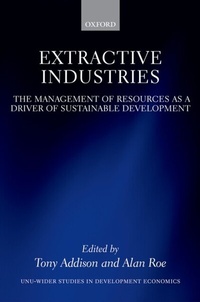
Extractive Industries
The Management of Resources as a Driver of Sustainable Development
1st Edition
Published on 22. October 2018
704 pages
978-0-19-254954-9 (ISBN)
Description

This is an open access title available under the terms of a CC BY-NC-SA 3.0 IGO licence. It is free to read at Oxford Scholarship Online and offered as a free PDF download from OUP and selected open access locations. New initiatives recognize that resource wealth can provide a means, when properly used, for poorer nations to decisively break with poverty by diversifying economies and funding development spending. Extractive Industries: The Management of Resources as a Driver of Sustainable Development explores the challenges and opportunities facing developing countries in using oil, gas, and mining to achieve inclusive change.
While resource wealth can yield prosperity it can also, when mismanaged, cause acute social inequality, deep poverty, environmental damage, and political instability. There is a new determination to improve the benefits of extractive industries to their host countries, and to strengthen the sector's governance. Extractive Industries provides a comprehensive contribution to what must be done in this sector to deliver development, protect often fragile environments from damage, enhance the rights of affected communities, and support climate change action. It brings together international experts to offer ideas and recommendations in the main policy areas. With a breadth of collective insight and experience, it argues that more attention must be given to the development role of extractive industries, and looks to the future to explain how action on climate change will profoundly shape the sector's prospects.
More details
Other editions
Additional editions
Tony Addison | Alan Roe
Extractive Industries
The Management of Resources as a Driver of Sustainable Development
Book
10/2018
Oxford University Press
€143.10
Shipment within 15-20 days
Persons
Tony Addison is the Chief Economist/Deputy Director of the United Nations University's World Institute for Development Economics Research (UNU-WIDER) in Helsinki, Finland. He was previously Professor of Development Studies at the University of Manchester, Executive Director of the Brooks World Poverty Institute (BWPI) at the University of Manchester, and Associate Director of the Chronic Poverty Research Centre (CPRC). He has also held positions at the University of Warwick, the School of Oriental and African Studies (London University), and the Overseas Development Institute (London). He has published widely in books and journals on the issues of post-conflict reconstruction, debt relief, fiscal policy, poverty dynamics, development finance, and foreign aid.
Alan Roe has worked for more than 45 years as an academic economist and as a policy adviser. Early in his career he was a research economist at the University of Dar-es-Salaam and then at the University of Cambridge (Economic Growth Project) and later a Visiting Professor of Economics at Washington University in the USA. He then taught economics for many years at the University of Warwick where he was also for a period the Chairman of Department. In 1994 he was appointed Principal Economist at the World Bank where he worked for 7 years. After retiring from the Bank in 2000, he returned part-time to Warwick University but also joined Oxford Policy Management (OPM) as Principal Economist and a Board Director. In this capacity he helped to initiate OPM's involvement in natural resources issues. Now retired he remains as a Senior Associate at both OPM and the University of Warwick and a Senior Non-Resident Research Fellow at UNU-WIDER.
Content
- Cover
- Extractive Industries: The Management of Resources as a Driver of Sustainable Development
- Copyright
- Dedication
- Foreword
- Preface
- Acknowledgements
- Contents
- List of Figures
- List of Tables
- List of Abbreviations
- Notes on Contributors
- Part I: Overview
- 1: Extractives for Development: Introduction and Ten Main Messages
- 1.1 Introduction
- 1.1.1 This Book
- 1.2 The Main Messages of This Book
- 1.2.1 Message 1: Extractive Industries Are Important in Developing Economies and Will Remain Important
- 1.2.2 Message 2: Developing Economies Have Great Potential to Develop their Extractive Resources Further
- 1.2.3 Message 3: Strategies Should Be Guided by Realism: Neither Euphoria Nor Despair Is Helpful
- 1.2.4 Message 4: Diversifying Economies Is Critical, But Hard to Achieve
- 1.2.5 Message 5: Better Institutions Are Vital to Success But Technocratic Institution-building Has its Limitations
- 1.2.6 Message 6: Effective and Inclusive Government Working with Enlightened Companies Is the Ideal Combination. Ineffective and Divisive Government Combined with Rogue Companies Is the Worst
- 1.2.7 Message 7: Delivering Effective and Inclusive Governance Is Vital to Improving Outcomes in the Extractives Sector
- 1.2.8 Message 8: Improving the Practices of Companies Can Now Draw upon a Great Deal of Accumulated Experience
- 1.2.9 Message 9: There Are Now Many More Ways in Which Interventions by External Stakeholders, Especially Aid Donors, Can Improve Outcomes
- 1.2.10 Message 10: Climate Action Will Create New Winners and New Losers among the Extractives Sectors
- 1.3 Conclusions
- References
- Part II: Minerals and Oil and Gas in the Global Context
- 2: Dependence on Extractive Industries in Lower-income Countries: The Statistical Tendencies
- 2.1 Introduction
- 2.2 Current Levels of Dependence on Extractives
- 2.2.1 Minerals
- 2.2.2 Oil and Gas
- 2.3 Changes in Extractives Dependence since 1996
- 2.4 The Impact of the End of the Commodity Price Cycle
- 2.5 Implications of High Extractives Dependence
- 2.5.1 Short-term Consequences
- 2.5.2 The Longer-term Perspective
- 2.6 Conclusions
- References
- 3: Mining's Contribution to Low- and Middle-income Economies
- 3.1 Introduction
- 3.2 Methodology
- 3.2.1 Mining Contribution Index WIDER
- 3.2.2 Indicators
- 3.2.2.1 EXPORTS
- 3.2.2.2 VALUE OF MINE PRODUCTION
- 3.2.2.3 MINERAL RENTS
- 3.2.2.4 EXPLORATION
- 3.2.3 Calculation
- 3.3 Current Levels of Mining Contribution to National Economies
- 3.3.1 Country Rankings
- 3.3.2 Value of Mine Production
- 3.3.2.1 CHANGE OF MINING CONTRIBUTION OVER TIME, 1996-2014
- 3.3.3 Export Contribution
- 3.3.4 Exploration
- 3.3.5 Mineral Rents
- 3.3.6 Other Factors
- 3.3.6.1 GOVERNMENT REVENUES FROM MINING
- 3.3.6.2 EMPLOYMENT
- 3.4 Changes in MCI-W since 1996
- 3.5 The Impact of the End of the Super-cycle
- 3.6 Future Implications of Extractives Dependency
- 3.7 Conclusions
- 3.7.1 Contribution of Mining Industries in Low- and Middle-income Countries
- 3.7.2 Change in Contribution over the Past Twenty Years
- 3.7.3 Impact of the End of the Super-cycle
- References
- 4: The Role of Oil and Gas in the Economic Development of the Global Economy
- 4.1 Introduction
- 4.1.1 Recent History
- 4.1.1.1 AS A FACTOR INPUT
- 4.1.1.2 IN GLOBAL TRADE
- 4.1.1.3 PRICES AND THE MACRO ECONOMY
- 4.1.1.4 GEOPOLITICS AND THEIR ECONOMIC IMPACT
- 4.2 Current Conventional Views of the Future for Oil and Gas
- 4.3 Drivers of Future Trends: What Economic and Technical Factors Might Derail Conventional Views of the Future?
- 4.3.1 Technology
- 4.3.2 Incomes
- 4.3.3 Energy Pricing
- 4.3.4 Climate Change Policies
- 4.4 Drivers of Future Trends: How Geopolitics May Derail the Conventional Views of the Future
- 4.5 Conclusions
- References
- Part III: The Academic Literature and the Resources Curse
- 5: The Curse of the One-size-fits-all Fix: Re-evaluating What We Know about Extractives and Economic Development
- 5.1 Introduction
- 5.2 An Evolution in Thinking about the Use of Extractive Resources for Economic Growth
- 5.3 The Extractives-led Growth Agenda Emerges
- 5.3.1 Has the Remedy Worked?
- 5.4 What Are the Extractives-led Development Narrative's Flaws?
- 5.4.1 There Is a Tendency to Prescribe a One-size-fits-all Solution
- 5.4.2 Political and Psychological Impacts Can Overpower Attempts at Good Governance
- 5.4.3 Development Is Too Rapid
- 5.5 Considerations for Revising the Advice to Producers
- 5.5.1 Diversification as Key
- 5.5.2 Understanding Linkages-and their Limitations
- 5.5.3 The Pace of Development Matters
- 5.5.4 Alternative Measures of Performance and Models of Development Overlooked
- 5.6 Conclusions
- References
- 6: Political Economy and Governance
- 6.1 Introduction
- 6.2 The Political Economy of Extractive Resources and Institutions
- 6.2.1 Explaining Negative Outcomes
- 6.2.2 Explaining Variance in Outcomes
- 6.2.2.1 STRUCTURAL EXPLANATIONS
- 6.2.2.2 STRUCTURAL CHARACTERISTICS
- 6.2.3 Guiding Policy Interventions
- 6.3 What Are Institutions?
- 6.3.1 Taking Stock of Institutional Analyses
- 6.3.2 Gaps in Knowledge
- 6.3.2.1 HOW INSTITUTIONS CONNECT ACROSS THE LEVELS
- 6.3.2.2 INSTITUTIONAL CHANGE AND HOW INSTITUTIONS EVOLVE
- 6.3.2.3 HOW TO BRING ABOUT POSITIVE INSTITUTIONAL CHANGE
- 6.3.2.4 BUREAUCRACY AND STATE CAPACITY
- 6.3.3 Application to the Extractive Resources Sector
- 6.3.4 Gaps in Knowledge Applied to the Extractive Resources Sector
- 6.3.4.1 HOW DO INSTITUTIONS CONNECT ACROSS THE LEVELS?
- 6.3.4.2 INSTITUTIONAL CHANGE: HOW DO INSTITUTIONS EVOLVE?
- 6.3.4.3 BRINGING ABOUT POSITIVE INSTITUTIONAL CHANGE: WHERE ARE THE LEVERS?
- 6.3.4.4 WHAT ROLE DOES STATE CAPACITY PLAY?
- 6.4 Discussion
- 6.5 Summary
- References
- 7: New Industrial Policy and the Extractive Industries
- 7.1 Introduction
- 7.2 The Case for Industrial Policy
- 7.2.1 The Risks of 'State Failure'
- 7.2.2 Industrial Policy as a Discovery and Learning Process
- 7.2.3 Setting and Pursuing Socio-economic Objectives
- 7.2.4 Improving Productivity
- 7.2.5 Building Comparative Institutional Advantages
- 7.2.6 The Political Economy of Transaction Costs and Institutional Change
- 7.3 Industrial Policy and the Extractives-led Development Agenda
- 7.3.1 The Unfulfilled Promise of State-led Industrialization
- 7.3.2 Sector Liberalization in the Ascendant
- 7.3.3 The Promise of the Extractives-led Development Agenda
- 7.4 What Next on New Industrial Policy and Extractives-led Development?
- 7.4.1 A Positive Role for the Extractive Industries
- 7.4.2 Much Theory, Less Practice
- 7.4.3 Local Content as Industrial Policy
- 7.4.4 Secondary Impacts of International Environmental and Social Policies
- 7.5 Conclusions
- References
- Part IV: Policy Challenges in the Macro-management of Extractives
- 8: The Macroeconomic Management of Natural Resources
- 8.1 Introduction
- 8.2 The Nature of the Basic Problem
- 8.3 Macroeconomic Management and Dutch Disease
- 8.4 Fiscal Policy as the Main Instrument
- 8.5 The Hierarchy of Fiscal Policy Choices
- 8.6 Early-stage Borrowing
- 8.7 To Spend or to Save?
- 8.8 To Invest or to Consume?
- 8.9 Where Should Any Financial Savings Be Placed?
- 8.10 Chapters 9, 10, and 11
- References
- 9: Extractive Revenues and Government Spending: Short- versus Long-term Considerations
- 9.1 Introduction
- 9.2 Inter-temporal Efficiency and the Present Value Budget Constraint
- 9.3 Benchmark Management of Windfalls: The Permanent Income Hypothesis
- 9.4 The Case for Investing Resource Windfalls in the Domestic Economy
- 9.4.1 Using the Resource Windfall for Domestic Investment and Foreign Assets
- 9.4.2 Capital Scarcity and the Optimal Choice between Saving and Consumption
- 9.5 Absorption Constraints and the Case for a Parking Fund
- 9.6 Volatility of Commodity Prices and the Case for a Stabilization Fund
- 9.7 Conclusions
- Appendix: Optimization Problem in the Presence of Capital Scarcity
- References
- 10: The Copper Sector, Fiscal Rules, and Stabilization Funds in Chile: Scope and Limits
- 10.1 Introduction
- 10.2 Brief Historical Background of a Mineral-exporting Economy and Cycles Related to the Copper Sector
- 10.2.1 The Copper Sector, Policy Shocks, and Macroeconomic Cycles
- 10.3 The Evolving Institutional Framework of the Mining Sector: The Cycle of Foreign Ownership, Nationalization, and de facto Privatization
- 10.4 A Macroeconomic Perspective: Orthodoxy, Fiscal Rule, and Stabilization Funds
- 10.4.1 Asset Management of SWFs
- 10.4.2 Macroeconomic Effects: Growth Volatility and Country Risk Reductions
- 10.5 Conclusions
- References
- 11: Oil Discovery and Macroeconomic Management: The Recent Ghanaian Experience
- 11.1 Introduction
- 11.2 Ghana before Oil
- 11.3 Discovery of Oil
- 11.4 Deterioration of Public Finances
- 11.5 Rising Levels of Public Debt
- 11.6 Declining Capital Expenditure
- 11.7 Declining Real GDP Growth
- 11.8 Corruption, Post-discovery
- 11.9 Ghana's Political System in the Context of Oil
- 11.10 What Could Ghana Have Done Differently?
- 11.10.1 Anchoring Fiscal Discipline
- 11.10.2 Fiscal Rules and Budget Institutions
- 11.10.3 Anchoring Monetary Discipline
- 11.10.4 Bank of Ghana Act and Central Bank Independence
- 11.10.5 Transparency
- 11.10.6 Strengthening the Law on the Management of Oil Revenues
- 11.10.7 Forecasting Government Oil Revenues
- 11.11 Conclusions
- References
- Part V: National Institutions of Extractives Management
- 12: The Regulation of Extractives: An Overview
- 12.1 The Basic Frameworks
- 12.2 The Regulatory Challenge in Low-income Countries
- 12.3 Outline of Part V
- References
- 13: Regulatory Structures and Challenges to Developmental Extractives: Some Practical Observations from Ghana
- 13.1 Introduction and Background
- 13.2 The Role of Regulatory Structures in Mineral Resource Development
- 13.3 Trajectory of Mining Regulations in Ghana
- 13.4 The Regulatory Structures of the 1980s and Beyond
- 13.4.1 Mining Legislation
- 13.4.2 Investment
- 13.5 Contribution and Benefits Stream
- 13.5.1 Capital Injection and Production of Minerals
- 13.5.1.1 DOMESTIC REVENUE GENERATION
- 13.5.1.2 FOREIGN EXCHANGE
- 13.5.1.3 EMPLOYMENT GENERATION
- 13.5.2 Local Content: The Evolution of Regulatory Approaches
- 13.5.2.1 THE STATE OF IMPLEMENTATION
- 13.6 Key Regulatory Challenges
- 13.6.1 Multiple Regulations and Inter-institutional Conflicts
- 13.6.2 Capacity of Regulators
- 13.6.3 Political Will and Interference
- 13.6.4 The Balancing Act of Dealing with Large-scale Multinational and Local Small-scale Mining Sectors
- 13.7 Conclusions
- References
- 14: The Taxation of Extractive Industries: Mining
- 14.1 Mineral Taxation: A General Overview
- 14.1.1 Introduction
- 14.1.2 Mineral Rents
- 14.1.3 Evolution of Mineral Taxation Schemes
- 14.1.4 Revenue Distribution
- 14.1.5 Special Aspects of the Mining Industry and the Tax Policy Response
- 14.1.6 Transparency
- 14.1.7 Revenue Stabilization Funds
- 14.1.8 Sovereign Wealth Funds
- 14.1.9 Double Taxation Treaties
- 14.2 Direct Taxes and Indirect Taxes
- 14.2.1 Direct Taxes
- 14.2.2 Indirect Taxes
- 14.3 Tax Incentives and Income Tax Adjustments
- 14.4 Transfer Pricing and Other Tax Minimization Schemes
- 14.5 Conclusions
- References
- 15: Doubling Down: National Oil Companies as Instruments of Risk and Reward
- 15.1 Introduction
- 15.2 SOEs: Context and Core Characteristics
- 15.3 Analysing Risk and Reward
- 15.3.1 Key Choices and Lenses of Analysis
- 15.3.2 Categorization of Risks
- 15.3.2.1 COMMERCIAL/FINANCIAL RISK
- 15.3.2.2 GOVERNANCE RISKS
- 15.3.3 Assessment of Potential Rewards
- 15.3.4 Putting the Pieces Together
- 15.4 Mitigating Risks and Making Rewards More Likely to Materialize
- 15.5 Conclusions
- References
- 16: Protecting the Environment during and after Resource Extraction
- 16.1 Introduction: Resource Extraction Has High Potential for Immediate and Long-term Environmental Damage
- 16.2 Countries with Weak Institutions and Poor Success Rates in Addressing their Other Environmental Challenges Face Significant Challenges in Regulating Extraction
- 16.3 Commonly Used Approaches to Work around Domestic Legal, Institutional, and Experiential Deficiencies
- 16.3.1 How a Combination of Approaches Was Put to Work in a Liberian Mining Contract
- 16.3.2 How Effective Are Voluntary Standards for Improving Environmental Performance?
- 16.3.3 The Limits of CSR
- 16.3.4 Falling Commodity Prices: Some Consequences for Environmental Regulation
- 16.4 A Bigger Tool Box: Alternatives to Improve Environmental Performance in Extraction
- 16.5 Conclusions
- References
- 17: Enhancing Sustainable Development from Oil, Gas, and Mining: From an 'All of Government' Approach to Partnerships for Development
- 17.1 Overview
- 17.2 Evidence Base to Facilitate 'All of Government' Coordination
- 17.2.1 Context/Issue
- 17.2.2 Objectives
- 17.2.3 Action in Support of the Objectives
- 17.2.3.1 SHARED UNDERSTANDING OF THE EVIDENCE BASE
- 17.2.3.2 CROSS-GOVERNMENT COORDINATION
- 17.2.4 Early Results
- 17.2.4.1 RESULTS
- 17.2.4.2 CHALLENGES
- 17.3 Building Trust through Multi-stakeholder Dialogue
- 17.3.1 Context/Issue
- 17.3.2 Objectives
- 17.3.3 Action in Support of the Objectives
- 17.3.3.1 CREATE A NEUTRAL SPACE TO VOICE DIFFERENT PERSPECTIVES
- 17.3.3.2 IDENTIFY CHALLENGES AND OPPORTUNITIES
- 17.3.3.3 DEVELOP A SHARED UNDERSTANDING OF, AND ACCOUNTABILITY FOR, RESPONSIBLE INVESTMENT
- 17.3.4 Early Results
- 17.3.4.1 RESULTS
- 17.3.4.2 CHALLENGES
- 17.4 Partnerships for Development
- 17.4.1 Context/Issue
- 17.4.2 Objectives
- 17.4.3 Action in Support of the Objectives
- 17.4.3.1 ENHANCE ECONOMIC AND SOCIAL OUTCOMES BY FILLING GOVERNANCE CAPACITY GAPS
- 17.4.3.2 STRENGTHEN ACCOUNTABILITY
- 17.4.3.3 UNCOVER LOCAL CONTEXTUAL ISSUES
- 17.4.4 Early Results
- 17.4.4.1 RESULTS
- 17.4.4.2 CHALLENGES
- 17.5 Conclusions
- References
- Part VI: International Regulatory Concerns and Structures
- 18: Towards Contribution Analysis
- 18.1 Introduction
- 18.2 Conceptual Foundation
- 18.2.1 Substance
- 18.2.1.1 MEANS ASSESSMENT
- 18.2.1.2 ENDS ASSESSMENT
- 18.2.2 Process
- 18.3 Generic Assessment Cycle
- 18.3.1 Story
- 18.3.2 Measurement
- 18.3.3 Synthesis and Judgement
- 18.3.4 Communication
- 18.3.5 Explicitly Bringing Values into 'Technical' Assessment and Decision-making
- 18.3.6 Need for an Interdisciplinary Team
- 18.4 The Tough Challenge of Attribution
- 18.5 Steps towards Contribution Analysis
- 18.5.1 The 1997-2002 Assessment and Approval of the Labrador-based Voisey's Bay Nickel Project Based on Assessment of Projected Contribution to Sustainability
- 18.5.2 A First Nation's Assessment of Mining's Contribution: Past, Present, and Future
- 18.5.3 Strengthening Mining's Contribution to Poverty Alleviation
- 18.6 Progress Made, Progress Needed
- References
- 19: The Role of Governance and International Norms in Managing Natural Resources
- 19.1 Introduction
- 19.2 What Is the Rationale for Improving Governance in Resource-rich Economies?
- 19.2.1 The Emergence of Governance Initiatives
- 19.3 What Are the Governance Challenges Posed by Resource Wealth?
- 19.4 What Is the Rationale for Codes and Standards?
- 19.4.1 The Policy Makers' Dilemmas
- 19.5 What Is at Stake?
- 19.6 Examples of Codes and Standards
- 19.6.1 The Benefits of Transparency
- 19.6.2 Extractive Industries Transparency Initiative
- 19.6.2.1 HAS EITI HAD A POSITIVE IMPACT?
- 19.6.2.2 HAS EITI IMPROVED THE AVAILABILITY OF INFORMATION ABOUT PUBLIC REVENUE FROM EXTRACTIVE RESOURCES?
- 19.6.2.3 HOW HAS GOOD GOVERNANCE EVOLVED IN EITI ADOPTING COUNTRIES?
- 19.6.2.4 REFLECTING ON THE FIRST DECADE OF EITI
- 19.6.3 The Regulation of Conflict Minerals
- 19.6.4 Best Practices and Economic Policy Guides for Policy Makers
- 19.6.4.1 AFRICA MINING VISION
- 19.6.4.2 NATURAL RESOURCE CHARTER
- 19.7 Critical Reflections
- 19.7.1 Downsides of Codes and Standards
- 19.7.2 Looking Ahead
- References
- 20: Oil and Gas Companies and the Management of Social and Environmental Impacts and Issues: The Evolution of the Industry's Approach
- 20.1 Introduction
- 20.2 The Initial Industry Response
- 20.3 Laggards Catching Up: The Impact of International Standards
- 20.4 Environmental and Social Performance in the Industry Today: The Realities and Problems of Practice
- 20.5 Moving beyond Corporate Social Responsibility and Common Misunderstandings
- 20.6 Conclusions
- References
- 21: The Role of Gender in the Extractive Industries
- 21.1 Overview
- 21.1.1 Scope
- 21.1.2 Content
- 21.2 The Many Facets of Gender and the Extractive Industries
- 21.2.1 Women and Gender: What Do We Mean?
- 21.2.2 Aspects of Gender in the Extractives Sector
- 21.2.3 Gendered Impacts
- 21.2.4 Gender-based Violence and Sex Work
- 21.2.5 Women's Resistance to Extractives Projects
- 21.2.6 Industry Efforts towards Gender Balance
- 21.3 Conclusions
- References
- 22: Climate Change and the Extractives Sector
- 22.1 Introduction
- 22.2 Looking to the Energy Future
- 22.2.1 Natural Gas, Carbon Sequestration, and Energy Efficiency
- 22.2.2 Stranded Assets
- 22.2.3 Implications for Extractives Companies
- 22.3 Impact of a 'Net Zero-carbon' Future for Minerals and Metals
- 22.3.1 Supply Concerns
- 22.3.2 Development Impacts and Concerns
- 22.4 Conclusions
- References
- Part VII: Leveraging the Direct Impacts of Extractives into Sustainable Development
- 23: FrameworkThe Channels for Indirect Impacts
- 23.1 Introduction
- 23.2 Channels of Impact
- 23.3 Industry Channel: Downstream and Upstream Multiplier Effects
- 23.4 Estimates of Impact Multipliers for Mining Activity
- 23.4.1 Measuring the Size of Secondary Impacts
- 23.4.2 Input-Output (I-O) Modelling
- 23.4.3 CGE Modelling
- 23.4.4 Econometric Modelling
- 23.5 Public Spending Channel
- 23.5.1 Direct Impacts on Human Development
- 23.5.2 Indirect Effects via the Public Spending Channel
- 23.5.2.1 INVESTING IN INFRASTRUCTURE
- 23.5.2.2 INVESTING IN STRUCTURAL TRANSFORMATION AND ECONOMIC DIVERSIFICATION
- 23.6 Conclusions
- References
- 24: Local Content, Supply Chains, and Shared Infrastructure
- 24.1 Introduction
- 24.2 Scope and Background
- 24.3 Local Procurement: The Corporate Perspective
- 24.3.1 Corporate Procurement
- 24.3.2 Supplier Development
- 24.3.3 Some Conclusions
- 24.4 Policies for Influencing Supply Chains
- 24.4.1 Trade-offs and Constraints
- 24.4.2 Government Policies
- 24.4.2.1 QUANTITATIVE TARGETING
- 24.4.2.2 NON-COERCIVE APPROACHES AND THE ENABLING ENVIRONMENT
- 24.5 Infrastructure
- 24.6 Conclusions
- References
- 25: Downstream Activities: The Possibilities and the Realities
- 25.1 Introduction
- 25.2 Explanations for the Lack of Downstream Integration in Extractive Industries
- 25.2.1 Declining Terms of Trade and Unequal Market Power
- 25.2.2 Tariff Escalation
- 25.2.3 Economies of Scale
- 25.2.4 Availability of Inputs
- 25.2.5 Size of Domestic Market
- 25.2.6 Closeness to Market
- 25.2.7 Business Environment
- 25.2.8 Conclusions
- 25.3 Economics and Geography of Downstream Processing: Some Empirical Data
- 25.3.1 Extent of Vertical Integration in Selected Mineral Industries
- 25.3.2 Processing Margins
- 25.3.3 Some Conclusions
- 25.4 Review of Policies
- 25.4.1 Policy Objectives and Means
- 25.4.2 Indonesia's Unprocessed Mineral Exports Ban
- 25.4.3 Export Taxes on Iron Ore in India
- 25.4.4 Processing of Copper in Zambia
- 25.4.5 Exports or Local Use of Natural Gas in Tanzania
- 25.5 Conclusions
- References
- 26: Choices for Spending Government Revenue: New African Oil, Gas, and Mining Economies
- 26.1 Introduction
- 26.2 Estimating Revenues from Extractives Projects in Africa
- 26.3 Comparison with Spending Gaps and Current Funding for Social Sectors
- 26.3.1 Opportunities in the Health Sector
- 26.3.2 Opportunities in the Education Sector
- 26.3.3 Opportunities in Social Protection
- 26.4 Policy Choices: What to Consider When Spending Natural Resources in Social Sectors
- 26.4.1 Importance of Addressing Demand-side Barriers in Conjunction with Supply
- 26.5 Conclusion
- References
- 27: Donor-supported Approaches to Improving Extractives Governance: Lessons from Nigeria
- 27.1 Introduction: The Rationale for Donor Engagement
- 27.2 The Political Economy of Reform: Thinking and Working Politically
- 27.3 Facility for Oil Sector Transparency and Reform (FOSTER)
- 27.3.1 Context
- 27.3.2 Programme Design
- 27.3.3 How FOSTER Worked
- 27.3.3.1 BEING DRIVEN BY THE PREVAILING POLITICAL ENVIRONMENT
- 27.3.3.2 EMPLOYING LOCALLY EMBEDDED 'DEVELOPMENT ENTREPRENEURS'
- 27.3.3.3 USING FLEXIBLE AND ADAPTIVE PROGRAMMING
- 27.3.3.4 EMBRACING RISK . . .BUT ALSO MANAGING IT
- 27.3.3.5 OPERATING 'UNDER THE RADAR'
- 27.3.3.6 TAKING AN 'ARM'S LENGTH' APPROACH TO AID
- 27.3.4 What Has Been Achieved?
- 27.3.4.1 RAISING THE STATE OF KNOWLEDGE AND CALIBRE OF PUBLIC DEBATE ON OIL AND GAS POLICY
- 27.3.4.2 ACHIEVING SIGNIFICANT AGREEMENT ABOUT WHAT THE LEGAL FRAMEWORK FOR THE SECTOR SHOULD BE
- 27.3.4.3 MAKING LARGE REVENUE SAVINGS FOR THE GOVERNMENT OF NIGERIA
- 27.3.4.4 INSTITUTIONALIZING TRANSPARENCY AND ACCOUNTABILITY
- 27.4 Challenges in Applying the Approach, and Lessons for Donors
- 27.4.1 Challenges in Applying the Approach
- 27.4.1.1 DISRUPTING THE STATUS QUO CAN CREATE CONFLICT
- 27.4.1.2 SPENDING TIME AND MONEY BUILDING RELATIONSHIPS VS SHOWING HOW SUCH AN APPROACH IS EFFECTIVE
- 27.4.1.3 WORKING ON SUPPLY AND DEMAND AT THE SAME TIME
- 27.4.1.4 ACTING POLITICALLY VS MAINTAINING DONOR POLITICAL RELATIONS
- 27.4.1.5 ADHERENCE TO DONOR PROGRAMMING INCENTIVES VS USING PEA AND FLEXIBLE PROGRAMMING
- 27.4.2 Lessons for Donors
- References
- Part VIII: Capturing Economic and Social Benefits at Community Level
- 28: The Role of Participation in Sustainable Community Development Programmes in the Extractive Industries
- 28.1 Introduction
- 28.1.1 Scope
- 28.1.2 Structure
- 28.2 The Conceptual Dimensions
- 28.2.1 Literature Review
- 28.2.2 Conclusion
- 28.3 The Practical Aspects
- 28.3.1 Industry Efforts to Improve Local Community Development Performance
- 28.3.2 Practical Participation
- 28.3.3 Participatory Planning in Action: Tanzanian Examples
- 28.3.3.1 CASE STUDY: PARTICIPATORY PLANNING IN NZEGA DISTRICT, TANZANIA
- 28.3.3.2 BUZWAGI GOLD MINE
- 28.3.4 Summary
- 28.4 Conclusions
- References
- 29: Approaches to Supporting Local and Community Development: The View from Zambia
- 29.1 Introduction
- 29.1.1 Historical Context of Social Responsibility in Zambian Mining
- 29.1.1.1 CORPORATE SOCIAL RESPONSIBILITY BEFORE PRIVATIZATION
- 29.1.1.2 THE ZCCM PRIVATIZATION AND ITS CONSEQUENCES FOR CSR
- 29.1.1.3 CSER SHORTCOMINGS FOLLOWING PRIVATIZATION
- 29.1.1.4 CHINA'S MINING FOOTPRINT IN ZAMBIA
- 29.1.1.5 THE AUDITOR GENERAL'S 2014 REPORT ON ENVIRONMENTAL DEGRADATION
- 29.1.2 The Zambian Policy Context
- 29.2 Mining Impacts and CSER
- 29.2.1 The Growing Prominence of CSER in Zambia
- 29.2.2 The Lingering Crisis of Expectations Following the Privatization of ZCCM
- 29.3 Case Studies in Zambia's Mining Communities
- 29.3.1 FQM's Kansanshi Mining
- 29.3.1.1 KANSANSHI MINING'S CSER INTERVENTIONS
- 29.3.1.2 PERSPECTIVES AND REACTIONS OF THE SOLWEZI COMMUNITY
- 29.3.2 Nonferrous Company Africa Mining
- 29.3.2.1 NFCA'S CSER INTERVENTIONS
- 29.3.2.2 PERSPECTIVES AND REACTIONS OF THE CHAMBISHI COMMUNITY
- 29.4 Advantages and Disadvantages of the Mining Companies' Approaches
- 29.4.1 Key Shortcomings in CSER Approaches
- 29.4.2 Tripartite Dialogue and Other Success Factors for CSER
- 29.5 Conclusions and Recommendations
- 29.5.1 The International Drive to Integrate CSER in Business Strategies
- 29.5.2 Towards a Community Self-help Approach
- References
- 30: Approaches to Supporting Local and Community Development: Brazil and the Vale SA Model of Corporate Interaction
- 30.1 Vale SA: An Overview
- 30.2 Vale's Social Investment Evolution
- 30.3 Public-Private Social Partnership
- 30.4 Southeast Pará (Geography, Economy, Vale's Presence)
- 30.5 The PPSP in Southeast Pará: The Canaã dos Carajás Case
- 30.5.1 A Few of the Main Results of the Cross-sector Partnerships by 2014/15
- 30.6 Challenges Faced and Critical Success Factors for the PPSP Approach
- References
- 31: Capturing Economic and Social Benefits at the Community Level: Opportunities and Obstacles for Civil Society
- 31.1 Introduction
- 31.2 Role of Civil Society in Communities Affected by the Extractive Industries
- 31.3 Origins of the Extractives Revenue Transparency Movement
- 31.4 The Politics of Extractive Industries Revenue Distribution
- 31.5 Ghana
- 31.6 Peru
- 31.7 Strengthening the Role of Civil Society in Capturing Local Benefits
- 31.7.1 Strengthening Technical Capacity
- 31.7.2 Providing Civic Education
- 31.7.3 Focusing on Appropriate Countries
- 31.7.4 Promoting Positive Examples
- 31.8 Conclusions
- References
- 32: How Do We Legislate for Improved Community Development?
- 32.1 Challenges of Non-renewable Resources-led Development
- 32.2 Respective Roles of Government and Investors in Community Development
- 32.3 Voluntary vs Mandatory Approaches
- 32.3.1 Legal Mandates: Acts of Law and State Mining Agreements
- 32.3.2 World Bank Model CDA Regulations and Later Improvements
- 32.4 Legislated Requirements
- 32.4.1 What Is a CDA?
- 32.4.2 Parties to a CDA
- 32.4.3 Participatory Processes: Meeting the Needs of Disparate Communities
- 32.4.4 Community Contract Negotiating Capacity
- 32.5 Mining Act and Mining Regulations Provisions
- 32.5.1 Which Operations Require CDAs?
- 32.5.2 Which Communities Qualify for a CDA?
- 32.5.3 Mandatory CDA Obligations under the Mining Act
- 32.5.4 Enforcement, Offences, and Penalties
- 32.5.5 Applicability to Pre-existing Mining Rights
- 32.5.6 Legal Effect of a CDA
- 32.5.7 Effect of Transfer of the Underlying Exploration/Mining Right
- 32.6 Conclusions
- References
- 33: Conclusions
- 33.1 Challenges
- 33.2 Articulating and Implementing a Vision
- 33.3 Final Words
- Index
