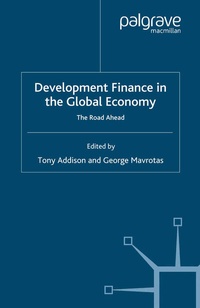
Development Finance in the Global Economy
Description

Reviews / Votes
The publication of this book on development finance is most timely, and should contribute to the major international conferences in 2008 considering financing for development issues. It significantly advances new thinking, especially on aid and new sources of development finance.
Jomo Kwame Sundaram, UN Assistant Secretary General for Economic Development
Since the UN Monterrey conference in March 2002, the international structure of financing for development has changed profoundly. This volume, which extends UNU-WIDER's work in this field, provides a timely update and analysis of the developments in key areas of development financing foreign direct investment, debt, financing from the Bretton Woods institutions, official development assistance, and the so-called innovative sources of international financing.
Manuel F. Montes, Chief, Policy Analysis and Development, Financing for Development Office, UNDESA
Comprising outstanding contributions by well-known economists, this book takes the debate on development finance a step further: the focus is on emerging issues in aid delivery and effectiveness multilateral aid vis-à-vis bilateral aid, the contribution of aid in the provision of international public goods, the role of Multi-actor Global Funds, and the impact of recently introduced Millennium Challenge Account by the USA. The book does an excellent job of presenting a balanced and appropriately nuanced assessment of these issues andcomplements other volumes on new sources development finance.
Sanjeev Gupta, Senior Advisor, Fiscal Affairs Department, IMF
An excellent account of the current state of affairs in development finance.
Yilmaz Akyüz, Former Director, Division on Globalization and Development Strategies, UNCTAD
This interesting, balanced and well-argued new book is a timely reminder of the risks and challenges of current financial arrangements. Abundant liquidity, cheap credit and high commodity prices may not last forever. The current reality of a high concentration of private financing in a handful of emerging economies and the often cumbersome process of foreign aid to low-income nations is far from optimal. The book reviews alternatives, discusses new financial schemes to support development and warns against unwarranted financial optimism. Highly recommended.
Andrés Solimano, Regional Advisor, UN-ECLAC, and editor of The International Mobility of Talent
More details
Other editions
Additional editions