

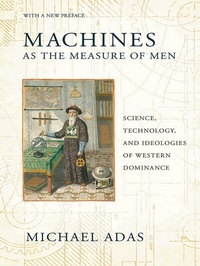
Machines As the Measure of Men
Description

Beginning with the early decades of overseas expansion in the sixteenth century, Adas traces the impact of scientific and technological advances on European attitudes toward Asians and Africans and on their policies for dealing with colonized societies. He concentrates on British and French thinking in the nineteenth century, when, he maintains, scientific and technological measures of human worth played a critical role in shaping arguments for the notion of racial supremacy and the "civilizing mission" ideology which were used to justify Europe's domination of the globe. Finally, he examines the reasons why many Europeans grew dissatisfied with and even rejected this gauge of human worth after World War I, and explains why it has remained important to Americans.
Showing how the scientific and industrial revolutions contributed to the development of European imperialist ideologies, Machines as the Measure of Men highlights the cultural factors that have nurtured disdain for non-Western accomplishments and value systems. It also indicates how these attitudes, in shaping policies that restricted the diffusion of scientific knowledge, have perpetuated themselves, and contributed significantly to chronic underdevelopment throughout the developing world. Adas's far-reaching and provocative book will be compelling reading for all who are concerned about the history of Western imperialism and its legacies.
First published to wide acclaim in 1989, Machines as the Measure of Men is now available in a new edition that features a preface by the author that discusses how subsequent developments in gender and race studies, as well as global technology and politics, enter into conversation with his original arguments.
Reviews / Votes
Provocative and fascinating.... Adas's deft use of quotation gives the missionaries, travelers, explorers, administrators, and teachers their authentic voices. He provides a wealth of documentation. One learns things worth knowing on every page.... One leaves Machines as the Measure of Men persuaded by its essential analysis: that mastery of nature lay at the heart of Europe's comparison of itself to others. As an intellectual history of French and British assessments of Africa, China, and India, the book is wonderfully informative and nuanced. It will alter the debate about the history of Europe's relationship to the rest of the world.(New York Times Book Review) The terrain of Adas's magnificent book is vast. He starts with the first encounters of intrepid European explorers in the seventeenth century and ends with the seeds of doubt which the Great War in Europe sowed in the western civilizing process.... A vast range of sources are cited. Alternatives to the predominant ideology of western scientific and technological progress are explored, and the potential for diffusion of science and technology into different third world societies is also illuminated.
(Times Higher Education Supplement) Remarkable' is an adjective that is most appropriate for this study. Broad in interpretation, rich in detail, and supported by a wealth of information, Michael Adas's work will command the attention of every scholar of modern imperialism, every student of the broad subject of 'technology.'... Adas offers an example of popular history at its very best, which is cultural history exquisitely constructed of detailed research, a well-designed overarching theme, and nicely polished prose.... It will long be pivotal in all discussions that revolve around the technology and culture of modern European expansion. In sum, this is a most compelling, splendid book.
(American Historical Review)
More details
Other editions
New editions
Additional editions
Person
Content
Preface to the 2014 Edition
Introduction
Part I. Before the Industrial Revolution
Chapter 1. First Encounters: Impressions of Material Culture in an Age of Exploration
Technology-Perceptions of Backwardness: Qualified Praise
"Natural Philosophy"-Illiteracy and Faulty Calendars
Scientific and Technological Convergence and the First Hierarchies of Humankind
Chapter 2. The Ascendancy of Science: Shifting Views of Non-Western Peoples in the Era of the Enlightenment
Model of Clay: The Rise and Decline of Sinophilism in Enlightenment Thought
Ancient Glories, Modern Ruins: The Orientalist Discover of Indian Learning
African Achievement and the Debate over the Abolition of the Slave Trade
Scientific Gauges and the Spirit of the Times
Part II. The Age of Industrialization
Chapter 3. Global Hegemony and the Rise of Technology as the Main Measure of Human Achievement
Africa: Primitive Tools and the Savage Mind
India: The Retreat of Orienta1ism
China: Despotism and Decline
Materia1 Mastery as a Prerequisite of Civilized Life
Chapter 4. Attributes of the Dominant: Scientific and Technological Foundations of the Civilizing Mission
Perceptions of Man and Nature as Gauges of Western Uniqueness and Superiority
The Machine as Civilizer
Displacement and Revolution: Marx on the Impact of Machines in Asia
Time, Work, and Discipline
Space, Accuracy, and Uniformity
Worlds Apart: The Case of Ye Ming-chen
Chapter 5. The Limits of Diffusion: Science and Technology in the Debate over the African and Asian Capacity for Acculturation
The First Generations of Improvers
The Search for Scientific and Technological Proofs of Racial Inequality
Qualifying the Civilizing Mission: Racists versus Improvers at the Tum of the Century
Missing the Main Point: Science and Technology in Nineteenth-Century Racist Thought
Part III. The Twentieth Century
Chapter 6. The Great War and the Assault on Scientific and Technological Measures of Human Worth
The Specter of Asia Industrialized
Trench Warfare and the Crisis of Western Civilization
Challenges to the Civilizing Mission and the Search for Alternative Measures of Human Worth
Epilogue: Modernization Theory and the Revival of the Technological Standard
Index
