

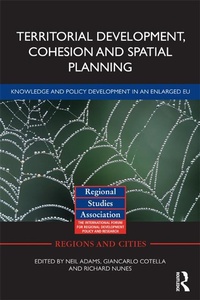
Territorial Development, Cohesion and Spatial Planning
Building on EU Enlargement
1st Edition
Published on 6. August 2012
464 pages
978-1-136-90951-1 (ISBN)
Description

This book examines some of the evolving challenges faced by EU regional policy in light of enlargement and to assess some of the approaches and trends in terms of territorial development policy and practice that are emerging out of this process. Focusing on the experiences on Central and Eastern Europe, these chapters reflect on the diversity of approaches to spatial planning and the the politics of policy formation and multi-level governance operations - from local to trans-national agendas.
Promoting increased awareness and understanding of these issues is the main purpose of the book, as well as harnessing the extensive capacity and 'knowledge' within these countries that can greatly enrich the discourse within an enlarged 'epistemic community' of European spatial planning academics, practitioners and policy-makers. The recently acquired CEE dimension provides a unique opportunity to examine the evolution of existing 'epistemic communities' as well as to explore the potential emergence of new ones..
Promoting increased awareness and understanding of these issues is the main purpose of the book, as well as harnessing the extensive capacity and 'knowledge' within these countries that can greatly enrich the discourse within an enlarged 'epistemic community' of European spatial planning academics, practitioners and policy-makers. The recently acquired CEE dimension provides a unique opportunity to examine the evolution of existing 'epistemic communities' as well as to explore the potential emergence of new ones..
More details
Series
Language
English
Place of publication
London
United Kingdom
Publishing group
Taylor & Francis Ltd
Target group
College/higher education
Illustrations
14 s/w Tabellen, 17 s/w Zeichnungen
14 Tables, black and white; 17 Line drawings, black and white
File size
8,70 MB
ISBN-13
978-1-136-90951-1 (9781136909511)
Copyright in bibliographic data and cover images is held by Nielsen Book Services Limited or by the publishers or by their respective licensors: all rights reserved.
Schweitzer Classification
Other editions
Additional editions
Neil Adams | Giancarlo Cotella | Richard Nunes
Territorial Development, Cohesion and Spatial Planning
Building on EU Enlargement
Book
08/2013
1st Edition
Routledge
€65.00
Shipment within 15-20 days
Neil Adams | Giancarlo Cotella | Richard Nunes
Territorial Development, Cohesion and Spatial Planning
Building on EU Enlargement
Book
08/2010
1st Edition
Routledge
€265.40
Shipment within 15-20 days
Persons
Neil Adams is Senior Lecturer at London Southbank University, Department of Urban, Environmental and Leisure Studies. Giancarlo Cotella is a Research Fellow at Politecnico di Torino, Eupolis, Dipartimento Interateneo Territorio (DITER) . Richard Nunes is a Senior Lecturer in Spatial Planning and Governance Department of Planning at Oxford Brookes University.
Content
INTRODUCTION
1. Territorial Challenges in the New Europe and the Cognitive Bounds of European Spatial Planning -Neil Adams, Giancarlo Cotella and Richard Nunes
Part 1: EVOLVING SPATIAL AGENDA IN AN ENLARGED EU
2. Cohesion and Competitiveness: the Context for Territorial Development in the Evolving European Landscape - Mark Tewdwr-Jones
3. The Evolution of EU Territorial Policy and Potential Challenges for the Future of the European Territory after EU Enlargement - Klaus Kunzmann
4. Evolving Frameworks for Regional Development and Spatial Planning in the New Regions of the EU - Maros Finka
5. The Emergence of New 'Epistemic Communities' in the New European Landscape: Some Theoretical Implications for the Spatial Agenda of the EU - Karina Pallagst
PART 2: ENGAGING SYSTEMS OF MULTI-LEVEL GOVERNANCE
6. Emerging Forms of Territorial Governance and the 'Europeanization' of Spatial Planning - Vincent Nadin and Dominic Stead
7. Technocratic Networks, Path Dependency and Institutional Change: Civic Engagement and the Implementation of the Structural Funds in Poland - Marcin Dabrowski
8. The Limits of Trans-boundary Spatial Planning Networks. Perspectives from the Austrian-Slovakian Border Region - Beatrix Haselsberger and Paul Benneworth
9. New Planning Jurisdictions, Scant Resources and Local Public Responsibility: Delivering Planning in Slovenia - Naja Marot
PART 3: ADDRESSING INCREASING DISPARITIES AND INEQUALITIES IN THE NEW REGIONS OF EUROPE
10. The Pursuit of Balanced Territorial Development: The Realities and Complexities of the Cohesion Agenda - Karel Maier
11. The Impact of Education on Regional Development in Poland - Konrad Czapiewski and Krzysztof Janc
12. The Rhetoric and Reality of Pursuing Territorial Cohesion in Latvia - Zaiga Krisjane, Laila Kule and Maris Berzins
13. Regional Promotion and Competition: Determinants of Long-Term and ad hoc Approaches to FDI Attraction in Central and Eastern Europe - Pawel Capik
PART 4: LEARNING FROM EXPERIENCES BEYOND THE BORDER
14. Strategic Planning Practices in North-West Russia: European Influences, Challenges and Future Perspectives - Natalia Razumeyko
15. The Kalingrad Question: An Assessment of the Evolution of Spatial Policy - Nikiforova Evgeniya
CONCLUSION
16. Building on the Eastwards Enlargement: Addressing the New Challenges for EU Regional Policy - Neil Adams, Giancarlo Cotella and Richard Nunes
1. Territorial Challenges in the New Europe and the Cognitive Bounds of European Spatial Planning -Neil Adams, Giancarlo Cotella and Richard Nunes
Part 1: EVOLVING SPATIAL AGENDA IN AN ENLARGED EU
2. Cohesion and Competitiveness: the Context for Territorial Development in the Evolving European Landscape - Mark Tewdwr-Jones
3. The Evolution of EU Territorial Policy and Potential Challenges for the Future of the European Territory after EU Enlargement - Klaus Kunzmann
4. Evolving Frameworks for Regional Development and Spatial Planning in the New Regions of the EU - Maros Finka
5. The Emergence of New 'Epistemic Communities' in the New European Landscape: Some Theoretical Implications for the Spatial Agenda of the EU - Karina Pallagst
PART 2: ENGAGING SYSTEMS OF MULTI-LEVEL GOVERNANCE
6. Emerging Forms of Territorial Governance and the 'Europeanization' of Spatial Planning - Vincent Nadin and Dominic Stead
7. Technocratic Networks, Path Dependency and Institutional Change: Civic Engagement and the Implementation of the Structural Funds in Poland - Marcin Dabrowski
8. The Limits of Trans-boundary Spatial Planning Networks. Perspectives from the Austrian-Slovakian Border Region - Beatrix Haselsberger and Paul Benneworth
9. New Planning Jurisdictions, Scant Resources and Local Public Responsibility: Delivering Planning in Slovenia - Naja Marot
PART 3: ADDRESSING INCREASING DISPARITIES AND INEQUALITIES IN THE NEW REGIONS OF EUROPE
10. The Pursuit of Balanced Territorial Development: The Realities and Complexities of the Cohesion Agenda - Karel Maier
11. The Impact of Education on Regional Development in Poland - Konrad Czapiewski and Krzysztof Janc
12. The Rhetoric and Reality of Pursuing Territorial Cohesion in Latvia - Zaiga Krisjane, Laila Kule and Maris Berzins
13. Regional Promotion and Competition: Determinants of Long-Term and ad hoc Approaches to FDI Attraction in Central and Eastern Europe - Pawel Capik
PART 4: LEARNING FROM EXPERIENCES BEYOND THE BORDER
14. Strategic Planning Practices in North-West Russia: European Influences, Challenges and Future Perspectives - Natalia Razumeyko
15. The Kalingrad Question: An Assessment of the Evolution of Spatial Policy - Nikiforova Evgeniya
CONCLUSION
16. Building on the Eastwards Enlargement: Addressing the New Challenges for EU Regional Policy - Neil Adams, Giancarlo Cotella and Richard Nunes
