

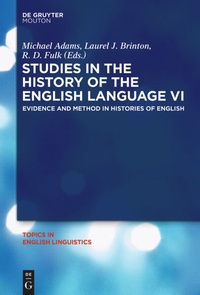
Studies in the History of the English Language VI
Evidence and Method in Histories of English
1st Edition
Published on 12. December 2014
VI, 337 pages
978-3-11-034595-7 (ISBN)
Available for download
Description

The relationships among data, evidence, and methodology in English historical linguistics are perennially vexed. This volume - which ranges chronologically from Old to Present-Day English and from manuscripts to corpora - challenges a wide variety of assumptions and practices and illustrates how diverse methods and approaches construct evidence for historical linguistic arguments from an increasingly large and diverse body of linguistic data.
More details
Other editions
Additional editions
Michael Adams | Laurel J. Brinton | R.D. Fulk
Studies in the History of the English Language VI
Evidence and Method in Histories of English
E-Book
12/2014
1st Edition
De Gruyter Mouton
€149.95
Available for download
Michael Adams | Laurel J. Brinton | R.D. Fulk
Studies in the History of the English Language VI
Evidence and Method in Histories of English
Book
11/2014
1st Edition
De Gruyter Mouton
€149.95
Shipment within 7-9 days
Persons
Michael Adams and R. D. Fulk, Indiana University, USA; Laurel J. Brinton, University of British Columbia, Canada.
Content
- Intro
- Contents
- Introduction: Evidence and method in the historical study of English
- Part I: Corpora, evidence, method
- The development of free adjuncts in English and Dutch
- Semantic dependencies and the history of ellipsis alternation
- The phrasal verb in American English: Using corpora to track down historical trends in particle distribution, register variation, and noun collocations
- On the grammaticalization of the thing is and related issues in the history of American English
- Alfredian io ~ eo, reluctant function words, and Schriftbilder
- Part II: Reconfiguring History: Overlooked evidence of English
- Metrical resolution, spelling, and the reconstruction of Old English syllabification
- The shortest history of vowel lengthening in English
- Vowel system restructuring in the West Midlands of England
- Style and politics in The Battle of Brunanburh and The Battle of Maldon
- Trinitarian terminology in Old English liturgical creeds
- Part III: Emerging paradigms: New methods, new evidence
- Ælc þara þe þas min word gehierþ and þa wyrcþ . : Psycholinguistic perspectives on early Englishes
- Complex systems and the history of the English language
- An ideological history of the English term onomatopoeia
- Name index
- Subject index

