

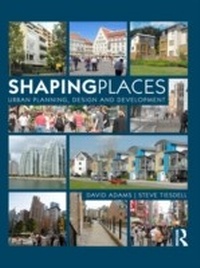
Shaping Places
Urban Planning, Design and Development
1st Edition
Published on 21. August 2012
368 pages
978-1-136-25465-9 (ISBN)
Description

Shaping Places explains how towns and cities can turn real estate development to their advantage to create the kind of places where people want to live, work, relax and invest. It contends that the production of quality places which enhance economic prosperity, social cohesion and environmental sustainability require a transformation of market outcomes. The core of the book explores why this is essential, and how it can be delivered, by linking a clear vision for the future with the necessary means to achieve it. Crucially, the book argues that public authorities should seek to shape, regulate and stimulate real estate development so that developers, landowners and funders see real benefit in creating better places.
Key to this is seeing planners as market actors, whose potential to shape the built environment depends on their capacity to understand and transform the embedded attitudes and practices of other market actors. This requires planners to be skilled in understanding the political economy of real estate development and successful in changing its outcomes through smart intervention. Drawing on a strong theoretical framework, the book reveals how the future of places will come to be shaped through constant interaction between State and market power.
Filled with international examples, essential case studies, color diagrams and photographs, this is essential reading for undergraduate and graduate students taking planning, property, real estate or urban design courses as well as for social science students more widely who wish to know how the shaping of place really occurs.
Key to this is seeing planners as market actors, whose potential to shape the built environment depends on their capacity to understand and transform the embedded attitudes and practices of other market actors. This requires planners to be skilled in understanding the political economy of real estate development and successful in changing its outcomes through smart intervention. Drawing on a strong theoretical framework, the book reveals how the future of places will come to be shaped through constant interaction between State and market power.
Filled with international examples, essential case studies, color diagrams and photographs, this is essential reading for undergraduate and graduate students taking planning, property, real estate or urban design courses as well as for social science students more widely who wish to know how the shaping of place really occurs.
Reviews / Votes
In the dark days of public sector retrenchment and the loss of a progressive role for planning it's more important than ever that our understanding of place making is not forgotten. David Adams and Steve Tiesdell have spent the last decade exploring successful places. Shaping Places is the culmination of that work. In what will undoubtedly become a key text Shaping Places assembles a wide range of international research and experiences around the processes of making socially, environmentally and economically successful places. - Phil Allmendinger, Professor of Land Economy and Head of the Department of Land Economy, University of CambridgeA distinctive feature of this book is that it brings together, through the different backgrounds of its authors, a passion for urban design and a sophisticated understanding of how real estate markets operate. - Cliff Hague, http://www.innovationcircle.net/shaping-places.5106978-113437.html In the dark days of public sector retrenchment and the loss of a progressive role for planning it's more important than ever that our understanding of place making is not forgotten. David Adams and Steve Tiesdell have spent the last decade exploring successful places. Shaping Places is the culmination of that work. In what will undoubtedly become a key text Shaping Places assembles a wide range of international research and experiences around the processes of making socially, environmentally and economically successful places. - Phil Allmendinger, Professor of Land Economy and Head of the Department of Land Economy, University of Cambridge
A distinctive feature of this book is that it brings together, through the different backgrounds of its authors, a passion for urban design and a sophisticated understanding of how real estate markets operate. - Cliff Hague, Innovation Circle Network
"This is a very useful book on the development process and how to enhance its contribution to successful place-making. Its intellectual perspective is clearly stated and contrasted with others, and it is lucidly written and helpful for students coming new to these issues. It should become a key text on real estate and planning programmes, particularly in the UK, and could usefully be read by those interested in urban studies more widely. I have already highlighted its value for UK policy-makers in the planning and development field. It is also a fitting memorial to Steve Tiesdell."- Patsy Healey, Newcastle University
More details
Language
English
Place of publication
London
United Kingdom
Publishing group
Taylor & Francis Ltd
Target group
College/higher education
Professional and scholarly
Illustrations
7 Tables, color; 31 Line drawings, black and white; 77 Halftones, color
File size
10,34 MB
ISBN-13
978-1-136-25465-9 (9781136254659)
Copyright in bibliographic data and cover images is held by Nielsen Book Services Limited or by the publishers or by their respective licensors: all rights reserved.
Schweitzer Classification
Other editions
Additional editions
Book
09/2012
1st Edition
Routledge
€85.58
Shipment within 15-20 days

Book
09/2012
1st Edition
Routledge
€282.16
Shipment within 15-20 days
Persons
David Adams holds the Ian Mactaggart Chair of Property and Urban Studies at the University of Glasgow, where Steve Tiesdell was Senior Lecturer in Public Policy until his death in 2011. They worked together for over a decade, first at the University of Aberdeen and then at Glasgow, sharing a mutual interest in state-market relations in land and property, and applying this to research and teaching on planning, public policy, real estate development, urban design and urban regeneration. Before moving to Aberdeen, Steve worked at the Universities of Nottingham and Sheffield, while David was previously at the Universities of Reading and Manchester. Shaping Places represents the culmination of their mutual endeavour and builds on previous joint publications, including their edited book Urban Design in the Real Estate Development Process (2011).
David and Steve have each researched and published widely in their respective fields. Steve's previous books include Revitalising Historic Urban Quarters (co-author 1996), Public Places - Urban Spaces: The Dimensions of Urban Design (co-author 2003 and 2010) and The Urban Design Reader (co-editor 2006). David's previous books include Urban Planning and the Development Process (author 1994), Greenfields, Brownfields and Housing Development (co-author 2002) and Planning, Public Policy and Property Markets (co-editor 2005).
David and Steve have each researched and published widely in their respective fields. Steve's previous books include Revitalising Historic Urban Quarters (co-author 1996), Public Places - Urban Spaces: The Dimensions of Urban Design (co-author 2003 and 2010) and The Urban Design Reader (co-editor 2006). David's previous books include Urban Planning and the Development Process (author 1994), Greenfields, Brownfields and Housing Development (co-author 2002) and Planning, Public Policy and Property Markets (co-editor 2005).
Content
Part 1: The Development Context 1. Introduction 2. Successful Places 3. Real Estate Markets 4. Real Estate Values and the State 5. Real Estate Development 6. The Governance of Place Part 2: Market Roles and Actors 7. Real Estate Developers 8. Landowners 9. Funders And Investors Part 3: Policy Instruments 10. Shaping Markets - Making Plans and Reforming Institutions Shaping 11. Shaping Markets by Strategic Transformation 12. Regulating Markets 13. Market Stimulus 14. Capacity-Building 15. Conclusions
