

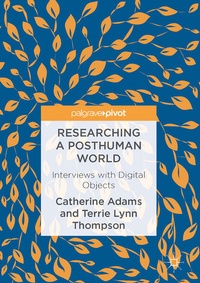
Researching a Posthuman World
Description

This book provides a practical approach for applying posthumanist insights to qualitative research inquiry. Adams and Thompson invite readers to embrace their inner - and outer - cyborg as they consider how today's professional practices and everyday ways of being are increasingly intertwined with digital technologies. Drawing on posthuman scholarship, the authors offer eight heuristics for "interviewing objects" in an effort to reveal the unique - and sometimes contradictory - contributions the digital is making to work, learning and living. The heuristics are drawn from Actor Network Theory, phenomenology, postphenomenology, critical media studies and related sociomaterial approaches. This text offers a theoretically informed yet practical approach for asking critical questions of digital and non-digital things in professional and personal spaces, and ultimately, for considering the ethical and political implications of a technology mediated world. A thought-provokingand innovative study, this book will be of great interest to scholars and researchers of technology studies, digital learning, and sociology.
Reviews / Votes
"In this very timely text, Adams and Thompson provide us with a clearly formulated set of heuristics to enact reflectively a posthumanist research practice. In this practice, nonhuman actors are given a voice. Deploying their heuristics carefully will enliven fields of inquiry and produce research that is buzzing with agency, in which the humans no longer are the only ones that speak. This flourishing of otherness is desperately needed in our research accounts. I hope the transformative potential of
Researching a Posthuman World
will find its way to the research practices of many researchers, across a wide variety of disciplines." (Lucas Introna, Professor of Organisation, Technology and Ethics, University of Lancaster)
" Researching a Posthuman World is a concise and highly readable overview of the theories and perspectivesclustering around posthumanism. Students and researchers in all disciplines concerned with understanding digital society will find Adams' and Thompson's proposed set of research heuristics of great value. This book is a very welcome contribution to the project of building research practices aligned with contemporary cultural theory." (Sian Bayne, Professor of Digital Education, University of Edinburgh)
"In their superb scholarly Researching a Posthuman World, Cathy Adams and Terrie Lynn Thompson bring us face to face with the riddle of the Digital, and the puzzling significance of the Posthuman. They show how the Digital pervades, mediates, and technologizes virtually all dimensions of our quotidian lives. Yet, in spite of its ubiquitous presence, the Digital remains largely hidden and unnoticed. They explore our enigmatic human entanglements with the evanescent properties of "things" that surround us and that we constantly (re)turn to; they show how the "objects" in our lives disturbingly and quite insistently object to their objectification. The result is a remarkably fascinating account of "interviewing things" and "conversing with objects". We wonder: are the exterior things and objects that we encounter in our lives intimate "others" or, ultimately and more accurately, do things constitute our interior selves? What could a human existence possibly look like without things? In our present age where scientific speculations of dark matter and parallel universes become increasingly posited, the birth of virtual and augmented realities of our posthuman world turn evidentially more real than real as they are digitally diffracted and deepened, and phenomenally intensified. I warmly recommend this phenomenologically engaging and eloquently accessible text to anyone who wants to understand the wondrous world in which we live." (Max van Manen, Professor Emeritus, University of Alberta)
More details
Other editions
Additional editions
Persons
Content
- Intro
- Researching a Posthuman World
- Acknowledgements
- Contents
- List of Figures
- 1 Introduction to Posthuman Inquiry
- Introduction
- Theoretical Framings
- The Posthuman
- ANT and Beyond
- Phenomenology and Its Kin
- Phenomenology and ANT Together and Not
- Objects and Things, Materialities and Medialities
- Interviewing Objects
- Interviewing
- The Heuristics
- Organization of This Book
- 2 Attending to Objects, Attuning to Things
- Heuristic 1: Gathering Anecdotes
- Posthuman Anecdotes Show Things Thinging, and Nonhumans Doing
- Constructing Posthuman Anecdotes
- Anecdotes as Reassembled Resemblings in the Enactment of Research Practice
- Heuristic 2: Following the Actors
- Objects Coming to Attention
- Following the Hybrids: Co(a)gents
- Heuristic 3. Listening for the Invitational Quality of Things
- Affordances and Valences
- Tones, Melodies and Utterances
- Heuristic 4. Studying Breakdowns, Accidents, and Anomalies
- Tool (Ready-to-Hand) and Broken Tool (Present-at-Hand)
- 3 Loosening the Meshwork, Analyzing Medialities and Materialities
- Heuristic 5: Discerning the Spectrum of Human-Technology-World Relations
- Embodiment Relations
- Hermeneutic Relations
- Alterity Relations
- Background Relations
- A Brief Example
- Heuristic 6: Applying the "Laws of Media"
- Enhancement
- Obsolescence
- Retrieval
- Reversal
- Tetrad
- Heuristic 7: Unraveling Translations
- Heuristic 8: Tracing Responses and Passages
- 4 Interviewing Objects as Co-researchers
- The Silent Sway of Software: Coding Researchers
- Digital Devices: Who-What's Research?
- The Sociomateriality of Data
- The Many Social Lives of Data Visualized
- Speaking with the Things of Research
- 5 Posthuman Confluencies
- New Confluencies
- Developing a Posthumanist Ethic
- Anticipating Changes to Our Thinking, Being, and Doing
- Reckoning with the Deskilling and Upskilling of Work Practices
- Dealing with Digital Data
- Questioning Digital Politics
- In Closing
- References
- Author Index
- Subject Index
