

Repeater Nodes: Optoelectronic Amplification in the Global Submarine Data Backbone
Lasers, Fiber, and the Physical Logistics of Transcontinental Internet Traffic
1st Edition
Published on 8. April 2026
189 pages
978-3-565-39529-3 (ISBN)
Description

Light fired through a glass filament does not travel infinitely. Over the span of thousands of kilometers across the Pacific Ocean floor, the optical pulses carrying global internet traffic inevitably succumb to attenuation, growing dim and unreadable. Without regular intervention, transcontinental video calls and high-frequency trading algorithms would instantly degrade into digital static.
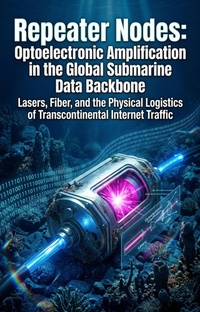
The solution lies housed inside pressure-resistant titanium cylinders spaced precisely every fifty kilometers along the seabed: optical repeater nodes. These complex machines utilize Erbium-Doped Fiber Amplifiers (EDFA) to literally boost the fading light. By firing localized "pump lasers" directly into the fiber, they excite erbium ions that clone and amplify the passing data stream without ever converting it back into a slow, electrical signal. Maintaining power to these deep-sea lasers requires a continuous, high-voltage electrical current running the entire length of the transoceanic cable.
Navigate the physical reality of the cloud. Analyze the extreme optoelectronic engineering and deep-sea power logistics that keep the global internet brightly illuminated across the abyss.
More details
Person
Author
