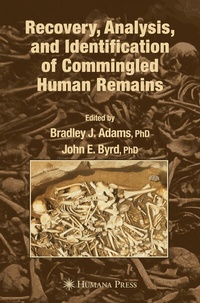
Recovery, Analysis, and Identification of Commingled Human Remains
Description

Mass fatality events can result in the intermixing, or commingling, of human remains. Commingling of human remains presents an added challenge to all phases of the forensic process. As the number of individuals increases, so does the complexity of the forensic investigation and the skills needed for case resolution. In Recovery, Analysis, and Identification of Commingled Human Remains, top professionals illustrate successful techniques for sorting and determining the number of individuals, the role of DNA, ethical considerations and data management. Instrumental to the forensic community, Recovery, Analysis, and Identification of Commingled Human Remains provides case examples and an in depth review of experiences, methods, and research related to commingling.
Reviews / Votes
From the reviews:
"This volume will be of significant help to forensic practitioners, when charged with the forensic determination of identification following the identification of a mass grave scenario. . For new members of the forensic community, such as students for example, it will make an interesting and informative read. Novices or the general public may find the integration of archaeological and forensic applications interesting, and the book does successfully highlight the need for multi-dimensional investigations." (Xanth D. G. Mallett-Telling, The British Association of Human Identification, June, 2008)
"The book . deals with practical issues in the forensic sciences, documenting examples of successful techniques for sorting and determining the number of individuals, and illustrates the role of DNA analyses, ethical considerations, and data management. These should be helpful for forensic experts, especially those who encounter mass fatality events accompanied by commingling of human remains. . The volume . will give readers several practical examples that illustrate up-to-date advantages and issues in analyses of commingled human remains." (Osamu Kondo, Primates, Vol. 50, March, 2009)
More details
Other editions
Additional editions