

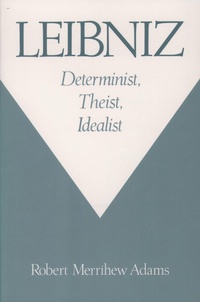
Leibniz
Determinist, Theist, Idealist
Published on 12. November 1998
446 pages
978-0-19-802460-6 (ISBN)
Description

Legendary since his own time as a universal genius, Gottfried Wilhelm Leibniz (1646-1716) contributed significantly to almost every branch of learning, from mathematics to ecumenical theology. But the part of his work that is most studied today is probably his writings in metaphysics, which have been the focus of particularly lively philosophical discussion in the last twenty years or so.
Leibniz's writings in metaphysics contain one of the great classic systems of modern philosophy, but the system must be pieced together from a vast and miscellaneous array of manuscripts, letters, articles, and books, in a way that makes especially strenuous demands on scholarship. This book presents an in-depth interpretation of three important parts of Leibniz's metaphysics, thoroughly grounded in the texts as well as in philosophical analysis and critique. The three areas discussed are the metaphysical part of Leibniz's philosophy of logic, his essentially theological treatment of the central issues of ontology, and his theory of substance (the theory of monads).
More details
Other editions
Additional editions
Book
02/1999
195th Edition
Oxford University Press Inc
€100.60
Shipment within 15-20 days
Book
01/1995
Oxford University Press Inc
€277.40
Shipment within 15-20 days
Content
- Intro
- Contents
- Introduction
- I. Determinism: Contingency and Identity
- 1. Leibniz's Theories of Contingency
- 1. Leibniz's First Main Solution
- 2. Leibniz's Second Main Solution
- 3. Leibniz and Possible Worlds Semantics
- 4. On Leibniz's Sincerity
- 2. The Logic of Counterfactual Non-identity
- 1. Problems of Transworld Identity
- 2. The Conceptual Containment Theory of Truth
- 3. Actuality in the Conceptual Containment Theory
- 4. An Anti-Semantical Theory of Truth
- 5. Why Did Leibniz Hold the Conceptual Containment Theory?
- 6. Conceptual Containment and Transworld Identity
- 3. The Metaphysics of Counterfactual Nonidentity
- 1. Substance and Law
- 2. Substance and Miracle
- 3. Perception and Relations
- 4. Conclusions
- Appendix: A Priori and A Posteriori
- II. Theism: God and Being
- 4. The Ens Perfectissimum
- 1. Absolute Qualities as "Requirements" of Things
- 2. Sensible Qualities, Knowledge, and Perfection
- 3. Is Leibniz's Conception of God Spinozistic?
- 5. The Ontological Argument
- 1. The Incomplete Proof
- 2. Proof of Possibility
- 6. Existence and Essence
- 1. Is Existence an Essential Quality of God?
- 2. Defining Existence
- 3. Existence Irreducible
- 7. The Root of Possibility
- 1. The Proof of the Existence of God from the Reality of Eternal Truths
- 2. Leibniz's Theory Examined
- 8. Presumption of Possibility
- 1. Jurisprudence and Pragmatism in Theology
- 2. Jurisprudence and the Logic of Probability
- 3. A Proof for the Presumption of Possibility
- 4. Presuming the Possibility of Beings as Such
- 5. Objections Considered
- III. Idealism: Monads and Bodies
- 9. Leibniz's Phenomenalism
- 1. Phenomena
- 2. Esse Is Percipi
- 3. Aggregates
- 4. The Reality of Phenomena
- 10. Corporeal Substance
- 1. Bodies and Corporeal Substances
- 2. The Structure of a Corporeal Substance: Alternative Interpretations
- 3. The Structure of a Corporeal Substance: Some Texts
- 4. Monadic Domination
- 5. Principles of Unity
- 11. Form and Matter in Leibniz's Middle Years
- 1. Form
- 2. Matter
- 3. Realism
- 12. Primary Matter
- 1. Three Senses of "Matter" in a Letter to Arnauld
- 2. Matter and the Eucharist
- 3. Bernoulli's Questions
- 4. The Debate about Thinking Matter
- 5. Conclusions
- 13. Primitive and Derivative Forces
- 1. The "Mixed" Character of Derivative Forces
- 2. Primary Matter and Quantity
- Bibliography
- Index of Leibniz Texts Cited
- A
- B
- C
- D
- E
- F
- G
- L
- M
- N
- P
- R
- S
- T
- V
- W
- General Index
- A
- B
- C
- D
- E
- F
- G
- H
- I
- J
- K
- L
- M
- N
- O
- P
- Q
- R
- S
- T
- U
- V
- W
