

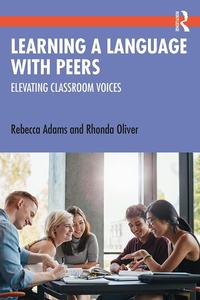
Learning a Language with Peers
Elevating Classroom Voices
1st Edition
Published on 19. June 2023
174 pages
978-1-000-87849-3 (ISBN)
Description

Drawing on experiences of ESOL teachers from around the world, this book provides insights into how peer learning is understood and used in real language classrooms.
Based on survey responses, interviews, and observations in a wide range of classroom settings, this book integrates research on peer interaction in second language learning from cognitive and social frameworks with original data on teacher beliefs and practices around the use of peer learning in their teaching. Readers will gain understanding, through teachers' own words, of how peer interaction is used to teach linguistic form, how learners collaborate to develop oral and written communication skills, and how technology is used with peer learning. This book also delineates the ways that current second language peer interaction research diverges from classroom practice and concludes with a classroom-centered research agenda that addresses the nexus of research and practice on second language peer interaction.
The book provides a template for integrating research- and practice-based perspectives on second language learning. Language teachers, teacher educators, second language researchers, and advanced students of applied linguistics, SLA, TESOL, and language pedagogy will benefit from this volume's perspective and unique work.
Based on survey responses, interviews, and observations in a wide range of classroom settings, this book integrates research on peer interaction in second language learning from cognitive and social frameworks with original data on teacher beliefs and practices around the use of peer learning in their teaching. Readers will gain understanding, through teachers' own words, of how peer interaction is used to teach linguistic form, how learners collaborate to develop oral and written communication skills, and how technology is used with peer learning. This book also delineates the ways that current second language peer interaction research diverges from classroom practice and concludes with a classroom-centered research agenda that addresses the nexus of research and practice on second language peer interaction.
The book provides a template for integrating research- and practice-based perspectives on second language learning. Language teachers, teacher educators, second language researchers, and advanced students of applied linguistics, SLA, TESOL, and language pedagogy will benefit from this volume's perspective and unique work.
Reviews / Votes
Adams and Oliver's volume is a much-needed contribution. It provides second language researchers with teachers' insights into the role of peer interaction and into their successes and challenges when implementing interactive tasks in their classrooms. Most importantly in my opinion, the volume offers a research agenda on interaction grounded in the realities of classroom language teaching.Maria del Pilar Garcia Mayo, Universidad del Pais Vasco (UPV/EHU)
Adams and Oliver's Learning a Language with Peers: Elevating Classroom Voices delivers a state-of-the-art exploration of peer interaction from the expertise and experiences of language teachers in diverse contexts. An ideal complement to their 2019 empirically focused volume, this book provides an unprecedented look at the nuances of peer interaction with tangible, concrete ideas on how to maximize classroom language learning. A must-read for language teachers and research-focused academics alike.
Laura Gurzynski-Weiss, Indiana University
More details
Edition
1. Auflage
Language
English
Place of publication
London
United Kingdom
Publishing group
Taylor & Francis Ltd
Target group
College/higher education
Professional and scholarly
Illustrations
2 Tables, black and white; 17 Line drawings, black and white; 17 Illustrations, black and white
ISBN-13
978-1-000-87849-3 (9781000878493)
Copyright in bibliographic data and cover images is held by Nielsen Book Services Limited or by the publishers or by their respective licensors: all rights reserved.
Schweitzer Classification
Other editions
Additional editions
Book
06/2023
1st Edition
Routledge
€195.00
Shipment within 15-20 days
Book
06/2023
1st Edition
Routledge
€67.90
Shipment within 15-20 days
Persons
Rebecca Adams is an Associate Professor of Applied Linguistics in the Department of English at the University of Memphis, USA, where she teaches on second language acquisition, applied linguistics research, and TESOL pedagogy. Her prior research on peer interaction in second language learning has been published in journals including TESOL Quarterly, Language Learning, the Modern Language Journal, Language Teaching Research, and in edited volumes and handbooks. Her two previous co-authored books on this topic were published by Routledge.
Rhonda Oliver is a Research Professor of Applied Linguistics working within the School of Education at Curtin University, Australia. Her research has involved studies about the role of interaction, especially peer interaction, in second language and dialect acquisition. Her key focus has been children and adolescents. Her book with Bich Nguyen, Child Second Language Learning in Different Classroom Contexts, was published by Routledge in 2018. In recent times, her research has led her to work in Indigenous Education with an award-winning book in this area published by Routledge in 2021.
Rhonda Oliver is a Research Professor of Applied Linguistics working within the School of Education at Curtin University, Australia. Her research has involved studies about the role of interaction, especially peer interaction, in second language and dialect acquisition. Her key focus has been children and adolescents. Her book with Bich Nguyen, Child Second Language Learning in Different Classroom Contexts, was published by Routledge in 2018. In recent times, her research has led her to work in Indigenous Education with an award-winning book in this area published by Routledge in 2021.
Content
Acknowledgements
1: Peer Interaction in Second Language Contexts
2: Focus Teachers, Teaching Contexts, and Data Collection
3: Why Teachers Use Peer Interaction to Promote Language Learning
4: Peer Interaction and Second Language Literacy
5: Peer Interactions with Technology
6: Factors Affecting Peer Interaction
7: Peer Interaction in the Classroom: Challenges and Concerns
8: Peer Interaction Research and Pedagogy
References
Appendix: Peer Interaction Survey
Index
1: Peer Interaction in Second Language Contexts
2: Focus Teachers, Teaching Contexts, and Data Collection
3: Why Teachers Use Peer Interaction to Promote Language Learning
4: Peer Interaction and Second Language Literacy
5: Peer Interactions with Technology
6: Factors Affecting Peer Interaction
7: Peer Interaction in the Classroom: Challenges and Concerns
8: Peer Interaction Research and Pedagogy
References
Appendix: Peer Interaction Survey
Index
