

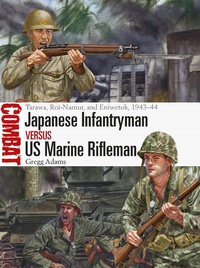
Japanese Infantryman vs US Marine Rifleman
Tarawa, Roi-Namur, and Eniwetok, 1943-44
1st Edition
Published on 26. October 2023
80 pages
978-1-4728-5789-7 (ISBN)
Description

Featuring evocative artwork plates and carefully selected photographs, this book assesses the US Marines and Japanese troops who contested the islands of Tarawa, Roi-Namur, and Eniwetok during 1943-44.
On November 20, 1943, amphibious vehicles carrying Marines of the 2d Marine Division reached the shores of Betio Island in the Tarawa Atoll, defended by a determined Japanese garrison that would fight to the last man. This began a test by combat of over two decades of US studies, analyses, and planning for capturing and defending naval bases in Micronesia. The Tarawa assault was followed in February 1944 by the rapid capture of the Kwajalein and Eniwetok atolls in the Marshall Islands.
In these battles US Marines fought a mix of Imperial Japanese Navy and Imperial Japanese Army ground units. All but a handful of the defenders, whether they were organized ground combat troops or infantry improvised from aviators and service troops, were determined to die for the Emperor while killing as many of the enemy as possible. In this study, Gregg Adams shows how the US Marine Corps and US Navy drew upon these pivotal actions to improve their tactics, organization, and equipment for the next round of amphibious operations. He also explains how their Japanese opponents - realizing that isolated island garrisons were doomed to destruction or isolation if the Imperial Japanese Navy could not defeat the US Navy at sea - moved from seeking to repel an invasion to one inflicting maximum American casualties through prolonged defensive fighting.
On November 20, 1943, amphibious vehicles carrying Marines of the 2d Marine Division reached the shores of Betio Island in the Tarawa Atoll, defended by a determined Japanese garrison that would fight to the last man. This began a test by combat of over two decades of US studies, analyses, and planning for capturing and defending naval bases in Micronesia. The Tarawa assault was followed in February 1944 by the rapid capture of the Kwajalein and Eniwetok atolls in the Marshall Islands.
In these battles US Marines fought a mix of Imperial Japanese Navy and Imperial Japanese Army ground units. All but a handful of the defenders, whether they were organized ground combat troops or infantry improvised from aviators and service troops, were determined to die for the Emperor while killing as many of the enemy as possible. In this study, Gregg Adams shows how the US Marine Corps and US Navy drew upon these pivotal actions to improve their tactics, organization, and equipment for the next round of amphibious operations. He also explains how their Japanese opponents - realizing that isolated island garrisons were doomed to destruction or isolation if the Imperial Japanese Navy could not defeat the US Navy at sea - moved from seeking to repel an invasion to one inflicting maximum American casualties through prolonged defensive fighting.
More details
Series
Edition
1. Auflage
Language
English
Place of publication
London
United Kingdom
Publishing group
Bloomsbury Publishing PLC
Illustrations
Colour artwork plates and maps; black & white and colour photographs and illustrations.
ISBN-13
978-1-4728-5789-7 (9781472857897)
Copyright in bibliographic data and cover images is held by Nielsen Book Services Limited or by the publishers or by their respective licensors: all rights reserved.
Schweitzer Classification
Other editions
Additional editions
Book
10/2023
Osprey Publishing
€22.00
Shipment within 3-4 weeks
Persons
Gregg Adams earned a doctorate in physics in 1983 from the University of Missouri-Rolla. He is the author of several Osprey books including King's African Rifles Soldier vs Schutztruppe Soldier and US Marine vs German Soldier. He lives in Missouri, USA.
Johnny Shumate works as an illustrator in Tennessee. His greatest influences are Angus McBride, Don Troiani and Édouard Detaille.
Johnny Shumate works as an illustrator in Tennessee. His greatest influences are Angus McBride, Don Troiani and Édouard Detaille.
Content
Introduction
The Opposing Sides
Betio Island, November 20-23, 1943
Namur Island, February 1-2, 1944
Engebi Island, February 18, 1944
Analysis
Aftermath
Unit Organizations
Bibliography
Index
The Opposing Sides
Betio Island, November 20-23, 1943
Namur Island, February 1-2, 1944
Engebi Island, February 18, 1944
Analysis
Aftermath
Unit Organizations
Bibliography
Index
