

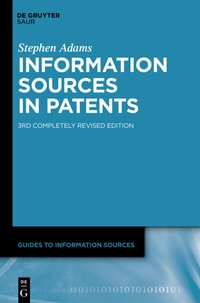
Information Sources in Patents
3rd Edition
Published on 30. November 2011
XXIV, 333 pages
978-3-11-023512-8 (ISBN)
Description

Since the publication of the 2nd edition additional countries especially in Asia have become more prominent in industry. This completely revised edition takes account of the changing information scene e.g. in new chapters like BRIC nations (Brazil, Russia, India, and China), Asia and regional patent systems or Sources for legal status searching. This is an essential reference tool for academic librarians and information specialists as well as anyone needing to know where and how patent information can be found.
More details
Series
Edition
3rd completely revised edition
Language
English
Place of publication
Berlin/Boston
Germany
Target group
Professional and scholarly
US School Grade: College Graduate Student
Edition type
Revised edition
File size
7,14 MB
ISBN-13
978-3-11-023512-8 (9783110235128)
Schweitzer Classification
Other editions
Additional editions
Stephen Adams
Information Sources in Patents
Book
11/2011
3rd Edition
De Gruyter Saur
€229.00
Article exhausted; check different version
Book
11/2011
3rd Edition
De Gruyter
€210.00
Shipment within 7-9 days
Previous edition
Stephen Adams
Information Sources in Patents
E-Book
09/2020
1st Edition
De Gruyter Saur
€149.95
Available for download
Person
Stephen R. Adams, Managing Director at Magister Limited, Reading, Great Britain
Content
- Intro
- List of Figures
- List of Tables
- Series Editor's Foreword
- Preface to Second Edition
- Preface to Third Edition
- Part I: Patent processes and documentation
- 1 Principles of patenting
- Legal Processes
- Defining a patent
- The concept of priority
- The historical examination process for patents
- The development of deferred examination and early publication
- A typical sequence in modern patent examination
- Patents as Information Tools
- Language of publication
- Patents as accessible documents
- Patent families
- Bibliographic Standards and the Form of a Patent Document
- Special Document Types
- Alternative forms of intellectual property (IP) rights
- Patent amendments and corrections
- Patent-related protection mechanisms
- References
- 2 The European Patent system
- EP Patent Documents - Centralised and Nationalised Procedures
- Formal examination and search report
- Unexamined publication
- Grant publication
- Post-grant publications
- Post-grant translations and the London Agreement
- Other post-grant events
- European Classification
- Databases and Database-Specific Aspects
- Relationships with the European Union
- The effect of European Regulations and Directives
- The Community Patent
- References
- 3 The United States patent system
- Historical Aspects
- Recent Law Changes
- US Patent Documents
- Application procedure
- Examination, early publication and grant
- Post-grant activities
- Databases and Database-Specific Aspects
- The US Patent Classification
- References
- 4 The Japanese patent system
- History of Japanese Patents
- Japanese Patent Documentation and Recent Law Changes
- Normal progress to grant
- Japanese B1 publications
- The importance of utility models
- Databases and Database-Specific Aspects
- The Japanese Patent Classification and Indexing Systems
- References
- 5 The Patent Co-operation Treaty
- Background to the PCT System
- PCT Documentation
- Databases Covering the PCT System
- References
- 6 National patent systems of the G7 countries
- Introduction
- Canada
- Historical aspects and current law
- National patent documentation
- Databases and database-specific aspects
- France
- Historical aspects and current law
- National patent documentation
- Databases and database-specific aspects
- Germany
- Historical aspects and current law
- National patent documentation
- Databases and database-specific aspects
- Italy
- Historical aspects and current law
- National patent documentation
- Databases and database-specific aspects
- United Kingdom
- Historical aspects and current law
- National patent documentation
- Databases and database-specific aspects
- References
- 7 The BRIC nations, Asia and regional patent systems
- Introduction
- Brazil
- Historical aspects and current law
- National patent documentation
- Databases and database-specific aspects
- Russian Federation
- Historical aspects and current law
- National patent documentation
- Databases and database-specific aspects
- India
- Historical aspects and current law
- National patent documentation
- Databases and database-specific aspects
- China
- Historical aspects and current law
- National patent documentation
- Databases and database-specific aspects
- Other Asian Countries
- South Korea
- Taiwan
- Regional Patent Systems
- The Eurasian Patent Office
- Africa - ARIPO and OAPI
- The Gulf Co-operation Council (GCC)
- Future developments in regional patent systems
- References
- Part II - Databases and search techniques
- 8 Patent guides and libraries
- General Directories and Reference Works
- United Kingdom Patent Libraries
- United States Patent Libraries
- German Patent Libraries
- The European PATLIB Network
- Japanese Patent Libraries
- Chinese Patent Libraries
- References
- 9 National and international patent information sources
- Paper Sources
- Optical Disk (CD-ROM, DVD)
- Integrated Disk-Internet Products Via Mimosa
- Proprietary Electronic Databases
- Derwent World Patent Index (DWPI) (Thomson-Reuters)
- Patent Citation Index (PCI) (Thomson-Reuters)
- PlusPat, FamPat (Questel)
- API Encompass and WPAM (Questel)
- INPADOC PFS and Open Patent Services (EPO)
- Pharm (Questel)
- Other Thomson-Reuters products
- IMS Patent Focus (IMS Health)
- GeneSeq (DGENE)
- Chemical Abstracts / Marpat (CAS)
- MMS (Questel)
- SureChem (Macmillan)
- Public Internet Sources
- National patent office websites
- Patent Office portal sites
- Controlled-Access Internet
- Password- or account-based systems
- Encrypted systems
- References
- 10 The non-patent literature for the patent searcher
- Legal Background to Non-Patent Literature Use
- Open-Access Journals
- Internet Disclosures
- Reference Guides
- Source Indexes
- Special Library Sources
- Subject Guides
- Reviews
- Tertiary Literature
- Other Forms Of Literature
- Grey literature
- Theses
- Traditional Knowledge (TK)
- Conference literature and technical standards
- Technical disclosure bulletins
- Conclusion
- References
- 11 Common search types (I) - Alerting searches
- Standard Bulletins
- In-House Strategies
- Specialist Suppliers
- 12 Common search types (II) - Patentability and freedom-to-operate searches
- The Patentability Search
- The Infringement Search
- References
- 13 Common search types (III) - Portfolio and legal proceedings searching
- The Portfolio Search
- Validity and Opposition Searching
- References
- 14 Sources for legal status searching
- What is 'Legal Status'?
- Services from patent offices
- Multi-country coverage sources
- Commercial sources for legal status
- References
- 15 Commercial intelligence search and analysis
- State-of-the-Art Searches
- Patent Analysis Tools and Techniques
- References
- 16 Specialist techniques
- Searching of Citations
- Patent Classification
- The International Patent Classification and its derivatives
- The US Patent Classification
- Japanese F-term indexing
- The IP5 CHC project and the US-EP CPC
- Additional Non-Word Elements
- References
- 17 Future developments
- The Impact of the World Trade Organisation and WIPO
- The TRIPS Agreement
- The Patent Law Treaty (PLT)
- The Trilateral Offices and the IP5
- The Future of Patent Searching?
- References
- Annex A: USPTO classification (current at 2011.02)
- Annex B: Historical JPO classification
- Annex C: Classes of the IPC (Edition dated 2011.01)
- Annex D: The theme groups of the Japanese F-term system
- Appendix 1: Glossary of patenting terms
- Appendix 2: Contact list for major database producers, hosts and libraries
- Appendix 3: Index of abbreviations
- Index
