

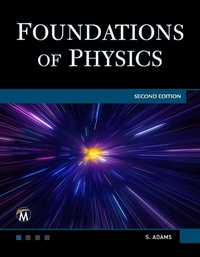
Foundations of Physics
2nd Edition
Published on 13. April 2023
650 pages
978-1-68392-969-7 (ISBN)
Description

This updated edition is designed as a self-teaching, calculus-based introduction to the concepts of physics. Numerous examples, applications, and figures provide readers with simple explanations. Standard topics include vectors, conservation of energy, Newton's Laws, momentum, motion, gravity, relativity, waves, fluid mechanics, circuits, nuclear physics, astrophysics, and more. Features: - Designed as a calculus-based, introduction to the key concepts of physics
- Practical techniques, including the collection, presentation, analysis and evaluation of data, are discussed in the context of key experiments linked to the theoretical spine of the work
- Practical techniques, including the collection, presentation, analysis and evaluation of data, are discussed in the context of key experiments linked to the theoretical spine of the work
More details
Edition
2nd Revised edition
Language
English
Place of publication
Herndon, VA
United States
Target group
Professional and scholarly
US School Grade: College Graduate Student
Edition type
Revised edition
File size
41,57 MB
ISBN-13
978-1-68392-969-7 (9781683929697)
Copyright in bibliographic data and cover images is held by Nielsen Book Services Limited or by the publishers or by their respective licensors: all rights reserved.
Schweitzer Classification
Other editions
Additional editions
Steve Adams
Foundations of Physics
Book
05/2023
2nd Edition
Mercury Learning & Information
€89.95
Shipment within 3-4 weeks

Steve Adams
Foundations of Physics
E-Book
04/2023
2nd Edition
Mercury Learning and Information
from
€89.95
Available for download
Previous edition

Steve Adams
Foundations of Physics
E-Book
04/2019
1st Edition
Mercury Learning and Information
€42.99
Available for download
Person
Adams Steve :
Steve Adams, PhD, is a physics instructor, teacher trainer, and consultant for the Cambridge International Examinations.
Steve Adams, PhD, is a physics instructor, teacher trainer, and consultant for the Cambridge International Examinations.
Content
- Cover
- Half-Title
- Title
- Copyright
- Dedication
- Contents
- Preface
- Chapter 1: The Language of Physics
- 1.0 Introduction
- 1.1 The SI System of Units
- 1.1.1 Derived Units
- 1.1.2 Energy
- 1.1.3 Viscosity
- 1.2 Dimensions
- 1.2.1 Method of Dimensions
- 1.3 Scientific Notation, Prefixes, and Significant Figures
- 1.4 Uncertainties
- 1.4.1 Types of Uncertainty
- 1.4.2 Combining Uncertainties
- 1.5 Dealing with Random and Systematic Experimental Errors
- 1.5.1 Random Errors
- 1.5.2 Systematic Errors
- 1.6 Differential Calculus
- 1.6.1 Derivatives and Rates of Change
- 1.6.1.1 Second Derivatives
- 1.6.2 Maximum and Minimum Values
- 1.7 Differential Equations
- 1.8 Integral Calculus
- 1.9 Vectors and Scalars
- 1.9.1 Adding Vectors
- 1.9.2 Resolving Vectors into Components
- 1.9.3 Multiplying Vectors
- 1.9.3.1 Scalar Product
- 1.9.3.2 Vector Product
- 1.10 Symmetry Principles
- 1.11 Exercises
- Chapter 2: Representing and Analyzing Data
- 2.0 Introduction
- 2.1 Experimental Variables
- 2.2 Recording Data
- 2.3 Straight-Line Graphs
- 2.3.1 Interpreting Straight-Line Graphs
- 2.3.2 Analyzing Straight-Line Graphs
- 2.4 Plotting Graphs and Using Error Bars
- 2.4.1 Plotting Graphs by Hand
- 2.4.2 Finding a Gradient from a Straight-Line Graph
- 2.4.3 Using a Spreadsheet Program (e.g., Excel)
- 2.4.4 Using Error Bars
- 2.5 Logarithms
- 2.5.1 Logarithmic Scales and Logarithms
- 2.5.2 Using Logarithms
- 2.6 Testing Mathematical Relationships between Variables
- 2.6.1 Direct Proportion
- 2.6.2 Inverse Proportion
- 2.6.3 Inverse-Square Law
- 2.6.4 Power Law
- 2.6.5 Exponential Decay or Growth
- 2.7 Exercises
- Chapter 3: Capturing, Displaying, and Analyzing Motion
- 3.0 Introduction
- 3.1 Motion Terminology
- 3.2 Graphs of Motion
- 3.3 Equations of Motion for Constant Acceleration: The Suvat Equations
- 3.3.1 Derivation 1: From Graphs of Motion
- 3.3.2 Derivation 2: Using Calculus
- 3.4 Projectile Motion
- 3.4.1 Independence of Horizontal and Vertical Components of Motion
- 3.4.2 Parabolic Paths
- 3.4.3 The Range of a Projectile
- 3.5 Equation of Motion
- 3.6 Methods to Capture and Display Graphs of Motion
- 3.6.1 Motion Sensors and Dataloggers
- 3.6.2 Light Gates
- 3.6.3 Mobile Phones and Tablets
- 3.6.3.1 Accelerometer Sensor
- 3.6.3.2 Video Capture
- 3.7 Exercises
- Chapter 4: Forces and Equilibrium
- 4.1 Force as a Vector
- 4.1.1 Free-Body Diagrams
- 4.1.2 Resolving Forces
- 4.1.3 Finding a Resultant Force
- 4.2 Mass, Weight, and Center of Gravity
- 4.2.1 Mass
- 4.2.2 Weight
- 4.2.3 Center of Gravity
- 4.3 Equilibrium of Coplanar Forces
- 4.3.1 Using the Triangle of Forces to Solve Equilibrium Problems
- 4.3.2 Resolving Forces to Solve Equilibrium Problems
- 4.4 Turning Effects of a Force: Moments, Torques, and Couples
- 4.4.1 Moments and Torques
- 4.4.2 Resultant Moment
- 4.4.3 Couples
- 4.4.4 The Principle of Moments
- 4.5 Stability
- 4.5.1 Types of Mechanical Equilibrium
- 4.5.2 Degrees of Stability
- 4.6 Frictional Forces
- 4.6.1 The Origin of Frictional Forces Between Surfaces in Contact
- 4.6.2 Static and Dynamic (Kinetic) Friction
- 4.6.3 The Coefficients of Friction
- 4.6.4 Measuring the Coefficient of Static Friction
- 4.6.5 Measuring the Coefficient of Dynamic (Kinetic) Friction
- 4.7 Exercises
- Chapter 5: Newtonian Mechanics
- 5.0 Introduction
- 5.1 Newton's Laws of Motion
- 5.1.1 Newton's First Law of Motion
- 5.1.2 Galilean Relativity
- 5.1.3 Newton's Second Law of Motion
- 5.1.4 Free Fall
- 5.1.5 Newton's Third Law of Motion
- 5.2 Linear Momentum
- 5.2.1 Newton's Second Law in Terms of Linear Momentum
- 5.2.2 Impulse and Change of Momentum
- 5.2.3 Conservation of Linear Momentum
- 5.3 Work Energy and Power
- 5.3.1 Work
- 5.3.2 Gravitational Potential Energy Changes (Uniform Field)
- 5.3.3 Kinetic Energy
- 5.3.4 The Law of Conservation of Energy
- 5.3.5 Energy and Momentum in a 2D Collision
- 5.3.6 Energy Transfers
- 5.3.7 Power
- 5.4 Energy Resources
- 5.5 Propulsion Systems
- 5.5.1 Jet Propulsion
- 5.5.2 Rockets
- 5.5.3 Radiation Pressure
- 5.6 Frames of Reference
- 5.6.1 The Center of Mass Frame
- 5.6.2 The Galilean Transformation
- 5.7 Theoretical Mechanics
- 5.7.1 Force and Energy
- 5.7.2 Lagrangian Mechanics
- 5.8 Exercises
- Chapter 6: Fluids
- 6.0 Introduction
- 6.1 Hydrostatic Pressure
- 6.1.1 Excess Pressure Caused by a Column of Fluid
- 6.1.2 Atmospheric Pressure
- 6.1.3 Using a Manometer to Measure Pressure Differences
- 6.1.4 Barometers
- 6.1.5 Dams
- 6.2 Buoyancy and Archimedes Principle
- 6.2.1 Buoyancy Forces
- 6.2.2 Archimedes' Principle
- 6.2.3 Flotation
- 6.3 Viscosity
- 6.3.1 The Coefficient of Viscosity
- 6.4 Fluid Flow
- 6.4.1 Laminar and Turbulent Flow
- 6.4.2 The Equation of Continuity
- 6.4.3 Drag Forces in a Fluid
- 6.4.4 Stokes' Law
- 6.4.5 Turbulent Drag
- 6.4.6 The Bernoulli Equation
- 6.4.7 The Bernoulli Effect
- 6.4.8 Viscous Flow Through a Horizontal Pipe - The Poiseuille Equation
- 6.4.9 Measuring the Coefficient of Viscosity
- 6.5 Measuring Fluid Flow Rates
- 6.5.1 A Venturi Meter
- 6.5.2 A Pitot Tube
- 6.6 Exercises
- Chapter 7: Mechanical Properties
- 7.1 Density
- 7.2 Inter-atomic Forces
- 7.3 Stretching Springs
- 7.3.1 The Spring Constant
- 7.3.2 Springs in Series and in Parallel
- 7.3.3 Elastic Potential Energy (Strain Energy)
- 7.4 Stress and Strain
- 7.4.1 The Young's Modulus
- 7.4.2 Experimental Measurement of Young's Modulus for a Metal Wire
- 7.4.3 Stress Versus Strain Graph for a Ductile Metal
- 7.4.4 Rubber Hysteresis
- 7.5 Material Terminology
- 7.6 Material Types
- 7.7 Exercises
- Chapter 8: Thermal Physics
- 8.0 Introduction
- 8.1 Thermal Equilibrium
- 8.2 Measuring Temperature
- 8.3 Temperature Scales
- 8.4 Heat Transfer Mechanisms
- 8.4.1 Conduction
- 8.4.2 Convection
- 8.4.3 Radiation
- 8.5 Black Body Radiation
- 8.6 Heat Capacities
- 8.6.1 Specific Heat Capacity
- 8.6.2 Molar Heat Capacities of Gases
- 8.6.3 Measuring Specific Heat Capacity
- 8.7 Specific Latent Heat
- 8.8 Exercises
- Chapter 9: Gases
- 9.1 The Gas Laws
- 9.1.0 Introduction
- 9.1.1 Boyle's Law
- 9.1.2 Charles's Law
- 9.1.3 Gay Lussac's Law (The Pressure Law)
- 9.2 The Ideal Gas Equation
- 9.3 The Kinetic Theory of Gases
- 9.3.1 Assumptions of the Kinetic Theory
- 9.3.2 Explaining Gas Pressure
- 9.3.3 Molecular Kinetic Energy and Temperature
- 9.3.4 Molar Heat Capacities of an Ideal Monatomic Gas
- 9.3.5 Equipartition of Energy
- 9.3.6 The Law of Dulong and Petit
- 9.3.7 Graham's Law of Diffusion
- 9.3.8 The Speed of Sound in a Gas
- 9.4 The Maxwell Distribution
- 9.5 The Boltzmann Factor and Activation Processes
- 9.6 The First Law of Thermodynamics
- 9.6.1 Internal Energy
- 9.6.2 Heating, Working, and the First Law of Thermodynamics
- 9.6.3 Work Done by an Ideal Gas
- 9.6.4 Thermodynamic Changes
- 9.7 Heat Engines and Indicator Diagrams
- 9.7.1 What Is a Heat Engine?
- 9.7.2 Indicator Diagrams
- 9.7.3 The Otto Cycle
- 9.7.4 The Diesel Cycle
- 9.8 Exercises
- Chapter 10: Statistical Thermodynamics and the Second Law
- 10.0 Introduction
- 10.1 Reversible and Irreversible Processes
- 10.2 The Second Law of Thermodynamics as a Macroscopic Principle
- 10.2.1 Macroscopic Statements of the Second Law
- 10.2.2 Heat Transfer and Entropy
- 10.2.3 Entropy and Maximum Efficiency of a Heat Engine
- 10.3 Entropy and Number of Ways
- 10.3.1 Macro-state and Micro-states
- 10.3.2 Entropy and Number of Ways
- 10.3.3 Poincaré Recurrence
- 10.4 What Is Temperature?
- 10.5 Absolute Zero and Absolute Entropy
- 10.5.1 Entropy at Absolute Zero
- 10.5.2 Calculating Absolute Entropy
- 10.5.3 Entropy Changes for an Ideal Gas
- 10.6 Refrigerators and Heat Pumps
- 10.6.1 Refrigerators
- 10.6.2 Heat Pumps
- 10.7 Implications of the Second Law
- 10.7.1 The Second Law, the Arrow of Time, and the Universe
- 10.7.2 The Second Law and Living Things
- 10.7.3 Entropy and Energy Availability
- 10.8 Exercises
- Chapter 11: Oscillations
- 11.0 Oscillations
- 11.1 Capturing and Displaying Oscillatory Motion
- 11.1.1 Graphs and Equations of Displacement, Velocity, and Acceleration
- 11.1.2 Phase and Phase Difference
- 11.2 Simple Harmonic Motion
- 11.2.1 Equation of Motion for Simple Harmonic Motion
- 11.2.2 Physical Conditions for Simple Harmonic Motion
- 11.3 The Mass-Spring Oscillator
- 11.4 The Simple Pendulum
- 11.5 Energy in Simple Harmonic Motion
- 11.5.1 Variation of Energy with Time
- 11.5.2 Variation of Energy with Position
- 11.5.3 Damping
- 11.6 Forced Oscillations and Resonance
- 11.7 Exercises
- Chapter 12: Rotational Dynamics
- 12.0 Introduction
- 12.1 Angles
- 12.1.1 Measuring Angles in Radians
- 12.1.2 Small Angle Approximations
- 12.2 Describing Uniform Circular Motion
- 12.2.1 Angular Displacement, Angular Velocity, and Angular Acceleration
- 12.3 Centripetal Acceleration and Centripetal Force
- 12.3.1 Centripetal Acceleration
- 12.3.2 Centripetal Force
- 12.3.3 Centripetal Not Centrifugal
- 12.3.4 Moving in Uniform Circular Motion
- 12.4 Circular Motion, Simple Harmonic Motion, and Phasors
- 12.5 Rotational Kinematics
- 12.5.1 Equations for Uniform Angular Acceleration
- 12.5.2 Rotational Kinetic Energy
- 12.5.3 Angular Momentum
- 12.5.4 The Second Law of Motion for Rotation.
- 12.5.5 Conservation of Angular Momentum
- 12.6 Deriving Expressions for Moments of Inertia
- 12.6.1 Moment of Inertia of One or More Point Masses
- 12.6.2 Moment of Inertia of a Rod
- 12.6.3 Moment of Inertia of a Cylindrical Shell and a Uniform Cylinder
- 12.6.4 Moment of Inertia of a Uniform Sphere
- 12.7 Torque Work and Power
- 12.8 Rotational Oscillations, the Compound Pendulum
- 12.9 Exercises
- Chapter 13: Waves
- 13.0 Introduction
- 13.1 Describing and Representing Waves
- 13.1.1 Basic Wave Terminology
- 13.1.2 Transverse and Longitudinal Waves
- 13.1.3 Graphs of Wave Motion
- 13.1.4 Equation for a One-Dimensional Traveling Wave
- 13.1.5 Amplitude and Intensity
- 13.2 Reflection
- 13.3 Refraction
- 13.3.1 Refraction at a Boundary Between Two Different Media
- 13.3.2 Snell's Law of Refraction
- 13.3.3 Absolute and Relative Refractive Indices
- 13.3.4 Total Internal Reflection
- 13.3.5 Optical Fibers
- 13.3.6 Dispersion
- 13.4 Polarization
- 13.4.1 What Is Polarization?
- 13.4.2 Polarizing Filters
- 13.4.3 Rotation of the Plane of Polarization
- 13.4.4 Polarization by Reflection and Scattering
- 13.5 Exercises
- Chapter 14: Light
- 14.1 Light as an Electromagnetic Wave
- 14.1.1 Waves or Particles?
- 14.1.2 Electromagnetism
- 14.1.3 Electromagnetic Waves
- 14.1.4 Measuring the Speed of Light
- 14.1.5 Maxwell's Equations and the Speed of Light
- 14.1.6 Defining Speed, Time, and Distance
- 14.2 Ray Optics
- 14.2.1 Thin Lenses
- 14.2.2 Predictable Rays for Thin Lenses
- 14.2.3 Images
- 14.2.4 Image Formation with a Convex Lens
- 14.2.5 Image Formation with a Concave Lens
- 14.2.6 Object at Infinity
- 14.2.7 The Lens Equation
- 14.2.8 Virtual Image Formed by a Plane Mirror
- 14.2.9 Real and Apparent Depth
- 14.3 Optical Instruments
- 14.3.1 An Astronomical Refracting Telescope
- 14.3.2 An Astronomical Reflecting Telescope (Newtonian Telescope)
- 14.3.3 A Compound Microscope
- 14.4 The Doppler Effect
- 14.4.1 The Doppler Effect for Electromagnetic Waves
- 14.4.2 "Red Shift" and "Blue Shift"
- 14.5 Exercises
- Chapter 15: Superposition Effects
- 15.0 Superposition Effects
- 15.1 Two-Source Interference
- 15.1.1 Demonstrating Superposition Effects with Sound
- 15.1.2 Demonstrating Superposition Effects with Light
- 15.1.3 Using the Double Slit Experiment to Find the Wavelength of Light
- 15.1.4 Superposition of Harmonic Waves
- 15.2 Diffraction Gratings
- 15.2.1 The Diffraction Grating Formula
- 15.2.2 Spectroscopy
- 15.2.3 Spectrometers
- 15.3 Diffraction by Slits and Holes
- 15.3.1 Diffraction by a Narrow Slit
- 15.3.2 Analysis of the Single Slit Diffraction Pattern
- 15.3.3 Diffraction Through a Circular Hole
- 15.3.4 Resolving Power and the Rayleigh Criterion
- 15.4 Standing (Stationary) Waves
- 15.4.1 Standing Waves on a String (Melde's Experiment)
- 15.4.2 The Mathematics of Standing Waves
- 15.5 Exercises
- Chapter 16: Sound
- 16.1 The Nature and Speed of Sound
- 16.2 The Decibel Scale
- 16.3 Standing Waves in Air Columns
- 16.4 Measuring the Speed of Sound
- 16.5 Ultrasound
- 16.6 Analysis and Synthesis of Sound
- 16.7 Exercises
- Chapter 17: Electric Charge and Electric Fields
- 17.1 Electric Charge
- 17.2 Electrostatics
- 17.2.1 Charging by Friction
- 17.2.2 The Gold Leaf Electroscope
- 17.2.3 Using a Coulomb Meter
- 17.3 Electrostatic Forces
- 17.3.1 Coulomb's Law
- 17.3.2 Investigating Electrostatic Forces
- 17.4 The Electric Field
- 17.4.1 Electric Field Strength
- 17.4.2 Electric Field Strength of a Point Charge
- 17.4.3 Gauss's Law
- 17.4.4 Using Gauss's Theorem
- 17.5 Electric Potential Energy and Electric Potential
- 17.5.1 Electric Potential and Potential Difference
- 17.5.2 Electric Potential Gradient and Electric Field Strength
- 17.5.3 Accelerating Charged Particles in an Electric Field
- 17.5.4 Deflecting Charged Particles in an Electric Field
- 17.5.5 The Absolute Electric Potential of a Point Charge
- 17.6 Exercises
- Chapter 18: DC Electric Circuits
- 18.0 Direct Current (DC) Circuits and Conventional Current
- 18.1 Charge and Current
- 18.1.1 Charge Carriers and Charge Carrier Density
- 18.1.2 Measuring Current
- 18.1.3 Currents in Circuits - Kirchhoff's First Law
- 18.2 Measuring Potential Difference
- 18.2.1 EMF Potential Difference and Voltage
- 18.2.2 Kirchhoff's Second Law
- 18.3 Resistance
- 18.3.1 Measuring Resistance
- 18.3.2 Current-Voltage Characteristics
- 18.3.3 Resistors in Series and in Parallel
- 18.3.4 Resistivity
- 18.4 Electrical Energy and Power
- 18.4.1 EMF and Internal Resistance of a Real Cell
- 18.4.2 Measuring the Internal Resistance and emf of a Cell
- 18.4.3 Power Transfer from a Real Cell to a Load Resistor
- 18.5 Resistance Networks
- 18.5.1 Potential Dividers
- 18.5.2 Using Kirchhoff's Laws to Solve Resistance Networks
- 18.6 Semiconductors and Superconductors
- 18.6.1 Semiconductors
- 18.6.2 Variation of Resistance of a Metal with Temperature
- 18.7 Exercises
- Chapter 19: Capacitance
- 19.1 What Is a Capacitor?
- 19.1.1 Capacitors and Charge
- 19.1.2 Capacitance
- 19.1.3 Energy Stored on a Charged Capacitor
- 19.1.4 Efficiency of Charging a Capacitor
- 19.2 The Parallel Plate Capacitor
- 19.3 Capacitor Charging and Discharging
- 19.3.1 Equations for Capacitor Discharge
- 19.3.2 Equations for Capacitor Charging
- 19.4 Capacitors in Series and Parallel
- 19.4.1 Capacitance of Capacitors in Series
- 19.4.2 Capacitors in Parallel
- 19.5 The Capacitance of a Charged Sphere
- 19.6 Exercises
- Chapter 20: Magnetic Fields
- 20.0 The Magnetic Field
- 20.1 Permanent Magnets
- 20.2 Magnetic Forces on Electric Currents and Moving Charges
- 20.2.1 The Magnetic Force on an Electric Current
- 20.2.2 The Force on a Moving Charge
- 20.2.3 The Path of a Moving Charged Particle in a Magnetic Field
- 20.2.4 The Velocity-Selector: Crossed Electric and Magnetic Fields
- 20.3 The Magnetic Fields Created by Electric Currents
- 20.3.1 The Biot-Savart Law
- 20.3.2 The Magnetic Field at the Center of a Narrow Coil
- 20.3.3 The Magnetic Field of a Long Straight Current-Carrying Wire
- 20.3.4 The Magnetic Field Along the Axis of a Solenoid
- 20.3.5 Ampère's Theorem
- 20.4 Electric Motors
- 20.4.1 The Turning Effect on a Coil in a Uniform Magnetic Field
- 20.4.2 A Simple DC Electric Motor
- 20.5 Exercises
- Chapter 21: Electromagnetic Induction
- 21.1 Induced emfs
- 21.1.1 What Is Electromagnetic Induction?
- 21.1.2 Electromagnetic Induction Experiments
- 21.2 The Laws of Electromagnetic Induction
- 21.2.1 Magnetic Flux and Magnetic Flux Linkage
- 21.2.2 Faraday's Law of Electromagnetic Induction
- 21.2.3 Changing the Flux-Linkage in a Coil
- 21.3 Inductance
- 21.3.1 Self-inductance
- 21.3.2 The Rise of Current in an Inductor
- 21.3.3 The Energy Stored in an Inductor
- 21.3.4 Mutual Inductance
- 21.4 Transformers
- 21.4.1 An Ideal Transformer
- 21.4.2 Transmission of Electrical Energy
- 21.4.3 Real Transformers
- 21.5 A Simple AC Generator
- 21.6 Electromagnetic Damping
- 21.7 Induction Motors
- 21.8 Exercises
- Chapter 22: AC
- 22.1 AC and DC
- 22.1.1 AC Power and rms Values
- 22.2 Resistance and Reactance
- 22.2.1 Resistors in AC Circuits
- 22.2.2 Capacitors in AC Circuits
- 22.2.3 Inductors in AC Circuits
- 22.3 Resistance, Reactance, and Impedance
- 22.3.1 Phasor Diagrams for AC Series Circuits
- 22.3.2 Impedance
- 22.4 AC Series Circuits
- 22.4.1 RC Series Circuit
- 22.4.2 RL Series Circuit
- 22.4.3 RCL Series Circuit
- 22.4.4 Parallel Circuits Containing Resistors, Capacitors, and Inductors
- 22.5 Electric Oscillators
- 22.5.1 A Mechanical Analogy
- 22.6 Exercises
- Chapter 23: The Gravitational Field
- 23.1 Gravitational Forces and Gravitational Field Strength
- 23.1.1 Newton's Law of Gravitation
- 23.1.2 Gravitational Field Strength
- 23.1.3 The Gravitational Field Strength of the Earth
- 23.2 Gravitational Potential Energy and Gravitational Potential
- 23.2.1 Change in Gravitational Potential Energy
- 23.2.2 Gravitational Potential
- 23.2.3 Gravitational Field Lines and Equipotentials
- 23.2.4 Gravitational Potential Energy in the Earth's Field
- 23.2.5 Escape Velocity
- 23.3 Orbital Motion
- 23.3.1 Early Ideas About Planetary Motion
- 23.3.2 Circular Orbits
- 23.3.3 Artificial Satellites
- 23.4 Tidal Forces
- 23.4.1 The Origin of Tidal Forces
- 23.4.2 The Earth's Ocean Tides
- 23.5 Einstein's Theory of Gravitation
- 23.5.1 Space-Time Curvature
- 23.5.2 The Equivalence Principle
- 23.5.3 Gravitational Time Dilation
- 23.5.4 Gravitational Waves
- 23.6 Exercises
- Chapter 24: Special Relativity
- 24.1 The Postulates of Special Relativity
- 24.1.1 Absolute Space
- 24.1.2 Einstein's Ideas About the Laws of Physics
- 24.2 Time in Special Relativity
- 24.2.1 Time Dilation
- 24.2.2 The "Twin Paradox"
- 24.2.3 The Relativity of Simultaneity
- 24.3 Length Contraction
- 24.4 The Lorentz Transformation
- 24.4.1 The Lorentz Transformation Equations
- 24.4.2 The Velocity Addition Equation
- 24.5 Mass, Velocity, and Energy
- 24.5.1 Mass and Velocity
- 24.5.2 Mass and Energy
- 24.6 Special Relativity and Geometry
- 24.6.1 Invariants
- 24.6.2 Space-Time
- 24.6.3 Mass, Energy, and Momentum
- 24.7 Exercises
- Chapter 25: Atomic Structure and Radioactivity
- 25.1 The Nuclear Atom
- 25.1.1 The Rutherford Scattering Experiment
- 25.1.2 Closest Approach and Nuclear Size
- 25.1.3 Using Electron Diffraction to Measure Nuclear Diameter
- 25.1.4 The Nuclear Atom
- 25.2 Ionizing Radiation
- 25.2.1 Types of Ionizing Radiation Emitted by Radioactive Sources
- 25.3 Attenuation of Ionizing Radiation
- 25.3.1 Inverse-Square Law of Absorption
- 25.3.2 Exponential Absorption and the Attenuation Coefficient
- 25.3.3 Absorption of Beta Radiation
- 25.3.4 Absorption of Alpha Particles
- 25.4 The Biological Effects of Ionizing Radiation
- 25.4.1 The Natural Background Radiation
- 25.4.2 Measuring Radiation Dose
- 25.4.3 The Effect of Radiation Dose on Human Health
- 25.4.4 Reducing Risks in the Laboratory
- 25.5 Radioactive Decay and Half-Life
- 25.6 Nuclear Transformations
- 25.6.1 Alpha Decay
- 25.6.2 Beta-Minus Decay
- 25.6.3 Gamma Emission
- 25.6.4 Beta-Plus Emission
- 25.6.5 Electron-Capture
- 25.7 Radiation Detectors
- 25.7.1 The Spark Counter
- 25.7.2 The Geiger Counter
- 25.7.3 Using a Geiger Counter to Measure Count Rates
- 25.8 Using Radioactive Sources
- 25.8.1 Radiological Dating
- 25.8.2 Radiological Dating of Rocks
- 25.9 Exercises
- Chapter 26: Nuclear Physics
- 26.1 Nuclear Energy Changes
- 26.1.1 Nuclear Binding Energy
- 26.1.2 Atomic Mass Units (amu)
- 26.1.3 Energy Released by Nuclear Decays
- 26.2 Nuclear Stability
- 26.2.1 Nuclear Configuration and Stability
- 26.2.2 Nuclear Binding Energy and Stability
- 26.3 Nuclear Fission and Nuclear Fusion
- 26.3.1 Nuclear Fission
- 26.3.2 The Principle of the Atomic Bomb
- 26.3.3 Nuclear Reactors
- 26.3.4 Plutonium
- 26.3.5 Nuclear Fusion
- 26.3.6 Nucleosynthesis
- 26.3.7 Thermonuclear Weapons
- 26.3.8 Fusion Reactors
- 26.4 Particle Physics
- 26.4.1 Leptons
- 26.4.2 Hadrons and Quarks
- 26.4.3 The Fundamental Interactions
- 26.4.4 The Conservation Laws
- 26.4.5 The Standard Model
- 26.4.6 Dark Matter and Dark Energy
- 26.5 Exercises
- Chapter 27: Quantum Theory
- 27.1 Problems in Classical Physics
- 27.1.1 Planck and the Black Body Radiation Spectrum
- 27.1.2 Explaining Heat Capacities
- 27.1.3 Explaining the Photoelectric Effect
- 27.1.4 Characteristics of Photoelectric Emission
- 27.1.5 Measuring the Planck Constant
- 27.2 Matter Waves
- 27.2.1 The de Broglie Relation
- 27.2.2 Electron Diffraction
- 27.2.3 The Compton Effect
- 27.3 Wave-Particle Duality
- 27.3.1 Young's Double Slit Experiment Revisited
- 27.3.2 Interpreting Wave-Particle Duality
- 27.3.3 The Schrödinger Equation
- 27.4 The Quantum Atom
- 27.4.1 Bohr's Model of the Hydrogen Atom
- 27.4.2 Explaining the Hydrogen Line Spectrum
- 27.4.3 Electron Waves in Atoms
- 27.4.4 The Schrödinger Atom
- 27.5 Interpretations of Quantum Theory
- 27.5.1 The Copenhagen Interpretation
- 27.5.2 Heisenberg's Uncertainty (Indeterminacy) Principle
- 27.5.3 The Sum-Over-Histories Approach
- 27.5.4 The Many-Worlds Theory
- 27.5.5 Schrödinger's Cat
- 27.6 Exercises
- Chapter 28: Astrophysics
- 28.0 Physics Astrophysics and Cosmology
- 28.1 Stars
- 28.1.1 Mass
- 28.1.2 Stars as Black Bodies
- 28.1.3 Stellar Spectra and the Hertzsprung-Russell Diagram
- 28.2 Distances
- 28.2.1 Trigonometric Parallax
- 28.2.2 The Inverse-Square Law and Cepheid Variables
- 28.2.3 Hubble's Law
- 28.3 Cosmology
- 28.3.1 The Origin and Age of the Universe
- 28.3.2 Evidence for the Big Bang
- 28.4 Exercises
- Chapter 29: Medical Physics
- 29.1 Ultrasound
- 29.1.1 Overview of Ultrasound
- 29.1.2 Ultrasound and the Eye
- 29.1.3 Doppler Ultrasound for Blood Flow Measurements
- 29.1.4 Using Ultrasound to Break Kidney Stones
- 29.2 X-rays
- 29.2.1 Overview of Medical X-rays
- 29.2.2 Generating X-Rays
- 29.2.3 Attenuation of X-Rays in Matter
- 29.2.4 Creating X-Ray Images
- 29.3 Magnetic Resonance Imaging (MRI)
- 29.3.1 Overview of MRI
- 29.3.2 The Physics of MRI
- 29.4 Radioactive Tracers
- 29.4.1 Overview of the Use of Radioactive Tracers
- 29.4.2 The Gamma-Camera
- 29.5 Positron Emission Tomography (PET Scans)
- 29.5.1 The Physics of PET Scans
- 29.6 Exercises
- Appendix A: Estimations and Fermi Questions
- A.0 Fermi and the Trinity Test
- A.1 Making Estimations
- A.1.1 How Many Air Molecules in the Earth's Atmosphere?
- A.1.2 What Is the Minimum Area for a Parachute?
- A.2 Useful Values
- A.3 Fermi Questions
- A.4 The Drake Equation
- A.5 Try These: Estimates and Fermi Questions
- Appendix B: Experimental Investigations
- B.0 Introduction: The Nature of Science
- B.1 Carrying Out an Experiment
- B.1.1 Variables
- B.1.2 Selecting Measuring Equipment
- B.1.3 Planning a Procedure
- B.1.4 Risk Assessments
- B.1.5 Writing Up an Experiment
- B.2 Investigations
- Appendix C: Units, Constants, and Equations
- C.1 SI Units
- C.2 Simple Approximate Combinations of Uncertainties
- C.3 Useful Derivatives
- C.4 Differential Equations
- C.5 Differentials and Integrals
- C.6 Equations
- C.7 Constants
- Appendix D: Solutions to Exercises
- Glossary
- Index
