

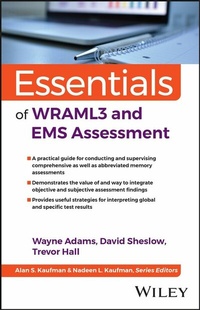
Essentials of WRAML3 and EMS Assessment
Description

Develop your memory assessment expertise with WRAML3 and EMS mastery
Essentials of WRAML3 and EMS Assessment allows you to dive deep into the intricacies of memory assessment and gain proficiency in making holistic, meaningful recommendations on the basis of test scores and subjective assessments. Explore the latest enhancements in the second version of WRAML, featuring a Performance Validity measure, heightened emphasis on delayed recall and working memory, more nuanced scoring, and an additional abbreviated format. This book will also help you develop expertise in administering the subjective EMS assessment tool, capturing everyday memory in addition to the more clinical information offered by the WRAML.
- Understand the nuances of memory assessment with visual cues highlighting crucial points
- Develop practical expertise with step-by-step guidelines that go beyond the official testing manuals.
- Gain a deeper knowledge of memory assessment with integrated theoretical and research content
- Enhance your own professional development or train students and colleagues in a multifaceted memory assessment approach
This comprehensive guide will elevate your memory assessment skills for children and adults, ensuring your recommendations are both informed and impactful.
More details
Other editions
Additional editions
Persons
WAYNE ADAMS, PHD, is Professor Emeritus of Psychology at George Fox University. He is a Fellow of APA's Division of Clinical Psychology, and the recipient of a Lifetime Achievement Award from the School Neuropsychology Institute.
DAVID SHESLOW, PHD, retired as Chief Psychologist and Head of the Division of Behavioral Health at Nemours Hospital for Children. He developed, along with Wayne Adams, the Wide Range Assessment of Memory and Learning.
TREVOR HALL, PsyD, is a Professor of Pediatrics in the Divisions of Pediatric Psychology and Pediatric Critical Care at Oregon Health & Science University, where he serves as the Associate Director of the Pediatric Critical Care and Neurotrauma Recovery Program.
Content
Series Preface xi
Acknowledgments xiv
One Essentials of Memory Measurement Using the WRAML3 and the EMS: Introduction and Overview 1
Two Measuring Memory: Foundations 9
Three Overview of the WRAML3 35
Four Interpreting WRAML3 Subtests, Indexes, and Process Scores 71
Five WRAML3 Interpretation: Levels of Analysis 148
Six WRAML3 Abbreviated Formats 165
Seven Integrated Interpretation of the WRAML3 181
Eight Everyday Memory Survey: Overview, Administration, and Scoring 220
Nine Uses and Interpretive Considerations for the Everyday Memory Survey 233
Ten Q&A with the Authors 249
References 266
About the Authors 276
Index 279
