

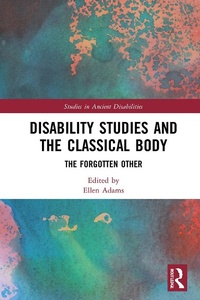
Disability Studies and the Classical Body
The Forgotten Other
1st Edition
Published on 13. May 2021
294 pages
978-1-000-38133-7 (ISBN)
Description

By triangulating the Greco-Roman world, classical reception, and disability studies, this book presents a range of approaches that reassess and reimagine traditional themes, from the narrative voice to sensory studies.
It argues that disability and disabled people are the 'forgotten other' of not just Classics, but also the Humanities more widely. Beyond the moral merits of rectifying this neglect, this book also provides a series of approaches and case studies that demonstrate the intellectual value of engaging with disability studies as classicists and exploring the classical legacy in the medical humanities. The book is presented in four parts: 'Communicating and controlling impairment, illness and pain'; 'Using, creating and showcasing disability supports and services'; 'Real bodies and retrieving senses: disability in the ritual record'; and 'Classical reception as the gateway between Classics and disability studies'. Chapters by scholars from different academic backgrounds are carefully paired in these sections in order to draw out further contrasts and nuances and produce a sum that is more than the parts. The volume also explores how the ancient world and its reception have influenced medical and disability literature, and how engagements with disabled people might lead to reinterpretations of familiar case studies, such as the Parthenon.
This book is primarily intended for classicists interested in disabled people in the Greco-Roman past and in how modern disability studies may offer insights into and reinterpretations of historic case studies. It will also be of interest to those working in medical humanities, sensory studies, and museum studies, and those exploring the wider tension between representation and reality in ancient contexts. As such, it will appeal to people in the wider Humanities who, notwithstanding any interest in how disabled people are represented in literature, art, and cinema, have had less engagement with disability studies and the lived experience of people with impairments.
It argues that disability and disabled people are the 'forgotten other' of not just Classics, but also the Humanities more widely. Beyond the moral merits of rectifying this neglect, this book also provides a series of approaches and case studies that demonstrate the intellectual value of engaging with disability studies as classicists and exploring the classical legacy in the medical humanities. The book is presented in four parts: 'Communicating and controlling impairment, illness and pain'; 'Using, creating and showcasing disability supports and services'; 'Real bodies and retrieving senses: disability in the ritual record'; and 'Classical reception as the gateway between Classics and disability studies'. Chapters by scholars from different academic backgrounds are carefully paired in these sections in order to draw out further contrasts and nuances and produce a sum that is more than the parts. The volume also explores how the ancient world and its reception have influenced medical and disability literature, and how engagements with disabled people might lead to reinterpretations of familiar case studies, such as the Parthenon.
This book is primarily intended for classicists interested in disabled people in the Greco-Roman past and in how modern disability studies may offer insights into and reinterpretations of historic case studies. It will also be of interest to those working in medical humanities, sensory studies, and museum studies, and those exploring the wider tension between representation and reality in ancient contexts. As such, it will appeal to people in the wider Humanities who, notwithstanding any interest in how disabled people are represented in literature, art, and cinema, have had less engagement with disability studies and the lived experience of people with impairments.
Reviews / Votes
"With its exploratory approach and chapters addressing a wide range of different topics and methods, this collection represents an admirable contribution to a growing appreciation for a disability-informed approach to Humanities research generally... I am grateful to the volume's editor and authors for a volume that has the potential to provoke readers into considering how disability can inform their own work and teaching."- Bryn Mawr, Classical Review
"The book constitutes a rich and dense contribution to the field of ancient disability studies. Ellen Adams' effort to position herself at the crossroads of several historiographies also makes her an excellent starting point for readers who would discover the field."-Helene Castelli, Anabases
More details
Series
Edition
1. Auflage
Language
English
Place of publication
London
United Kingdom
Publishing group
Taylor & Francis Ltd
Target group
College/higher education
Illustrations
4 Tables, black and white; 19 Halftones, black and white; 19 Illustrations, black and white
ISBN-13
978-1-000-38133-7 (9781000381337)
Copyright in bibliographic data and cover images is held by Nielsen Book Services Limited or by the publishers or by their respective licensors: all rights reserved.
Schweitzer Classification
Other editions
Additional editions
Book
05/2023
1st Edition
Routledge
€63.70
Shipment within 15-20 days
Book
05/2021
1st Edition
Routledge
€206.80
Shipment within 15-20 days
Book
05/2021
Routledge
Unfortunately, price unknown
Available (delivery time upon request)
Person
Ellen Adams is Senior Lecturer in Classical Art and Archaeology at King's College London, UK. She has published extensively on Minoan Crete, including a book entitled Cultural Identity in Minoan Crete: Social Dynamics in the Neopalatial Period (2017, CUP). For many years, she has also investigated how a dialogue between disability studies and Classics might enhance both disciplines.
Content
List of figures; List of tables; Contributors; Foreword by Lennard J. Davies; Acknowledgments; Chapter 1. 'Disability studies and the classical body: the forgotten other. Introduction', Ellen Adams; Part 1. Communicating and controlling impairment, illness and pain; Introduction, Ellen Adams; Chapter 2. Two troubles: the dramatic tragedy of Western medicine, Michael J. Flexer and Brian Hurwitz; Chapter 3. 'There is a pain - so utter': Narrating chronic pain and disability in antiquity and modernity, Georgia Petridou; Part 2. Using, creating and showcasing disability supports and services; Introduction, Ellen Adams; Chapter 4. Prostheses in classical antiquity: a taxonomy, Jane Draycott; Chapter 5. Displaying the forgotten other in museums: prostheses at the National Museums Scotland, Sophie Goggins; Chapter 6. New light on 'the viewer': sensing the Parthenon galleries in the British Museum, Ellen Adams; Part 3. Real bodies and retrieving senses: disability in the ritual record; Introduction, Ellen Adams; Chapter 7. Interactional sensibilities: bringing ancient disability studies to its archaeological senses, Emma-Jayne Graham; Chapter 8. Rational capacity and incomplete adults: the mentally impaired in classical antiquity, Patricia Baker and Sarah Francis; Part 4: Classical reception as the gateway between Classics and disability studies; Introduction, Ellen Adams; 9. The immortal forgotten other gang: dwarf Cedalion, lame Hephaestus, and blind Orion, Edith Hall; 10. A history of our own? Using Classics in disability histories, Helen King; Index
