

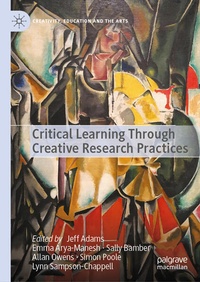
Critical Learning Through Creative Research Practices
Description

This book features international and interdisciplinary research into socially engaged, relational and critical creative practices. It comprises a range of authors who bring diverse cultural perceptions to bear on critical creativity and social learning through arts-based research practices and creative pedagogies. This network of authors from organisations and universities across Europe, Palestine and Japan have shared their research through RECAP (Research into Education, Creativity and Arts through Practice), a progressive arts-based research centre coordinated at the University of Chester, UK. The book is in two parts; the first, Culture and Community, comprises chapters that cover creative pedagogies in teacher education, languages, urban development, risk, creative writing, storytelling and educational ecosystems; the second, Methods and Models, consists of chapters on creative methodologies, graphic novels, poetry, children's voices, social trauma and performance, play rituals, management innovation and drama and theatre in education.
More details
Other editions
Additional editions
Persons
Jeff Adams is Emeritus Professor in the Department of Education at the University of Chester, UK.
Emma Arya-Manesh is Senior Researcher in the Department of Education at the University of Chester, UK.
Sally Bamber is Senior Lecturer in the Department of Education at the University of Chester, UK.
Allan Owens is Emeritus Professor in the Department of Education at the University of Chester, UK.
Simon Poole is Associate Professor in the Department of Education at the University of Chester, UK.
Lynn Sampson-Chappell is Senior Lecturer in the School of Education, Liverpool John Moores University, UK
Content
Chapter 1: Introduction.- Chapter 2: Data Drama: Critical Learning in an Immersive Drama Experience for Finnish High School Students.- Chapter 3: Creatively and Critically Reimagining The Ragged-Trousered Philanthropists .- Chapter 4: Navigating Risk in Collaborative Lesson Research.- Chapter 5: Reconceptualising Educational Assumptions in a Creative Pedagogy Summer School in Palestine.- Chapter 6: Empowering Children's Voice Globally Through Creative Participatory Methods.- Chapter 7: Critical Reflection on Applied Drama Activity in the Post Evacuee Zone of the Fukashima Daiichi Nuclear Plant: An Affective Neuroscience Point of View.- Chapter 8: To Cope With What's to Come: Using Utopian Stories to Build Literacy.- Chapter 9: Theatre in Education: Critical-Creativity, Care and Culture on the Floor in Norwegian, Danish and Italian Universities.- Chapter 10: Developing a Stage Model of the Play-Ritual Continuum's Underpinning Process.- Chapter 11: Keeping Languages in Mind and Body: An Investigation of Critical Creativity in Language Teacher Education.- Chapter 12: Creativity in English Teaching: Exploring Experience Through Poetry.- Chapter 13: Navigating Methodology and Methods in Arts-Based Research.- Chapter 14: Entering the Ecotone: Exploring Stories Through Process Drama in Teacher Education.- Chapter 15: Creating Elena: Constructing a Creative Intergenerational Legacy.
