

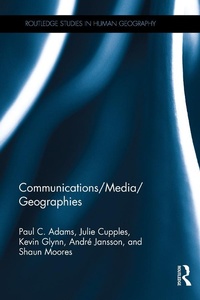
Communications/Media/Geographies
1st Edition
Published on 19. September 2016
214 pages
978-1-317-58105-5 (ISBN)
Description

Although there are human geographers who have previously written on matters of media and communication, and those in media and communication studies who have previously written on geographical issues, this is the first book-length dialogue in which experienced theorists and researchers from these different fields address each other directly and engage in conversation across traditional academic boundaries. The result is a compelling discussion, with the authors setting out statements of their positions before responding to the arguments made by others.
One significant aspect of this discussion is a spirited debate about the sort of interdisciplinary area that might emerge as a focus for future work. Does the already-established idea of communication geography offer the best way forward? If so, what would applied or critical forms of communication geography be concerned to do? Could communication geography benefit from the sorts of conjunctural analysis that have been developed in contemporary cultural studies? Might a further way forward be to imagine an interdisciplinary field of everyday-life studies, which would draw critically on non-representational theories of practice and movement?
Readers of Communications/Media/Geographies are invited to join the debate, thinking through such questions for themselves, and the themes that are explored in this book (for example, of space, place, meaning, power, and ethics) will be of interest not only to academics in human geography and in media and communication studies, but also to a wider range of scholars from across the humanities and social sciences.
One significant aspect of this discussion is a spirited debate about the sort of interdisciplinary area that might emerge as a focus for future work. Does the already-established idea of communication geography offer the best way forward? If so, what would applied or critical forms of communication geography be concerned to do? Could communication geography benefit from the sorts of conjunctural analysis that have been developed in contemporary cultural studies? Might a further way forward be to imagine an interdisciplinary field of everyday-life studies, which would draw critically on non-representational theories of practice and movement?
Readers of Communications/Media/Geographies are invited to join the debate, thinking through such questions for themselves, and the themes that are explored in this book (for example, of space, place, meaning, power, and ethics) will be of interest not only to academics in human geography and in media and communication studies, but also to a wider range of scholars from across the humanities and social sciences.
More details
Series
Edition
1. Auflage
Language
English
Place of publication
London
United Kingdom
Publishing group
Taylor & Francis Ltd
Target group
College/higher education
Product notice
Reflowable
Illustrations
4 s/w Abbildungen, 2 s/w Photographien bzw. Rasterbilder, 2 s/w Zeichnungen
2 Line drawings, black and white; 2 Halftones, black and white; 4 Illustrations, black and white
File size
1,14 MB
ISBN-13
978-1-317-58105-5 (9781317581055)
Copyright in bibliographic data and cover images is held by Nielsen Book Services Limited or by the publishers or by their respective licensors: all rights reserved.
Schweitzer Classification
Other editions
Additional editions
Paul C. Adams | Julie Cupples | Kevin Glynn
Communications/Media/Geographies
Book
05/2018
1st Edition
Routledge
€71.20
Shipment within 10-20 days
Paul C. Adams | Julie Cupples | Kevin Glynn
Communications/Media/Geographies
Book
09/2016
1st Edition
Routledge
€232.70
Shipment within 10-20 days
Persons
Paul C. Adams is Professor of Geography at the University of Texas at Austin, USA.
Julie Cupples is Reader in Human Geography and Co-director of the Global Development Academy at the University of Edinburgh, UK.
Kevin Glynn teaches in the Media Studies program at Massey University in Wellington, New Zealand.
Andre Jansson is Professor of Media and Communication Studies and Director of the Geomedia Research Group at Karlstad University, Sweden.
Shaun Moores is Professor of Media and Communications at the Centre for Research in Media and Cultural Studies, University of Sunderland, UK.
Julie Cupples is Reader in Human Geography and Co-director of the Global Development Academy at the University of Edinburgh, UK.
Kevin Glynn teaches in the Media Studies program at Massey University in Wellington, New Zealand.
Andre Jansson is Professor of Media and Communication Studies and Director of the Geomedia Research Group at Karlstad University, Sweden.
Shaun Moores is Professor of Media and Communications at the Centre for Research in Media and Cultural Studies, University of Sunderland, UK.
Content
List of Figures
Preface
Introduction
Paul C. Adams, Julie Cupples, Kevin Glynn, and Andre Jansson
Part I: Positions
1. Communication Geography: Pragmatic Goals
Paul C. Adams
2. Postcolonial Spaces of Discursive Struggle in the Convergent Media Environment
Julie Cupples and Kevin Glynn
3. Critical Communication Geography: Space, Recognition, and the Dialectics of Mediatization
Andre Jansson
4. Arguments for a Non-Media-Centric, Non-Representational Approach to Media and Place
Shaun Moores
Part II: Reflections
5. For an Ethic of Broader Recognition
Paul C. Adams
6. For Representation and Geographic Specificity
Julie Cupples and Kevin Glynn
7. For Communication Geography
Andre Jansson
8. For Everyday-Life Studies
Shaun Moores
9. Parting Thoughts
Paul C. Adams, Julie Cupples, Kevin Glynn, Andre Jansson and Shaun Moores
Index
Preface
Introduction
Paul C. Adams, Julie Cupples, Kevin Glynn, and Andre Jansson
Part I: Positions
1. Communication Geography: Pragmatic Goals
Paul C. Adams
2. Postcolonial Spaces of Discursive Struggle in the Convergent Media Environment
Julie Cupples and Kevin Glynn
3. Critical Communication Geography: Space, Recognition, and the Dialectics of Mediatization
Andre Jansson
4. Arguments for a Non-Media-Centric, Non-Representational Approach to Media and Place
Shaun Moores
Part II: Reflections
5. For an Ethic of Broader Recognition
Paul C. Adams
6. For Representation and Geographic Specificity
Julie Cupples and Kevin Glynn
7. For Communication Geography
Andre Jansson
8. For Everyday-Life Studies
Shaun Moores
9. Parting Thoughts
Paul C. Adams, Julie Cupples, Kevin Glynn, Andre Jansson and Shaun Moores
Index
