

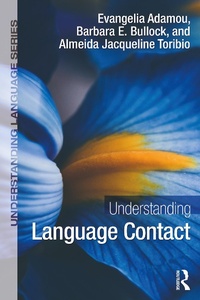
Understanding Language Contact
1st Edition
Published on 29. August 2023
224 pages
978-1-000-90320-1 (ISBN)
Description

Understanding Language Contact offers an accessible and empirically grounded introduction to contact linguistics. Rather than taking a traditional focus on the outcomes of language contact, this book takes the novel approach of considering these outcomes as an endpoint of bilingualism and multilingualism. Covering speech production and comprehension, language diffusion across different interactional networks and timeframes, and the historical outcomes of contact-induced language change, this book:
Discusses both how these areas relate to one another and how they correspond to different theoretical fields and methodologies;
Draws together concepts and methodological/theoretical advances from the related fields of bilingualism and sociolinguistics to show how these can shed new light on the traditional field of contact linguistics;
Presents up-to-date research in a digestible form;
Includes examples from a wide range of contact languages, including Creoles and pidgins; Indigenous, minority, and heritage languages; mixed languages; and immigrants' linguistic practices, to illustrate ideas and concepts;
Features exercises to test students' understanding as well as suggestions for further reading to expand knowledge in specific areas.
Written by three experienced teachers and researchers in this area, Understanding Language Contact is key reading for advanced undergraduate and postgraduate students approaching bilingualism and language contact for the first time.
Discusses both how these areas relate to one another and how they correspond to different theoretical fields and methodologies;
Draws together concepts and methodological/theoretical advances from the related fields of bilingualism and sociolinguistics to show how these can shed new light on the traditional field of contact linguistics;
Presents up-to-date research in a digestible form;
Includes examples from a wide range of contact languages, including Creoles and pidgins; Indigenous, minority, and heritage languages; mixed languages; and immigrants' linguistic practices, to illustrate ideas and concepts;
Features exercises to test students' understanding as well as suggestions for further reading to expand knowledge in specific areas.
Written by three experienced teachers and researchers in this area, Understanding Language Contact is key reading for advanced undergraduate and postgraduate students approaching bilingualism and language contact for the first time.
More details
Series
Edition
1. Auflage
Language
English
Place of publication
London
United Kingdom
Publishing group
Taylor & Francis Ltd
Target group
College/higher education
Illustrations
2 Tables, black and white; 7 Line drawings, black and white; 12 Halftones, black and white; 19 Illustrations, black and white
ISBN-13
978-1-000-90320-1 (9781000903201)
Copyright in bibliographic data and cover images is held by Nielsen Book Services Limited or by the publishers or by their respective licensors: all rights reserved.
Schweitzer Classification
Other editions
Additional editions

Evangelia Adamou | Barbara E. Bullock | Almeida Jacqueline Toribio
Understanding Language Contact
Book
08/2023
1st Edition
Routledge
€57.10
Shipment within 15-20 days

Evangelia Adamou | Barbara E. Bullock | Almeida Jacqueline Toribio
Understanding Language Contact
Book
08/2023
1st Edition
Routledge
€196.10
Shipment within 15-20 days
Persons
Evangelia Adamou is Senior Researcher at the CNRS, France.
Barbara E. Bullock is Professor of French Linguistics at The University of Texas at Austin, USA.
Almeida Jacqueline Toribio is Professor of Linguistics at The University of Texas at Austin, USA.
Barbara E. Bullock is Professor of French Linguistics at The University of Texas at Austin, USA.
Almeida Jacqueline Toribio is Professor of Linguistics at The University of Texas at Austin, USA.
Content
List of Abbreviations
Preface
Acknowledgments
PART I
From milliseconds to minutes: What bilinguals do when they speak or sign
Chapter 1
Interactive alignment and implicit priming
Chapter 2
Conceptual transfer
Chapter 3
Cognitive costs and cognitive load
PART II
From minutes to years: What bilinguals do when they communicate with others
Chapter 4
Code-switching, repertoires, and translanguaging
Chapter 5
Social networks and accommodation
Chapter 6
Acquisition and attrition
Chapter 7
Language ideologies and dispositions
PART III
From years to centuries: How languages change through contact
Chapter 8
Contact-induced changes in grammar and borrowing
Chapter 9
Linguistic areas
Chapter 10
Creoles, pidgins, and mixed languages
Chapter 11
Minority languages, heritage languages, and immigrant linguistic practices
Conclusion
Answers to exercises
Glossary
Author index
Subject index
Preface
Acknowledgments
PART I
From milliseconds to minutes: What bilinguals do when they speak or sign
Chapter 1
Interactive alignment and implicit priming
Chapter 2
Conceptual transfer
Chapter 3
Cognitive costs and cognitive load
PART II
From minutes to years: What bilinguals do when they communicate with others
Chapter 4
Code-switching, repertoires, and translanguaging
Chapter 5
Social networks and accommodation
Chapter 6
Acquisition and attrition
Chapter 7
Language ideologies and dispositions
PART III
From years to centuries: How languages change through contact
Chapter 8
Contact-induced changes in grammar and borrowing
Chapter 9
Linguistic areas
Chapter 10
Creoles, pidgins, and mixed languages
Chapter 11
Minority languages, heritage languages, and immigrant linguistic practices
Conclusion
Answers to exercises
Glossary
Author index
Subject index
