

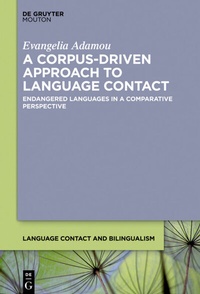
A Corpus-Driven Approach to Language Contact
Endangered Languages in a Comparative Perspective
1st Edition
Published on 29. January 2016
XX, 240 pages
978-1-61451-657-6 (ISBN)
Description

This book proposes a corpus-driven approach to language contact based on the study of endangered languages. Drawing on variationist and language contact frameworks, it presents an analysis of spoken corpora from Europe and Mexico using a combination of criteria. The aim of this approach is to establish patterns of multilingual speech prevailing in different communities and allow for crosslinguistic comparison.
More details
Other editions
Additional editions
Evangelia Adamou
A Corpus-Driven Approach to Language Contact
Endangered Languages in a Comparative Perspective
Book
01/2016
1st Edition
De Gruyter Mouton
€149.95
Article not available at the moment
Evangelia Adamou
A Corpus-Driven Approach to Language Contact
Endangered Languages in a Comparative Perspective
E-Book
01/2016
1st Edition
De Gruyter Mouton
€149.95
Available for download
Person
Evangelia Adamou, French National Centre for Scientific Research (CNRS), France.
Content
- Intro
- Preface
- Table of contents
- List of figures
- List of tables
- Abbreviations
- 1 Introduction
- 1.1 Contact linguistics
- 1.2 Language contact in endangered languages
- 1.3 Corpus-driven analysis of language contact
- 1.4 Overview of this book
- 2 Data collection and annotation
- 2.1 Data collection
- 2.2 The sample
- 2.3 Transcription and annotation
- 2.4 Corpus size
- 2.5 Corpus accessibility
- 3 Overall composition of a multilingual corpus
- 3.1 Background
- 3.1.1 Corpora with 0?5% contact words
- 3.1.1.1 The Ixcatec-Spanish corpora
- 3.1.1.2 The Balkan Slavic-Greek corpora
- 3.1.1.3 The Colloquial Upper Sorbian- and the Burgenland Croatian-German corpora
- 3.1.2 Corpora with 20?35% contact words
- 3.1.2.1 The Thrace Romani-Turkish-Greek and the Finnish Romani-Finnish corpora
- 3.1.2.2 The Molise Slavic-Italian corpora
- 3.2 Discussion
- 4 Borrowing or codeswitching?
- 4.1 Background
- 4.2 Degree of composition and flagging
- 4.2.1 The Balkan Slavic Nashta-Greek corpus
- 4.2.2 The Ixcatec-Spanish corpus
- 4.2.3 The Thrace Romani-Turkish-Greek corpus
- 4.2.4 The Finnish Romani-Finnish corpus
- 4.3 Word classes
- 4.3.1 The Ixcatec-Spanish corpus
- 4.3.2 The Balkan Slavic Nashta-Greek corpus
- 4.3.3 The Romani corpora
- 4.4 Lexical semantic fields
- 4.4.1 The Ixcatec-Spanish corpora
- 4.4.2 The Balkan Slavic-Greek corpora
- 4.4.3 The Thrace Romani-Turkish-Greek corpus
- 4.5 Regularity
- 4.5.1 The Ixcatec-Spanish corpora
- 4.5.2 The Balkan Slavic-Greek corpus
- 4.5.3 The Thrace Romani-Turkish-Greek corpus
- 4.5.4 The Finnish Romani-Finnish corpus
- 4.6 Discussion
- 5 Integration strategies
- 5.1 Background
- 5.2 Phonetics and phonology
- 5.3 Noun integration
- 5.3.1 The Ixcatec-Spanish corpus
- 5.3.2 The Romani-Turkish-Greek corpus
- 5.4 Verb integration
- 5.4.1 Light verb strategy
- 5.4.2 Indirect insertion
- 5.4.3 Paradigm transfer
- 5.5 Discussion
- 6 Inter-speaker variation
- 6.1 Background
- 6.2 Inter-speaker variation for contact words
- 6.2.1 The Ixcatec-Spanish corpus
- 6.2.2 The Balkan Slavic Nashta-Greek corpus
- 6.2.3 The Thrace Romani-Turkish-Greek corpus
- 6.2.4 The Finnish Romani-Finnish corpus
- 6.3 Inter-speaker variation for borrowing and codeswitching
- 6.3.1 The Slavic corpora
- 6.3.2 The Finnish Romani-Finnish corpus
- 6.4 Inter-speaker variation for borrowed nouns and verbs
- 6.4.1 The Ixcatec-Spanish corpus
- 6.4.2 The Slavic corpora
- 6.4.3 The Romani corpora
- 6.5 Discussion
- 7 Pattern replication
- 7.1 Background
- 7.2 The Balkan Slavic Nashta-Greek corpus
- 7.2.1 TMA markers
- 7.2.2 Phonetics
- 7.2.3 Articles
- 7.3 The Ixcatec-Spanish corpus
- 7.3.1 Articles
- 7.3.2 Clause-linking
- 7.3.3 Frames of reference
- 7.3.4 Word order in verbal clauses
- 7.4 The Thrace Romani-Turkish-Greek corpus
- 7.4.1 Prosody in wh- and polar questions
- 7.4.2 Articles
- 7.4.3 Verb morphology
- 7.4.4 Word order in noun phrases
- 7.5 Discussion
- 8 Information structure
- 8.1 Background
- 8.2 The Ixcatec-Spanish corpus
- 8.2.1 Prosody
- 8.2.2 Word order
- 8.2.3 Morphology
- 8.3 The Thrace Romani-Turkish-Greek corpus
- 8.3.1 Prosody
- 8.3.2 Word order
- 8.3.3 Morphology
- 8.4 Discussion
- 9 Contact settings
- 9.1 Background
- 9.2 The Balkan Slavic-Greek communities
- 9.2.1 Hrisa
- 9.2.2 Liti
- 9.3 The Ixcatec-Spanish community
- 9.4 The Thrace Romani-Turkish-Greek community
- 9.5 Discussion
- 9.5.1 An active bilingual community
- 9.5.2 Prescriptive attitudes and institutional support
- 9.5.3 Past contact settings
- 10 Concluding remarks
- 10.1 A scale of language mixing
- 10.2 Extra layers for a refined scale of language mixing
- 10.3 Types of contact phenomena and types of social settings
- 10.4 For a corpus-driven approach to language contact
- References
- Index of authors
- Index of subjects and languages
