

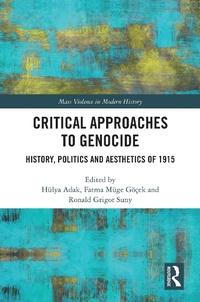
Critical Approaches to Genocide
History, Politics and Aesthetics of 1915
1st Edition
Published on 28. September 2023
304 pages
978-0-429-66294-2 (ISBN)
Description

The study of genocide has been appropriate in emphasizing the centrality of the Holocaust; yet, other preceding episodes of mass violence are of great significance. Taking a transnational and transhistorical approach, this volume redresses and replaces the silencing of the Armenian Genocide.
Scholarship relating to the history of denial, comparative approaches in the deportations and killings of Greeks and Armenians during the First World War, and women's histories during the genocide and post-genocide proliferated during the centennial of the Armenian Genocide in 2015. Collectively, however, these studies have not been enough to offer a comprehensive account of the historical record, documentation, and interpretation of events during 1915-1916. This study seeks to bridge the gap, by unsettling nationalist narratives and addressing areas such as aesthetics, gender, and sexuality. By bringing forward various dimensions of the human experience, including the political, socioeconomic, cultural, social, gendered, and legal contexts within which such silencing occurred, the essays address the methodological silences and processes of selectivity and exclusion in scholarship on the Armenian Genocide.
The interdisciplinary approach makes Critical Approaches to Genocide a useful resource for all students and scholars interested in the Armenian Genocide and memory studies.
Scholarship relating to the history of denial, comparative approaches in the deportations and killings of Greeks and Armenians during the First World War, and women's histories during the genocide and post-genocide proliferated during the centennial of the Armenian Genocide in 2015. Collectively, however, these studies have not been enough to offer a comprehensive account of the historical record, documentation, and interpretation of events during 1915-1916. This study seeks to bridge the gap, by unsettling nationalist narratives and addressing areas such as aesthetics, gender, and sexuality. By bringing forward various dimensions of the human experience, including the political, socioeconomic, cultural, social, gendered, and legal contexts within which such silencing occurred, the essays address the methodological silences and processes of selectivity and exclusion in scholarship on the Armenian Genocide.
The interdisciplinary approach makes Critical Approaches to Genocide a useful resource for all students and scholars interested in the Armenian Genocide and memory studies.
More details
Series
Edition
1. Auflage
Language
English
Place of publication
London
United Kingdom
Publishing group
Taylor & Francis Ltd
Target group
College/higher education
Product notice
Reflowable
Illustrations
1 Line drawings, black and white; 8 Halftones, black and white; 9 Illustrations, black and white
ISBN-13
978-0-429-66294-2 (9780429662942)
Copyright in bibliographic data and cover images is held by Nielsen Book Services Limited or by the publishers or by their respective licensors: all rights reserved.
Schweitzer Classification
Other editions
Additional editions
Huelya Adak | Fatma Muege Goecek | Ronald Grigor Suny
Critical Approaches to Genocide
History, Politics and Aesthetics of 1915
Book
05/2025
1st Edition
Routledge
€57.50
Shipment within 10-20 days
Huelya Adak | Fatma Muege Goecek | Ronald Grigor Suny
Critical Approaches to Genocide
History, Politics and Aesthetics of 1915
Book
09/2023
1st Edition
Routledge
€183.50
Shipment within 15-20 days
Persons
Huelya Adak is Associate Professor of Comparative Literature and Gender Studies at Sabanci University and Visiting Professor of Gender Studies at the Free University of Berlin (Margherita von Brentano Zentrum). Adak was the Director of Sabanci University's Gender and Women's Studies Center of Excellence (SU Gender) between 2019 and 2022. She is the founder of the ProGender+ Program, a Gender, Diversity, Equity and Inclusion program for professionals in the corporate sector. Her most relevant publications include Mapping Gender: What' New and What' Ahead in Ottoman and Turkish Studies (with Richard Wittmann, 2022), Performing Turkishness: Politics of Theatre in Turkey and Its Diasporas (with R. E. Altiay, 2018), Halide Edibve Siyasal Sddet (Bilgi UEiversitesi Yayilari 2016), Hundert Jahre Tuerkei: Zeitzeugen erzaehlen (with Erika Glassen, Unionsverlag 2014, 2010), and Gender, Ethnicity and the Nation-State (with Ays Gue Altiay, 2010). Her articles in the fields of gender studies, memory and trauma studies, history of human rights, literature, theater, and film studies have been published in the PMLA, South Atlantic Quarterly, Comparative Drama, Journal of Middle East Women's Studies, Journal of Genocide Research, New Perspectives on Turkey, and Zeitschrift fuer Religions- und Geistesgeschichte. Adak is on the Academic Advisory Board of the International Hrant Dink Foundation and Orient Institut Istanbul der Max Weber Stiftung. In 2021, her current book project (with Melanie Tanielian and Erdag Goeknar) titled Afterlives of Archives received the "Book Manuscript Award" of Duke University's Franklin Humanities Institute.
Fatma Muege Goecek is Professor of Sociology at the University of Michigan, Ann Arbor. Her research focuses on the comparative analysis of history, politics, and gender in the first and third worlds. She critically analyzes the impact of processes such as development, nationalism, religious movements, and collective violence on minorities. Goecek is the author of Denial of Violence: Ottoman Past, Turkish Present and Collective Violence against the Armenians, 1789-2009 (2014). She is currently working on a theory book, constructing social theory from the vantage point of minorities.
Ronald Grigor Suny is William H. Sewell, Jr. Distinguished University Professor of History and Professor of Political Science at the University of Michigan and Emeritus Professor of Political Science and History at the University of Chicago. He was the first holder of the Alex Manoogian Chair in Modern Armenian History at the University of Michigan, where he founded and directed the Armenian Studies Program. He is the author of The Baku Commune: Class and Nationality in the Russian Revolution; The Making of the Georgian Nation; Looking Toward Ararat: Armenia in Modern History; The Revenge of the Past: Nationalism, Revolution, and the Collapse of the Soviet Union; The Soviet Experiment: Russia, the Soviet Union and the Successor States; "They Can Live in the Desert But Nowhere Else": A History of the Armenian Genocide; Red Flag Unfurled: History, Historians, and the Russian Revolution; Red Flag Wounded: Stalinism and the Fate of the Soviet Experiment; Stalin: Passage to Revolution: and co-author with Valerie Kivelson of Russia's Empires. He is currently working on a book on the history of the nation-form and the recent upsurge of exclusivist nationalisms and authoritarian populisms: Forging the Nation: The Making and Faking of Nationalisms.
Fatma Muege Goecek is Professor of Sociology at the University of Michigan, Ann Arbor. Her research focuses on the comparative analysis of history, politics, and gender in the first and third worlds. She critically analyzes the impact of processes such as development, nationalism, religious movements, and collective violence on minorities. Goecek is the author of Denial of Violence: Ottoman Past, Turkish Present and Collective Violence against the Armenians, 1789-2009 (2014). She is currently working on a theory book, constructing social theory from the vantage point of minorities.
Ronald Grigor Suny is William H. Sewell, Jr. Distinguished University Professor of History and Professor of Political Science at the University of Michigan and Emeritus Professor of Political Science and History at the University of Chicago. He was the first holder of the Alex Manoogian Chair in Modern Armenian History at the University of Michigan, where he founded and directed the Armenian Studies Program. He is the author of The Baku Commune: Class and Nationality in the Russian Revolution; The Making of the Georgian Nation; Looking Toward Ararat: Armenia in Modern History; The Revenge of the Past: Nationalism, Revolution, and the Collapse of the Soviet Union; The Soviet Experiment: Russia, the Soviet Union and the Successor States; "They Can Live in the Desert But Nowhere Else": A History of the Armenian Genocide; Red Flag Unfurled: History, Historians, and the Russian Revolution; Red Flag Wounded: Stalinism and the Fate of the Soviet Experiment; Stalin: Passage to Revolution: and co-author with Valerie Kivelson of Russia's Empires. He is currently working on a book on the history of the nation-form and the recent upsurge of exclusivist nationalisms and authoritarian populisms: Forging the Nation: The Making and Faking of Nationalisms.
Content
Part 1: New Methodologies and Directions in Armenian and Genocide Studies 1. Armenian Genocide Studies: Development as a Field, Historiographic Appraisal and The Road Ahead 2. Eastern Turkey: The Known, The Unknown, The Disputed and The Desired 3. Time and Space Problematic in Studying Genocide: The Armenian Case 4. A Survivor of the Armenian Genocide as a perpetrator of the Holocaust: The Case of Eghia Hovhanessian Part 2: Repertoires of Violence and Demographic Engineering 5. Transmitting Ottomanism: Revolution, Diaspora, and the Legacies of Imperial Reform 6. Toward a more holistic history of demographic engineering in the Late Ottoman Empire: Possibilities for a New History? 7. The Multiple Narratives of the Assyrian Genocide 8. Colonial Pragmatism and Population Transfer: German perception of ethnic violence during the First World War and the Armenian Genocide 9. Challenges of Humanism: Johannes Lepsius (1858-1926) Part 3: Aesthetics, Linguistic Pluralism and Memory 10. Another Pluralism: Reading Dostoevsky across The Sea of Marmara 11. Between Communication and Miscommunication: An Essay on the Role and Representation of Language in Survivor Testimonies 12. Storation: A Small Guide to Undoing Restoration Part 4: Gender and Sexuality 13. Finding Place in Exile: Queer Armenian Voices Speak 14. The Space between Us: Feminist Conversations on Genocide, Survival and Gender Part 5: Higher Education and Genocide Commemorations in Contemporary Turkey 15. Tosun Terzioglu's Speech on the Groundbreaking Conference in 2005 16. Skeletons in the Turkish Closet: Remembering the Armenian Genocide 17. Commemorating the Armenian Genocide: Spatial Politics of Memory in Post-Imperial Istanbul Part 6: Afterword
