

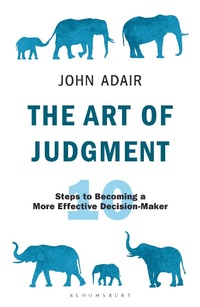
The Art of Judgment
10 Steps to Becoming a More Effective Decision-Maker
1st Edition
Published on 9. July 2020
224 pages
978-1-4729-8072-4 (ISBN)
Description

An essential guide for any business leader looking to hone, develop and master the art of judgment.
The success of any organization or individual depends upon making good decisions, arrived at through the use of a sound judgment. Too often, this elusive characteristic has been misperceived as an unchangeable, entrenched element of our character, over which we have little control. In fact, judgment is an art - one that can be honed, developed and mastered.
In The Art of Judgment, John Adair draws upon his decades of experience and expertise to provide a practical and fascinating insight into how you can harness the full potential of your judgment. These in-depth methods are summarised in 10 key principles, which include:
- Thinking to Some Purpose
- Experience - the Seedbed
- Truth - the Leading Star
- How to Share Decisions
- The Role of Values
With the divisiveness of public discourse and the complexities of modern business, it is more difficult than ever to be sure that you're making the right decision. Adair provides a clear pathway to improving your judgment, beginning with an exploration of the machinations behind decision-making, before demonstrating how you can develop a stronger understanding and control of your judgment.
This is an essential companion for any business leader interested in making the best decisions, whether personal or for their organization. Good judgment is the secret behind any success, and also has the potential to accelerate one's own career. This book provides insight, expertise and inspiration for anyone looking to cultivate and develop their art of judgment.
The success of any organization or individual depends upon making good decisions, arrived at through the use of a sound judgment. Too often, this elusive characteristic has been misperceived as an unchangeable, entrenched element of our character, over which we have little control. In fact, judgment is an art - one that can be honed, developed and mastered.
In The Art of Judgment, John Adair draws upon his decades of experience and expertise to provide a practical and fascinating insight into how you can harness the full potential of your judgment. These in-depth methods are summarised in 10 key principles, which include:
- Thinking to Some Purpose
- Experience - the Seedbed
- Truth - the Leading Star
- How to Share Decisions
- The Role of Values
With the divisiveness of public discourse and the complexities of modern business, it is more difficult than ever to be sure that you're making the right decision. Adair provides a clear pathway to improving your judgment, beginning with an exploration of the machinations behind decision-making, before demonstrating how you can develop a stronger understanding and control of your judgment.
This is an essential companion for any business leader interested in making the best decisions, whether personal or for their organization. Good judgment is the secret behind any success, and also has the potential to accelerate one's own career. This book provides insight, expertise and inspiration for anyone looking to cultivate and develop their art of judgment.
More details
Series
Edition
1. Auflage
Language
English
Place of publication
London
United Kingdom
Publishing group
Bloomsbury Publishing PLC
Target group
Professional and scholarly
ISBN-13
978-1-4729-8072-4 (9781472980724)
Copyright in bibliographic data and cover images is held by Nielsen Book Services Limited or by the publishers or by their respective licensors: all rights reserved.
Schweitzer Classification
Other editions
Additional editions
Book
07/2020
Bloomsbury Business
€41.03
Article exhausted; check different version
Person
John Adair is one of the world's leading authorities on leadership and leadership development. He is a teacher of leadership and an author of 50 books, which have been translated into over 18 languages. Since 2006, he has been Honorary Professor of Leadership at the China Executive Leadership Academy in Shanghai. In 2009, he was appointed Chair of Leadership Studies at the United Nations Staff College in Turin.
Content
- Intro
- Title Page
- Copyright Page
- Contents
- Introduction
- The way ahead
- How to use this book
- Part 1: Understanding judgment
- Chapter 1: Thinking to some purpose
- Purposive thinking
- 1. Interest
- 2. Attention
- 3. Suggestion
- 4. Reasoning
- 5. Conclusion
- 6. Test
- Key points: Thinking to some purpose
- Chapter 2: Decision-making
- Be disciplined or systematic
- Develop a proper range of options
- The Rule of Three
- The do-nothing option is sometimes worth considering
- In retrospect
- Options checklist
- False assumptions - or, walking on very thin ice
- Weighing up consequences
- Key points: Decision-making
- Chapter 3: Experience - the seedbed
- Judgment as intuitive decision-making
- How judgment develops in business
- Some takeaway points
- Business flair
- Personal intuition
- How intuitive are you?
- On intuition
- How your physical condition can affect judgment
- Remember, intuition is not always reliable
- Key points: Experience - the seedbed
- Chapter 4: Truth - the leading star
- Truth in business
- Do your political leaders act on the same principle?
- Key points: Truth - the leading star
- Chapter 5: Clear thinking
- Reasoning
- Reasoning before action
- Clarity - but not necessarily precision
- An example of clear thinking
- Flexibility
- A sense of direction
- A measure of progress
- Key points: Clear thinking
- Part 2: Leading with judgment
- Chapter 6: Your first vocation
- What is vocation?
- Three key factors in choosing your work
- Aptitudes
- Interests
- Exercise
- Temperament
- Identifying the feasible options
- Narrowing down the list
- From trial-and-error to trial and improve
- Crossing the Rubicon
- The choice of a life partner
- Getting to know people - a holistic process
- Key points: Your first vocation
- Chapter 7: Leadership - your second vocation
- On leadership
- The role of leader
- Levels of leadership
- Strategic leadership
- The hourglass model
- Strategic thinking and judgment
- A common judgment call: Timing the pace of change
- The product of good leadership
- Key points: Leadership - your second vocation
- Chapter 8: How to share decisions
- The nature of consensus
- The importance of listening to specialists
- Key points: How to share decisions
- Chapter 9: The role of values
- Social capitalism
- The challenge to business leaders
- Acting with integrity
- Humility
- Intellectual humility
- Key points: The role of values
- Chapter 10: Practical wisdom
- Key points: Practical wisdom
- Conclusion
- Index
