

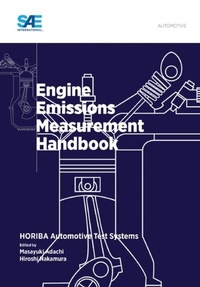
Engine Emissions Measurement Handbook
1st Edition
Published on 30. November 2013
192 pages
978-0-7680-8049-0 (ISBN)
Description

The subject of engine emissions is expected to be at the forefront of environmental regulations and consumers' concerns for years to come. As technology develops to comply with new and different requirements in various regions of the world, understanding the fundamental principles of how engine emissions occur, and how they can be properly measured, is vitally important. Engine Emissions Measurement Handbook, developed and co-authored by HORIBA Automotive Test Systems team addresses the main aspects of this subject. Written with the technical user in mind, this title is a must-have for those involved in engine development and testing, and environmental researchers focusing on better ways to minimize emissions pollution. Using easy-to-understand language, Engine Emissions Measurement Handbook covers, among others, the following topics: Measurement of gaseous emissions Measurement of particulate emission Evaporative emissions measurement Principles of exhaust gas analyzers Vehicle emissions testing equipment Emissions measurement applications Emissions regulations around the world
More details
Other editions
Additional editions
Masayuki Adachi | Hiroshi Nakamura
Engine Emissions Measurement Handbook
Book
09/2013
SAE International
€132.22
Article exhausted; check different version
Content
- Intro
- Contents
- Foreword
- Acknowledgments
- Introduction
- Chapter 1 Engine Emissions
- 1.1 Characteristics of Engine Exhaust Gas
- 1.1.1 Major Components of Engine Exhaust Gas
- 1.1.2 Units Used for Exhaust Gas Components
- 1.1.3 Concentration Variations of Exhaust Gas Components
- 1.1.4 Exhaust Gas as Fluid (Physical Characteristics)
- 1.1.4.1 Density
- 1.1.4.2 Viscosity (Coefficient of Viscosity)
- 1.1.4.3 Specific Heat
- 1.1.4.4 Temperature
- 1.2 Major Air Pollutants in Engine Exhaust
- 1.2.1 Inorganic Compounds
- 1.2.2 Organic Compounds
- 1.2.2.1 Hydrocarbons
- 1.2.2.2 Alcohols and Carbonyls
- 1.2.3 Engine Exhaust Particulates
- 1.3 Greenhouse Gases in Exhaust Emissions
- References
- Appendix A.1Calculations of EngineExhaust Gas Composition
- A.1.1 Combustion Reaction Formula
- A.1.2 Calculations of Gas Component Concentration
- A.1.2.1 Lean Combustion (? = (1 - d))
- A.1.2.2 Rich Combustion (? & (1 - d))
- A.1.3 Excess Air Ratio and Gas Component Concentration
- Chapter 2 Gaseous Emissions Measurement
- 2.1 Overview
- 2.1.1 Direct Sampling Method
- 2.1.1.1 Gas Sampling with the Direct Sampling Method
- 2.1.1.2 Equations of Mass Emission
- 2.1.2 Dilution Sampling Method
- 2.2 Constant Volume Sampler
- 2.2.1 Overview of the Constant Volume Sampler
- 2.2.2 System Structure
- 2.2.2.1 Mixing Tee
- 2.2.2.2 Flow Controller
- 2.2.2.3 Gas Sampling Bags
- 2.2.3 Calculation of Mass Emission
- 2.2.4 System Setup and System Check
- 2.2.4.1 Setting the Dilution Flow Rate
- 2.2.4.2 Calibration of the Dilution Flow Rate
- 2.2.4.3 Total System Verification
- 2.3 Measurement of Ultra-Low-Emission Vehicles by the CVS Method
- 2.3.1 Compensation of Background (Dilution Air)
- 2.3.1.1 Active Carbon Filter
- 2.3.1.2 Dilution Air Refiner
- 2.3.1.3 Proportional Ambient Sampling Method
- 2.3.2 Optimization of Dilution Ratio
- 2.3.2.1 Variable-Flow CVS
- 2.3.2.2 Heated CVS
- 2.3.2.3 Dehumidification of the Dilution Air
- 2.3.3 Preventing HC Hang-Up
- 2.3.3.1 Selection of Materials
- 2.3.3.2 Separate Sample Lines for Low-Concentration Measurement
- 2.3.3.3 Extensive Purging
- 2.3.3.4 Blank Tests
- 2.4 Bag Mini Diluter
- 2.4.1 System Configuration and Features
- 2.4.2 Mass Emission Calculation
- 2.5 Exhaust Flow Rate Measurement
- 2.5.1 Summary of Exhaust Flow Measurement
- 2.5.2 Direct Measurement Method
- 2.5.2.1 Ultrasonic Flow Meter
- 2.5.2.2 Pitot Tube Flow Meter
- 2.5.3 Indirect Measurement Method
- 2.5.3.1 Intake Air Flow and Fuel Flow
- 2.5.3.2 Intake Air Flow and Air-to-Fuel Ratio
- 2.5.3.3 Tracer Method
- References
- Chapter 3 Measurement of Particle Emissions and Black Smoke
- 3.1 PM Mass Filter Weighing (Balance) Method
- 3.1.1 PM Sampling from a Tunnel
- 3.1.1.1 Full-Flow Dilution Tunnel
- 3.1.1.2 Micro Dilution Tunnel
- 3.1.2 Filter Weighing
- 3.1.3 Separate Analysis of Soluble Organic Fraction
- 3.2 Other Methods for Exhaust Particle Mass Measurement
- 3.2.1 Filter Combustion Method for Measuring Low-Mass PM
- 3.2.2 Continuous Measurement of PM Mass Concentration
- 3.3 Particle Number Measurement
- 3.3.1 Continuous Measurement of Solid Particle Number
- 3.3.2 Particle Size Distribution Measurement
- 3.4 Measurement of Black Smoke
- 3.4.1 Opacity Meter
- 3.4.2 Light Reflection
- References
- Chapter 4 Evaporative Emissions Measurement
- 4.1 Outline of Evaporative Emission Regulation
- 4.2 Evaporation Test of Parked Vehicles
- 4.2.1 Outline of the Test
- 4.2.1.1 Variable Pressure Absorption System
- 4.2.1.2 Calibration and HC Retention Test
- 4.2.2 Analyzer for Evaporative Emission Measurement
- 4.2.2.1 Analyzer
- 4.2.2.2 Calculation of Evaporation Rate
- 4.3 Running Loss Evaporation Test
- 4.3.1 Evaluation of the Entire Vehicle
- 4.3.1.1 SHED Configuration
- 4.3.1.2 Fuel Temperature Profile
- 4.3.2 Evaluation of Evaporative Emission by the Point-Source Method
- 4.4 Evaporative Test After Vehicle Driving
- References
- Chapter 5 Principles of Exhaust Gas Analyzers
- 5.1 Analytical Principles for Regulated Emission Components of Interest
- 5.2 Non-Dispersive Infrared Detection
- 5.2.1 Principle
- 5.2.2 Infrared Detector
- 5.2.2.1 Pyroelectric-Type Infrared Detector
- 5.2.2.2 Pneumatic Cell-Type Detector
- 5.2.2.3 Detector Using Lead Selenide
- 5.2.3 Application to Exhaust Gas Analyzers
- 5.2.3.1 Interference Compensation by AS Method
- 5.2.3.2 Adjustment of Water Concentration in Calibration Gas
- 5.3 Flame Ionization Detection
- 5.3.1 Principle of Flame Ionization Detection
- 5.3.2 Application to Exhaust Gas Analyzer
- 5.3.2.1 Separate Measurement of Methane
- 5.3.2.2 Compensation of Oxygen Interference
- 5.4 Chemiluminescence Detection
- 5.4.1 Principle of Chemiluminescence Detection
- 5.4.2 Application to the Exhaust Gas Analyzer
- 5.4.2.1 Atmospheric Pressure-Type and Vacuum Pressure-Type NOx Analyzers
- 5.4.2.2 Options of Sample Dehumidification
- 5.5 Paramagnetic Detection
- 5.6 Zirconia Solid Electrolyte Method
- 5.6.1 Zirconia-Type Air-to-Fuel Ratio Sensor
- 5.6.2 Zirconia-Type Nitrogen Oxide Sensor
- 5.7 Fourier Transform Infrared Spectroscopy
- 5.7.1 Principle of Fourier Transform Infrared Gas Analyzer
- 5.7.2 Analyzer Configuration and Target Gas Components
- 5.8 Mid-Infrared Laser Spectroscopy
- 5.9 Gas Chromatography
- 5.9.1 Principle of Gas Chromatography
- 5.9.2 System Components and Conditions
- 5.9.2.1 Column
- 5.9.2.2 Oven Temperature
- 5.9.2.3 Detector
- 5.9.2.4 Sample Injector
- References
- Chapter 6 Testing Equipment for Vehicle Emissions
- 6.1 General Configuration
- 6.2 Equipment for Simulating Actual Driving Conditions
- 6.3 Equipment for Gas Component Analysis
- 6.3.1 Constant Volume Sampling System
- 6.3.2 Exhaust Gas Analyzer
- 6.4 Particle Measurement Equipment
- 6.5 Driving Aid Equipment/Automatic Driving Equipment
- 6.5.1 Driver's Aid System
- 6.5.2 Robot Driver
- 6.6 Automation System
- 6.6.1 Laboratory Automation System
- 6.6.2 Full-Automatic Unmanned Testing System
- Chapter 7 Practical Measurement of Engine Emissions
- 7.1 Emission Measurements for Powertrain Development
- 7.1.1 Air-to-Fuel Ratio and Excess Air Ratio
- 7.1.1.1 Calculating from Exhaust Gas Concentrations
- 7.1.1.2 Real-Time Measurement Using Zirconia Sensor
- 7.1.2 Exhaust Gas Recirculation Ratio
- 7.1.2.1 Calculation from CO2 Concentrations
- 7.1.2.2 Transient Measurement of EGR Ratio
- 7.1.3 Fuel Consumption
- 7.1.3.1 Vehicles Using Combustion Engine for Power Source
- 7.1.3.2 Hybrid Vehicles
- 7.1.4 Engine Oil Consumption
- 7.1.4.1 S-trace Method
- 7.1.4.2 Calculation of Oil Consumption
- 7.1.5 Catalytic Converter Evaluation
- 7.1.5.1 Three-Way Catalytic Converter Evaluation
- 7.1.5.2 Evaluation of Aftertreatment System for Nitrogen Compounds
- 7.1.5.3 Evaluation of Diesel Particulate Filter
- 7.1.5.4 Evaluation of Aftertreatment Catalyst Using Model Gas
- 7.1.6 Measurement of Oxygenated Hydrocarbons
- 7.1.6.1 Quantitative Estimation of Alcohols
- 7.1.6.2 Quantitative Estimation of Carbonyl Compounds
- 7.1.6.3 Measurement of Non-Methane Organic Gases
- 7.1.7 Measurement of Greenhouse Gases
- 7.1.8 Modal Mass Analysis
- 7.1.9 Onboard Emission Measurements
- 7.2 Emission Test for Type Approval
- 7.2.1 Scope of Regulation and Test Procedures
- 7.2.2 Common Test Procedure
- 7.2.2.1 Test Cycles
- 7.2.2.2 Off-Cycle Emission Tests
- 7.3 Emission Test for Production Vehicles
- 7.3.1 Random Sampling Inspection on Production Line
- 7.3.2 In-Use Vehicle Measurement
- References
- Chapter 8 Emission Regulations Around the World and Worldwide Harmonization of Technical Regulations
- 8.1 Emission Regulations Around the World
- 8.1.1 Japanese Emission Standards
- 8.1.1.1 History and Regulatory Process
- 8.1.1.2 Recent Trend
- 8.1.2 United States Emission Standards
- 8.1.2.1 History and Regulatory Process
- 8.1.2.2 Recent Trend
- 8.1.3 European Union Emission Standards
- 8.1.3.1 History and Regulatory Process
- 8.1.3.2 Recent Trend
- 8.1.4 Other Nations and Regions
- 8.2 Worldwide Harmonization of Technical Regulations and Mutual Recognition of Approval
- 8.2.1 1958 Agreement and ECE Regulation
- 8.2.2 1998 Agreement and gtr
- References
- Index
