

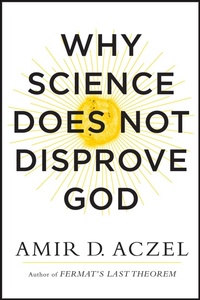
Why Science Does Not Disprove God
Published on 21. November 2023
309 pages
978-0-06-223061-4 (ISBN)
Description

The bestselling author "wields impressive intellectual weapons in demolishing the New Atheists' claims that science has disproven the existence of God" (
Booklist, starred review).
The renowned science writer, mathematician, and bestselling author of Fermat's Last Theoremmasterfully refutes the overreaching claims of the "New Atheists," providing millions of educated believers with a clear, engaging explanation of what sciencereallysays, how there's still much space for the Divine in the universe, and why faith in both God and empirical science are not mutually exclusive.
A highly publicized coterie of scientists and thinkers, including Richard Dawkins, the late Christopher Hitchens, and Lawrence Krauss, have vehemently contended that breakthroughs in modern science have disproven the existence of God, asserting that we must accept that the creation of the universe came out of nothing, that religion is evil, that evolution fully explains the dazzling complexity of life, and more. In this much-needed book, science journalist Amir Aczel profoundly disagrees and conclusively demonstrates that science has not, as yet, provided any definitive proof refuting the existence of God.
Why Science Does Not Disprove Godis his brilliant and incisive analyses of the theories and findings of such titans as Albert Einstein, Roger Penrose, Alan Guth, and Charles Darwin, all of whose major breakthroughs leave open the possibility-and even the strong likelihood-of a Creator. Bolstering his argument, Aczel lucidly discourses on arcane aspects of physics to reveal how quantum theory, the anthropic principle, the fine-tuned dance of protons and quarks, the existence of anti-matter and the theory of parallel universes, also fail to disprove God.
"[An] intelligent and stimulating book." - The Washington Post
The renowned science writer, mathematician, and bestselling author of Fermat's Last Theoremmasterfully refutes the overreaching claims of the "New Atheists," providing millions of educated believers with a clear, engaging explanation of what sciencereallysays, how there's still much space for the Divine in the universe, and why faith in both God and empirical science are not mutually exclusive.
A highly publicized coterie of scientists and thinkers, including Richard Dawkins, the late Christopher Hitchens, and Lawrence Krauss, have vehemently contended that breakthroughs in modern science have disproven the existence of God, asserting that we must accept that the creation of the universe came out of nothing, that religion is evil, that evolution fully explains the dazzling complexity of life, and more. In this much-needed book, science journalist Amir Aczel profoundly disagrees and conclusively demonstrates that science has not, as yet, provided any definitive proof refuting the existence of God.
Why Science Does Not Disprove Godis his brilliant and incisive analyses of the theories and findings of such titans as Albert Einstein, Roger Penrose, Alan Guth, and Charles Darwin, all of whose major breakthroughs leave open the possibility-and even the strong likelihood-of a Creator. Bolstering his argument, Aczel lucidly discourses on arcane aspects of physics to reveal how quantum theory, the anthropic principle, the fine-tuned dance of protons and quarks, the existence of anti-matter and the theory of parallel universes, also fail to disprove God.
"[An] intelligent and stimulating book." - The Washington Post
More details
Other editions
Additional editions
Person
Amir D. Aczel, Ph.D., is the author of the international bestseller Fermat's Last Theorem, which has been published in twenty-eight languages. A past recipient of a Sloan Foundation grant and a Guggenheim fellowship, Aczel was a visiting scholar at Harvard University from 2005 to 2007 and is currently a research fellow in the history of science at Boston University. He is a regular contributor to Discover magazine.
Content
- Intro
- Dedication
- Contents
- Introduction
- Prologue: The Birth of the New Atheism
- 1 The Coevolution of Very Early Science and Religion
- 2 Why Archaeology Does Not Disprove the Bible
- 3 The Revolt of Science
- 4 The Triumphs of Science in the Nineteenth Century
- 5 Einstein, God, and the Big Bang
- 6 God and the Quantum
- 7 The "Universe from Nothing" Deception
- 8 And on the Eighth Day, God Created the Multiverse
- 9 Mathematics, Probability, and God
- 10 Catastrophes, Chaos, and the Limits of Human Knowledge
- 11 Between God and the Anthropic Principle
- 12 The Limits of Evolution
- 13 Art, Symbolic Thinking, and the Invisible Boundary
- 14 Engaging the Infinite
- 15 Conclusion: Why the "Scientific" Argument for Atheism Fails
- Notes
- Bibliography
- Index
- About the Author
- Also by Amir D. Aczel
- Credits
- Copyright
- About the Publisher
