

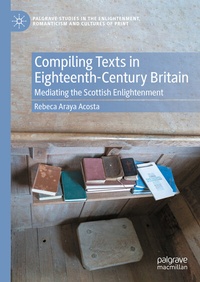
Compiling Texts in Eighteenth-Century Britain
Description

This book argues that the act of compiling texts together into collections in the eighteenth century is politically and epistemologically significant. Focusing on the reception of Scottish Enlightenment ideas, and ranging across an Edinburgh print shop, an excluded religious community in the North of England, and the story worlds of novelists and poets, the study reveals compilation to be a politically resistant activity: it challenged centralizing and homogenizing tendencies within the growing British empire in the latter half of the eighteenth century and actively built counternarratives. Rebeca Araya Acosta offers a fresh view of eighteenth-century literary transaction and shows how practices of compilation in the period were more diversified and had a far greater impact on readers than their modern descendants.
More details
Other editions
Additional editions
Person
Rebeca Araya Acosta is Lecturer in the English department of Humboldt University in Berlin, Germany. Her main research area is the long eighteenth century with an emphasis on print culture and the interaction between science and literature.
Content
Chapter 1: Introduction.- Chapter 2: Putting the Enlightened Self Together: William Smellie's Literary and Characteristical Lives (1800).- Chapter 3: Revisiting Enlightenment Historiography and Aesthetics: Smollett, Sterne, and Mackenzie.- Chapter 4: Revisiting Enlightenment Political Theory: Barbauld and the "Things Indifferent".- Chapter 5: Expanding Comparative Views: Erasmus Darwin's The Botanic Garden (1789-1791) and The Temple of Nature (1803).- Chapter 6: Conclusion: Compilation and the Literary History of the Scottish Enlightenment.
