
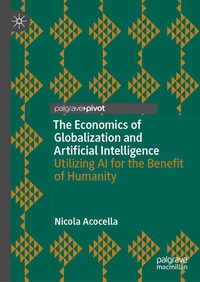
The Economics of Globalization and Artificial Intelligence
Description
Alles über E-Books | Antworten auf Fragen rund um E-Books, Kopierschutz und Dateiformate finden Sie in unserem Info- & Hilfebereich.
This book examines the impact of artificial intelligence (AI) on globalization, in relation to economics, society, and policy. It explores the broad and diverse ways that AI is changing the global ecosystem, including firm behaviour changes, labour market disruption, reduced production costs, and climate change concerns, to highlight both the positive and negative impacts of AI. By anticipating the potential impacts of AI, a framework is presented to combat the negative aspects and maximise the benefits.
This book offers a balanced and considered perspective on AI and the role it will play in the global economy. It will be of interest to students, researchers, and policymakers working in international economics, the political economy, and economic policy, as well as general readers interested in AI.
More details
Other editions
Additional editions
Person
Nicola Acocella is Emeritus Professor of Economics at Sapienza University of Rome.
Content
1. Introduction.- 2. The effects of AI on globalization.- 3. AI and income distribution.- 4. AI and foreign trade.- 5. How to maximise the net effects of AI in a globalised world.- 6. Need of a set of policies to safely leverage the vast potential of AI for the benefit of humanity.- 7. Conclusions.

System requirements
File format: PDF
Copy protection: Watermark-DRM (Digital Rights Management)
System requirements:
- Computer (Windows; MacOS X; Linux): Use the free software Adobe Reader, Adobe Digital Editions, or any other PDF viewer of your choice (see eBook Help).
- Tablet/Smartphone (Android; iOS): Install the free app Adobe Digital Editions or another reading app for eBooks, e.g., PocketBook (see eBook Help).
- E-reader: Bookeen, Kobo, Pocketbook, Sony, Tolino and many more (only limited: Kindle).
The file format PDF always displays a book page identically on any hardware. This makes PDF suitable for complex layouts such as those used in textbooks and reference books (images, tables, columns, footnotes). Unfortunately, on the small screens of e-readers or smartphones, PDFs are rather annoying, requiring too much scrolling.
This eBook uses Watermark-DRM, a „soft” copy protection. This means that there are no technical restrictions to prevent illegal distribution. However, there is a personalised watermark embedded in the eBook that can be used to identify the purchaser of the eBook in the event of misuse and to provide evidence for legal purposes.
For more information, see our eBook Help page.