

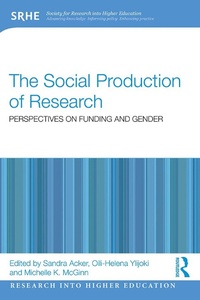
The Social Production of Research
Perspectives on Funding and Gender
1st Edition
Published on 20. May 2024
250 pages
978-1-040-02851-3 (ISBN)
Description

The Social Production of Research offers critical perspectives on the interrelations between research funding and gender, in a climate where universities expect accountability and publishing productivity to be maintained at peak levels.
Drawing upon a range of qualitative methods, contributors investigate experiences with research funding; the nature of institutional, funding body and country contexts; and the impact of social change and disruptions on research ecosystems and academic careers in Canada, Finland, Sweden and the UK. Nuanced accounts call attention to the social, emotional and political conditions within which research is produced, while identifying the ways academics enact, shape, negotiate and resist those conditions in their everyday practice.
Featuring thought-provoking and critical insights for an international readership, this volume is an essential resource for researchers, academics, administrators, managers, funders, politicians and others who are concerned about the future of research funding and the importance of gender equity.
Drawing upon a range of qualitative methods, contributors investigate experiences with research funding; the nature of institutional, funding body and country contexts; and the impact of social change and disruptions on research ecosystems and academic careers in Canada, Finland, Sweden and the UK. Nuanced accounts call attention to the social, emotional and political conditions within which research is produced, while identifying the ways academics enact, shape, negotiate and resist those conditions in their everyday practice.
Featuring thought-provoking and critical insights for an international readership, this volume is an essential resource for researchers, academics, administrators, managers, funders, politicians and others who are concerned about the future of research funding and the importance of gender equity.
Reviews / Votes
'This insightful book offers a critical multi-level account of the institutional complexity of ever-changing research funding conditions across Canada, Finland, Sweden and the UK. The work provides a fresh look at the gendered repercussions of external research funding imperatives and thus is a must-read for higher education policymakers, managers and researchers alike.'- Liudvika Leisyte, Professor of Higher Education, TU Dortmund University, Germany
'Shines a powerful light on unexamined gender dynamics of who - and what - secures research funding and how this contours academic lives and careers. Essential reading for everyone invested in understanding inequalities in knowledge production and how such inequalities can be challenged.'
- Dr Maddie Breeze, University of Stirling, UK
'In an era marked by a global competition based on publications and growing concerns for equity, diversity and inclusion, a nuanced and detailed exploration of the links between research funding and gender is more than necessary. Drawing on a diversity of qualitative approaches, these 23 respected scholars with varied expertise and experiences have produced an insightful comparative work structured around compelling themes such as stability and change, care and conflict, and funding and defunding. I strongly recommend The Social Production of Research: Perspectives on Funding and Gender to all current academics, future academics, and reflective practitioners, whether they work in granting agencies, government, higher education institutions or unions.'
- Dr Olivier Begin-Caouette, Universite de Montreal, Canada
'Acquiring competitive research funding is a must in today's hypercompetitive academia. The Social Production of Research: Perspectives on Funding and Gender explores the deeply gendered dynamics and experiences of that endeavour. This insightful book should be on the reading list of all higher education scholars and leaders.'
- Terhi Nokkala, Senior Researcher, Finnish Institute for Educational Research, Finland
'This book provides a broad and up-to-date account of gender and research funding by drawing attention to the gendered dimensions of the neoliberal research funding context. The use of qualitative methods makes it an important complement to existing bibliometric studies on the connection of gender and funding.'
- Charlotte Silander, Linnaeus University, Sweden
More details
Series
Edition
1. Auflage
Language
English
Place of publication
London
United Kingdom
Publishing group
Taylor & Francis Ltd
Target group
College/higher education
Professional and scholarly
Illustrations
1 Tables, black and white
ISBN-13
978-1-040-02851-3 (9781040028513)
Copyright in bibliographic data and cover images is held by Nielsen Book Services Limited or by the publishers or by their respective licensors: all rights reserved.
Schweitzer Classification
Other editions
Additional editions
Sandra Acker | Oili-Helena Ylijoki | Michelle K. McGinn
The Social Production of Research
Perspectives on Funding and Gender
Book
05/2024
1st Edition
Routledge
€58.30
Shipment within 10-20 days
Sandra Acker | Oili-Helena Ylijoki | Michelle K. McGinn
The Social Production of Research
Perspectives on Funding and Gender
Book
05/2024
1st Edition
Routledge
€196.30
Shipment within 10-20 days

The Social Production of Research
Perspectives on Funding and Gender
Book
05/2024
Taylor & Francis
Unfortunately, price unknown
Available (delivery time upon request)
Persons
Sandra Acker is Professor Emerita, University of Toronto, Canada.
Oili-Helena Ylijoki is Senior Research Fellow, Tampere University, Finland.
Michelle K. McGinn is Professor and Acting Vice-President, Research at Brock University, Canada.
Oili-Helena Ylijoki is Senior Research Fellow, Tampere University, Finland.
Michelle K. McGinn is Professor and Acting Vice-President, Research at Brock University, Canada.
Content
Introduction
1. Editors' introduction Sandra Acker, Oili-Helena Ylijoki & Michelle K. McGinn
2. Research funding and gender: insights from the literature Sandra Acker
Part one: stability and change
3. Here today, gone tomorrow: the vicissitudes of funding in gendered higher education contexts - a view from Sweden Gabriele Griffin
4. Discourses of university research in precarious times: a spatial/temporal analysis from the United Kingdom Barbara Read & Carole Leathwood
5. Gender inequalities, research funding and organisational practices: academic mothers in Finnish universities Marja Vehvilaeinen, Hanna-Mari Ikonen & Paeivi Korvajaervi
6. Casting a long shadow: COVID-19 and female academics' research productivity in the United Kingdom Kate Carruthers Thomas
Part two: care and conflict
7. Funding journeys in health technology in Finland: the atypical stories of Sara and Heidi Oili-Helena Ylijoki
8. Caring about research: gender, research funding and labour in the Canadian academy Marie A. Vander Kloet & Caitlin Campisi
9. The gendered affective economy of funding: conflicting realities of university leaders and researchers in Finnish academia Johanna Hokka, Elisa Kurtti, Pia Olsson, & Tiina Suopajaervi
10. Black women academics, research funding and institutional misogynoir in the United Kingdom Shirley Anne Tate
Part three: funding and defunding
11. Status hierarchies, gender bias and disrespect: ethnographic observations of Swedish Research Council review panels Lambros Roumbanis
12. Tracing excellence and equity in research funding: policy change in the Canada Research Chairs Program Merli Tamtik & Dawn Sutherland
13. Women academics under RAE and REF: the changing research funding policy landscape in the United Kingdom Lisa Lucas
14. Research funding organisations as change agents for gender equality: policies, practices and paradoxes in Sweden Liisa Husu & Helen Peterson
Index
1. Editors' introduction Sandra Acker, Oili-Helena Ylijoki & Michelle K. McGinn
2. Research funding and gender: insights from the literature Sandra Acker
Part one: stability and change
3. Here today, gone tomorrow: the vicissitudes of funding in gendered higher education contexts - a view from Sweden Gabriele Griffin
4. Discourses of university research in precarious times: a spatial/temporal analysis from the United Kingdom Barbara Read & Carole Leathwood
5. Gender inequalities, research funding and organisational practices: academic mothers in Finnish universities Marja Vehvilaeinen, Hanna-Mari Ikonen & Paeivi Korvajaervi
6. Casting a long shadow: COVID-19 and female academics' research productivity in the United Kingdom Kate Carruthers Thomas
Part two: care and conflict
7. Funding journeys in health technology in Finland: the atypical stories of Sara and Heidi Oili-Helena Ylijoki
8. Caring about research: gender, research funding and labour in the Canadian academy Marie A. Vander Kloet & Caitlin Campisi
9. The gendered affective economy of funding: conflicting realities of university leaders and researchers in Finnish academia Johanna Hokka, Elisa Kurtti, Pia Olsson, & Tiina Suopajaervi
10. Black women academics, research funding and institutional misogynoir in the United Kingdom Shirley Anne Tate
Part three: funding and defunding
11. Status hierarchies, gender bias and disrespect: ethnographic observations of Swedish Research Council review panels Lambros Roumbanis
12. Tracing excellence and equity in research funding: policy change in the Canada Research Chairs Program Merli Tamtik & Dawn Sutherland
13. Women academics under RAE and REF: the changing research funding policy landscape in the United Kingdom Lisa Lucas
14. Research funding organisations as change agents for gender equality: policies, practices and paradoxes in Sweden Liisa Husu & Helen Peterson
Index
