

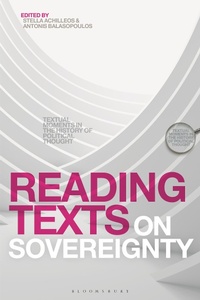
Reading Texts on Sovereignty
Textual Moments in the History of Political Thought
1st Edition
Published on 15. July 2021
208 pages
978-1-350-09971-5 (ISBN)
Description

Reading Texts on Sovereignty charts the development of the concept from the classical period to the present day. Defined in antiquity as an absolute or supreme type of power, sovereignty's history has been marked ever since by numerous moments of crisis and contestation through which its meaning has been redefined and reconfigured. Using extracts of key texts selected and analysed by leading contributors from the USA, the UK, New Zealand, Japan, Cyprus, Finland, France, Austria, Israel, and Italy, this volume examines these moments and how different societies have grappled with sovereignty through the ages.
The book explores a diverse range of geographical and cultural contexts within which the issue of sovereignty became critical, including ancient China and medieval Islam. In addition, the book includes chapters that respond to the vital interplay between the development of the theory of sovereignty and such momentous historical events and developments as the birth of the democratic polis in the classical world, the legal and political developments that attended the rise of the Roman and Islamic empires, the bitter struggles over sovereign rights between the 'temporal' and 'spiritual' authorities of medieval and early modern Europe, the English Civil War, the French and American Revolutions, and the October Revolution.
The book explores a diverse range of geographical and cultural contexts within which the issue of sovereignty became critical, including ancient China and medieval Islam. In addition, the book includes chapters that respond to the vital interplay between the development of the theory of sovereignty and such momentous historical events and developments as the birth of the democratic polis in the classical world, the legal and political developments that attended the rise of the Roman and Islamic empires, the bitter struggles over sovereign rights between the 'temporal' and 'spiritual' authorities of medieval and early modern Europe, the English Civil War, the French and American Revolutions, and the October Revolution.
More details
Series
Edition
1. Auflage
Language
English
Place of publication
London
United Kingdom
Publishing group
Bloomsbury Publishing PLC
Target group
College/higher education
ISBN-13
978-1-350-09971-5 (9781350099715)
Copyright in bibliographic data and cover images is held by Nielsen Book Services Limited or by the publishers or by their respective licensors: all rights reserved.
Schweitzer Classification
Other editions
Additional editions
Stella Achilleos | Antonis Balasopoulos
Reading Texts on Sovereignty
Textual Moments in the History of Political Thought
Book
08/2021
Bloomsbury Academic
€48.46
Shipment within 15-20 days
Persons
Stella Achilleos is Associate Professor of Early Modern Studies at the University of Cyprus, Cyprus. Her research interests include the intersections between early modern literature and political philosophy (with special focus on the concept of sovereignty), early modern utopian thought, and the early modern discourses of friendship. She has published widely within her areas of expertise and her current research projects include a book-length study on violence and utopia in the early modern period.
Antonis Balasopoulos is Associate Professor of Comparative Literature at the University of Cyprus, Cyprus. His research interests include comparative utopian studies, 19th and early 20th-century prose fiction, political theory and political philosophy. His essays have appeared in journals including Cultural Critique, Utopian Studies, Postcolonial Studies and Theory and Event, and in a number of edited collections, including the Cambridge Companion to the City in Literature. He is currently working on a book entitled Figures of Utopia: Literature, Politics, Philosophy.
Antonis Balasopoulos is Associate Professor of Comparative Literature at the University of Cyprus, Cyprus. His research interests include comparative utopian studies, 19th and early 20th-century prose fiction, political theory and political philosophy. His essays have appeared in journals including Cultural Critique, Utopian Studies, Postcolonial Studies and Theory and Event, and in a number of edited collections, including the Cambridge Companion to the City in Literature. He is currently working on a book entitled Figures of Utopia: Literature, Politics, Philosophy.
Content
Introduction, Stella Achilleos and Antonis Balasopoulos (both University of Cyprus, Cyprus)
1. The Book of Lord Shang and the Origins of the State, Yuri Pines (Hebrew University of Jerusalem, Israel)
2. Aristotle on Sovereignty, Kazutaka Inamura (Waseda University, Japan)
3. Divided Sovereignty: Polybius and the Compound Constitution, Jed W. Atkins (Duke University, USA) and Carl E. Young (Hillsdale College, USA)
4. Reading Sovereignty in Augustus' Res gestae, Dean Hammer (Franklin and Marshall College, USA)
5. Al-Farabi: The Sovereignty of the Philosopher King, Massimo Campanini? (University of Naples L' Orientale, Italy)
6. Marsilius of Padua on Sovereignty, Vasileios Syros (Universities of Helsinki and Jyväskylä, Finland)
7. The King 'Should Be' Sovereign: Christine de Pizan and the Problem of Sovereignty in Fifteenth-Century France, Kate Forhan (University of Southern Maine, USA)
8. Jean Bodin's République, Sara Miglietti (Warburg Institute, University of London, UK)
9. Hugo Grotius: Absolutism, Contractualism, Resistance,Marco Barducci (Durham University, UK)
10. Shakespeare on Sovereignty, Indivisibility, and Popular Consent, Stella Achilleos (University of Cyprus, Cyprus)
11. Sovereignty and the Separation of Powers on the Eve of the English Civil War: Henry Parker's Observations and Charles' Answer to the XIX Propositions, Michael Mendle (University of Alabama, USA)
12. Thomas Hobbes, Sovereign Representation, and the English Revolution, Glenn Burgess (University of Hull, UK)
13. John Locke and the Language of Sovereignty, Geoff Kemp (University of Auckland, New Zealand)
14. Rousseau's Sovereignty as the General Will, David Lay Williams (De Paul University, USA)
15. Sovereignty in the American Founding, Michael Zuckert (University of Notre Dame, USA)
16. Thomas Paine: Reinventing Popular Sovereignty in an Age of Revolutions, Carine Lounissi (University of Rouen-Normandie, France)
17. Sovereignty and Political Obligation: T. H. Green's Critique of John Austin, John Morrow (University of Auckland, New Zealand)
18. Divided Sovereignties: Lenin and Dual Power, Antonis Balasopoulos (University of Cyprus, Cyprus)
19. Carl Schmitt and the Sovereignty of Decision, Mika Ojakangas (University of Jyväskylä, Finland)
20. Arendt on Sovereignty, Shmuel Lederman (University of Haifa, Open University of Israel, Israel)
21. Foucault and Agamben on Sovereignty: Taking Life, Letting Live, or Making Survive, Carlo Salzani (Messerli Research Institute, Vienna, Austria)
22. Derrida on the 'Slow and Differentiated' Deconstruction of Sovereignty, James Martel (San Francisco State University, USA)
1. The Book of Lord Shang and the Origins of the State, Yuri Pines (Hebrew University of Jerusalem, Israel)
2. Aristotle on Sovereignty, Kazutaka Inamura (Waseda University, Japan)
3. Divided Sovereignty: Polybius and the Compound Constitution, Jed W. Atkins (Duke University, USA) and Carl E. Young (Hillsdale College, USA)
4. Reading Sovereignty in Augustus' Res gestae, Dean Hammer (Franklin and Marshall College, USA)
5. Al-Farabi: The Sovereignty of the Philosopher King, Massimo Campanini? (University of Naples L' Orientale, Italy)
6. Marsilius of Padua on Sovereignty, Vasileios Syros (Universities of Helsinki and Jyväskylä, Finland)
7. The King 'Should Be' Sovereign: Christine de Pizan and the Problem of Sovereignty in Fifteenth-Century France, Kate Forhan (University of Southern Maine, USA)
8. Jean Bodin's République, Sara Miglietti (Warburg Institute, University of London, UK)
9. Hugo Grotius: Absolutism, Contractualism, Resistance,Marco Barducci (Durham University, UK)
10. Shakespeare on Sovereignty, Indivisibility, and Popular Consent, Stella Achilleos (University of Cyprus, Cyprus)
11. Sovereignty and the Separation of Powers on the Eve of the English Civil War: Henry Parker's Observations and Charles' Answer to the XIX Propositions, Michael Mendle (University of Alabama, USA)
12. Thomas Hobbes, Sovereign Representation, and the English Revolution, Glenn Burgess (University of Hull, UK)
13. John Locke and the Language of Sovereignty, Geoff Kemp (University of Auckland, New Zealand)
14. Rousseau's Sovereignty as the General Will, David Lay Williams (De Paul University, USA)
15. Sovereignty in the American Founding, Michael Zuckert (University of Notre Dame, USA)
16. Thomas Paine: Reinventing Popular Sovereignty in an Age of Revolutions, Carine Lounissi (University of Rouen-Normandie, France)
17. Sovereignty and Political Obligation: T. H. Green's Critique of John Austin, John Morrow (University of Auckland, New Zealand)
18. Divided Sovereignties: Lenin and Dual Power, Antonis Balasopoulos (University of Cyprus, Cyprus)
19. Carl Schmitt and the Sovereignty of Decision, Mika Ojakangas (University of Jyväskylä, Finland)
20. Arendt on Sovereignty, Shmuel Lederman (University of Haifa, Open University of Israel, Israel)
21. Foucault and Agamben on Sovereignty: Taking Life, Letting Live, or Making Survive, Carlo Salzani (Messerli Research Institute, Vienna, Austria)
22. Derrida on the 'Slow and Differentiated' Deconstruction of Sovereignty, James Martel (San Francisco State University, USA)
