

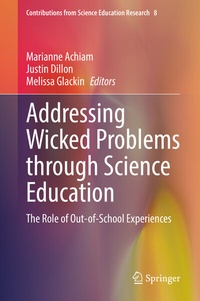
Addressing Wicked Problems through Science Education
Description

This book discusses a number of ways in which out-of-school science education can uniquely engage learners with 'wicked' global problems such as biodiversity loss and climate change. The idea for the volume originated in discussions among members of the ESERA special interest group on "Science Education in Out-of-School contexts". It emerged from these discussions that out-of-school institutions and experiences offer opportunities for critical engagement in wicked problems that go far beyond what is possible solely in the science classroom.
The book opens with a principled discussion of the nature of wicked problems and what addressing them involves. This introduction clarifies key terms and ideas to create a coherent backdrop for the rest of the book. Subsequent chapters discuss the challenges of designing educational experiences to address wicked problems, as well as the teaching and learning that takes place. The authors offer perspectives across a range of out-of-school environments such as science centres, natural history museums, botanical gardens, geological sites, and local communities. The book concludes with a chapter that synthesises the findings from the various contributions and points to the messages for educators. Finally, the editors outline an exciting research agenda to build knowledge of education addressing wicked problems. The intended audience of the book includes teachers, educators/facilitators, teacher educators, curriculum developers, and early career researchers as well as established researchers.
More details
Other editions
Additional editions
Persons
Justin Dillon is professor of science and environmental education at the University of Exeter. He is editor-in-chief of Studies in Science Education and co-edits the International Journal of Science Education. In 2007, he was elected President of the European Science Education Research Association. He has co-edited 18 books including Becoming a Teacher, Bad Education and the International Handbook of Research on Environmental Education. He has published around 100 papers in peer-reviewed journals and almost the same number of book chapters.
Melissa Glackin is senior lecturer in science education at King's College London. Her research has explored why teachers teach what they do, and how they do, within the fields of science education and environmental education particularly related to out-of-classroom teaching. Her research has been published in the journals Environmental Education Research, International Journal of Science Education and International Journal of Research & Method in Education. Between 2015-2019, she served as the co-chair for ESERA's SIG Science education in out-of-school contexts.
