

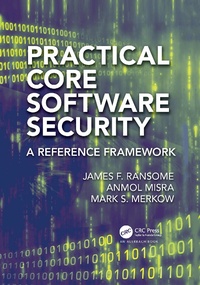
Practical Core Software Security
A Reference Framework
1st Edition
Published on 2. August 2022
286 pages
978-1-000-72571-1 (ISBN)
Description

As long as humans write software, the key to successful software security is making the software development program process more efficient and effective. Although the approach of this textbook includes people, process, and technology approaches to software security, Practical Core Software Security: A Reference Framework stresses the people element of software security, which is still the most important part to manage as software is developed, controlled, and exploited by humans.
The text outlines a step-by-step process for software security that is relevant to today's technical, operational, business, and development environments. It focuses on what humans can do to control and manage a secure software development process using best practices and metrics. Although security issues will always exist, students learn how to maximize an organization's ability to minimize vulnerabilities in software products before they are released or deployed by building security into the development process.
The authors have worked with Fortune 500 companies and have often seen examples of the breakdown of security development lifecycle (SDL) practices. The text takes an experience-based approach to apply components of the best available SDL models in dealing with the problems described above. Software security best practices, an SDL model, and framework are presented in this book. Starting with an overview of the SDL, the text outlines a model for mapping SDL best practices to the software development life cycle (SDLC). It explains how to use this model to build and manage a mature SDL program. Exercises and an in-depth case study aid students in mastering the SDL model.
Professionals skilled in secure software development and related tasks are in tremendous demand today. The industry continues to experience exponential demand that should continue to grow for the foreseeable future. This book can benefit professionals as much as students. As they integrate the book's ideas into their software security practices, their value increases to their organizations, management teams, community, and industry.
The text outlines a step-by-step process for software security that is relevant to today's technical, operational, business, and development environments. It focuses on what humans can do to control and manage a secure software development process using best practices and metrics. Although security issues will always exist, students learn how to maximize an organization's ability to minimize vulnerabilities in software products before they are released or deployed by building security into the development process.
The authors have worked with Fortune 500 companies and have often seen examples of the breakdown of security development lifecycle (SDL) practices. The text takes an experience-based approach to apply components of the best available SDL models in dealing with the problems described above. Software security best practices, an SDL model, and framework are presented in this book. Starting with an overview of the SDL, the text outlines a model for mapping SDL best practices to the software development life cycle (SDLC). It explains how to use this model to build and manage a mature SDL program. Exercises and an in-depth case study aid students in mastering the SDL model.
Professionals skilled in secure software development and related tasks are in tremendous demand today. The industry continues to experience exponential demand that should continue to grow for the foreseeable future. This book can benefit professionals as much as students. As they integrate the book's ideas into their software security practices, their value increases to their organizations, management teams, community, and industry.
More details
Edition
1. Auflage
Language
English
Place of publication
London
United Kingdom
Publishing group
Taylor & Francis Ltd
Target group
College/higher education
Illustrations
14 Tables, black and white; 49 Halftones, black and white; 49 Illustrations, black and white
File size
16,65 MB
ISBN-13
978-1-000-72571-1 (9781000725711)
Copyright in bibliographic data and cover images is held by Nielsen Book Services Limited or by the publishers or by their respective licensors: all rights reserved.
Schweitzer Classification
Other editions
Additional editions
James F. Ransome | Anmol Misra | Mark S. Merkow
Practical Core Software Security
A Reference Framework
Book
08/2022
1st Edition
Auerbach
€115.20
Shipment within 10-20 days
James F. Ransome | Anmol Misra | Mark S. Merkow
Practical Core Software Security
A Reference Framework
Book
08/2022
1st Edition
Auerbach
€272.60
Shipment within 10-20 days
Persons
James Ransome, PhD, CISSP, CISM is the Chief Scientist for CYBERPHOS, an early-stage cybersecurity startup. He is also a member of the board of directors for the Bay Area Chief Security Officer Council. Most recently, James was the Senior Director of Security Development Lifecycle Engineering for Intel's Product Assurance and Security (IPAS). In that capacity, he led a team of SDL engineers, architects, and product security experts to drive and implement security practices across the company. Prior to that, James was the Senior Director of Product Security and PSIRT at Intel Security (formerly McAfee).
Anmol Misra is an accomplished leader, researcher, author, and security expert, with over 16 years of experience in technology and cybersecurity. His engineering, security, and consulting background makes him uniquely suited to drive the adoption of disruptive technologies. He is a team builder focused on mentoring and nurturing high-potential leaders, fostering excellence, and building industry partnerships. He is known for his pragmatic approach to security.
Mark S. Merkow, CISSP, CISM, CSSLP has over 25 years of experience in corporate information security and 17 years in the AppSec space helping to establish and lead application security initiatives to success and sustainment. Mark is a faculty member at the University of Denver, where he works developing and instructing online courses in topics across the Information Security spectrum, with a focus on secure software development. He also works as an advisor to the University of Denver's Information and Computing Technology Curriculum Team for new course development and changes to the curriculum and for Strayer University as an advisor to the undergraduate and graduate programs in information security.
Anmol Misra is an accomplished leader, researcher, author, and security expert, with over 16 years of experience in technology and cybersecurity. His engineering, security, and consulting background makes him uniquely suited to drive the adoption of disruptive technologies. He is a team builder focused on mentoring and nurturing high-potential leaders, fostering excellence, and building industry partnerships. He is known for his pragmatic approach to security.
Mark S. Merkow, CISSP, CISM, CSSLP has over 25 years of experience in corporate information security and 17 years in the AppSec space helping to establish and lead application security initiatives to success and sustainment. Mark is a faculty member at the University of Denver, where he works developing and instructing online courses in topics across the Information Security spectrum, with a focus on secure software development. He also works as an advisor to the University of Denver's Information and Computing Technology Curriculum Team for new course development and changes to the curriculum and for Strayer University as an advisor to the undergraduate and graduate programs in information security.
Content
1. Introduction 2. The Security Development Lifecycle 3. Security Assessment (A1): SDL Activities and Best Practices 4. Architecture (A2): SDL Activities and Best Practices 5. Design and Development (A3): SDL Activities and Best Practices 6. Design and Development (A4): SDL Activities and Best Practices 7. Ship (A5): SDL Activities and Best Practices 8. Post-Release Support (PRSA1-5) 9. Adapting Our Reference Framework to Your Environment A. Case Study for Chapters 3 Through 8 Exercises B. Answers to Quick-Check Questions
